




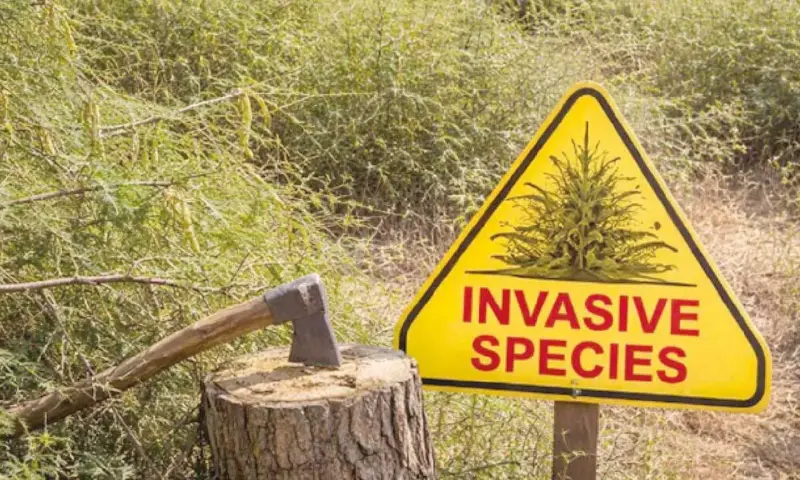

Kurnool: Large tracts of land across Andhra Pradesh are being rapidly overtaken by Prosopis juliflora, an invasive thorny species posing serious environmental and livelihood challenges.
Commonly known as Vilayati Babul or Seema Karuvelam, the plant forms dense, impenetrable thickets across dry and semi-arid regions.
Its aggressive and uniform spread, particularly in Rayalaseema districts like Kurnool and Anantapur, signals a growing ecological imbalance, with similar expansion reported in degraded lands, mining areas, and canal bunds in coastal regions.
The species has shown a remarkable ability to thrive in adverse conditions, including mining zones such as Mangampeta in Kadapa district, where it has even adapted to absorb heavy metals. Environmentalists note that drought conditions and livestock movement are accelerating its spread, as animals disperse seeds unknowingly. In coastal districts like Krishna and Guntur, water flow through rivers and irrigation canals further aids its expansion, enabling rapid invasion into new areas.
Experts warn that the ecological and agricultural impacts are severe, including loss of biodiversity, depletion of groundwater, and conversion of fertile land into unproductive terrain. Farmers face increasing difficulty in reclaiming affected lands, as the plant's deep-rooted system makes removal costly and labour-intensive. Livestock are also at risk due to injuries from sharp thorns and health issues caused by excessive consumption of pods.
Speaking to The Hans India on Friday, Dr M Suresh Babu, President of Praja Science Vedika emphasized that an integrated approach is essential to control the spread.
He highlighted that successful interventions require root-level removal, controlled herbicide application, and restoration with native species. Meanwhile, Dr Gangampalli Venkata Siva Reddy stressed the need for coordinated policy action, sustained funding, and community participation.
As Andhra Pradesh grapples with land degradation and water scarcity, addressing this invasive species has become an urgent priority.