




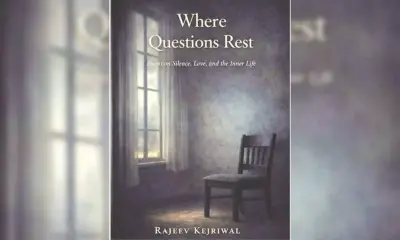

'Where Questions Rest' by Rajeev Kejriwal introduces a poet who is not in a hurry to impress. Instead, he allows emotions to unfold at their own pace, trusting quiet reflection over dramatic expression.
In a literary moment where poetry often swings between intense confession and intellectual cleverness, Kejriwal chooses a more measured path-one grounded in restraint, clarity, and emotional honesty.
There is a calm confidence that runs through the collection. It does not rush to resolve feelings or impose meaning prematurely. Rather, it sits with experience, allowing it to settle naturally. At times, this reflective stillness recalls Rainer Maria Rilke, while its emotional resonance echoes the quiet lyricism of Agha Shahid Ali. Yet Kejriwal's voice remains distinct-steady, thoughtful, and unforced.
The epigraph, "Some questions do not seek answers, they simply long for stillness," sets the tone for the entire book. It captures the essence of the collection's philosophy: that poetry need not resolve uncertainty, only hold space for it. These poems are less about answers and more about learning how to live with the questions.
In the opening section, Becoming, Kejriwal demonstrates a strong instinct for emotional recognition. Lines like "When you were shattered, torn apart, I saw my soul reflect your heart" convey empathy without tipping into sentimentality. Similarly, in "Unspoken Quiet," the line "For words, when spoken, must be true, not trembled out, but carried through" reflects a discipline that defines the collection. The poet knows when to speak-and more importantly, when not to. The love poems in the second section are among the most affecting. Unlike the passionate intensity often associated with Faiz Ahmed Faiz and Sahir Ludhianvi, Kejriwal approaches love with subtlety and inwardness. In "That Evening," memory is not dramatized but gently inhabited: "Each word held a thousand unspoken lines, silent, yet somehow heard." These poems dwell in what lingers-the pauses, the silences, the emotional afterglow.
As the collection progresses, it expands its gaze to a wider, more fractured world. Themes of distance, fatigue, and eroding empathy begin to surface. The line "So close to man, yet not quite human" stands out for its quiet precision. Notably, the poems were originally conceived in another language and later written by the poet in English. Yet nothing feels lost in translation. The emotional core remains intact, intimate, and immediate.
This is not a collection that demands instant attention. It unfolds slowly, asking the reader for patience. And perhaps that is its greatest strength. In an age defined by noise and urgency, 'Where Questions Rest' reminds us of the value of pause. Rajeev Kejriwal may not attempt to say everything, but what he does say carries sincerity-and that makes this debut quietly memorable.
(The reviewer is an internationally acclaimed literary critic and the founder of Authors Paradise Literary Group.)