




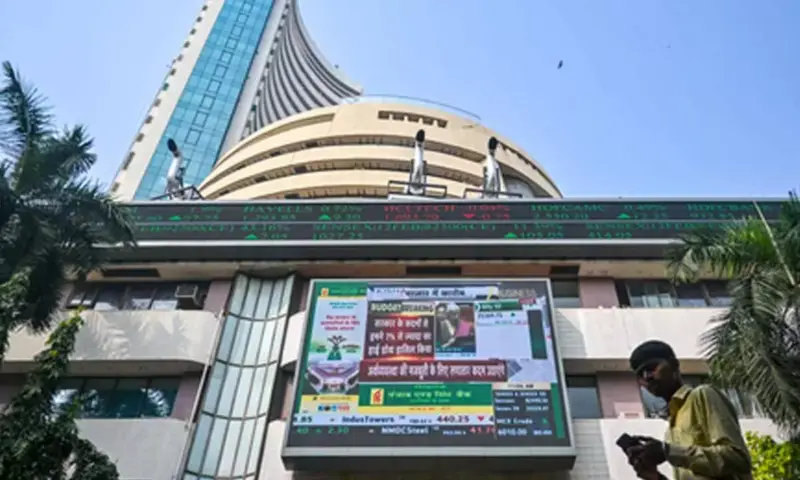

Spookedby the lack of any concrete outcome from the US-Iran peace talks, renewed FII outflows, fresh weakness in rupee and weak corporate earnings; equity markets were back in corrective mode during the week ended.
For the week, the Sensex declined by 1,812.25 points, or 2.30 per cent, to close at 76,681.29, while the Nifty fell 455.6 points, or 1.87 per cent, to settle at 23,897.95. The broader markets remained more resilient with the Nifty Midcap 100 index declining only 0.8 per cent and the Nifty Smallcap index ending the week on a flat note.
FIIs remained net sellers throughout the week, offloading equities worth Rs 17,139.86 crore. In contrast, DIIs emerged as net buyers, purchasing equities worth Rs 9,782.05 crore during the same period. The Indian rupee extended its decline during the week, depreciating by 133 paise to settle at 94.25 against the US dollar.
Markets are navigating with delicate balance between escalating geopolitical risk and tentative diplomatic progress, as tensions surrounding the Strait of Hormuz continued to shape investor sentiment. The Fed is widely expected to hold rates unchanged at its meeting next week, and markets have now priced out any cuts for the remainder of the year.
There are lots of things that can move the stock market, from economic data, to Federal Reserve pronouncements, to corporate developments. But for the past 15 months, traders' fortunes have been largely tethered to the whims of a single person: President Donald Trump. The impact of the president's words is even clearer when examined session-by-session. It isn't just equities that are seeing these moves either.
Commodity prices have also swung wildly, with oil market volatility rising to levels last seen at the start of the Covid-19 pandemic. In essence, Trump's wavering positions on the war have made him the market's "arsonist and firefighter," The rise of passive investing has made the market more reactive to news in general, whether it's a president's comments or an unexpected earnings report.
Traders should remain nimble, respect stop losses, and avoid over-leveraging in what is shaping up to be a volatile and range-bound environment. Looking ahead, market participants should adopt a cautious and defensive approach.
Quote of the week: "Courage taught me no matter how bad a crisis gets ... any sound investment will eventually pay off." - Carlos Slim Helú
Don't despair amid the inevitable setbacks that all investors face, especially during a crisis in the market. If the reasoning behind the investment is sound, stick with it, and it should eventually turn around.
Market Chatter: Investing / Gambling
It's getting harder to tell investing from gambling, and it's not your fault. When the stock market seems unstoppable, it's easy to step over the line. The biggest danger isn't that the markets can go crazy, but that they'll make you go crazy, too. The war in Iran is a seething stalemate, the price of oil is up about 60 per cent this year, inflation jumping sharply-and still U.S. stocks set all-time highs this week. In India, stocks in broader market are rallying to new highs. A kind of gambling fever seems to be setting in. On prediction markets, you can bet whether the price of bitcoin will go up or down in the next five to 15 minutes-24 hours a day. The line between investing and gambling has always been a bit blurry, but it has never been easier for investors to step over the line without even realizing it. You need to be on guard not only against the craziness of this market, but the possibility that you won't be able to resist it. Your mind plays all kinds of tricks on you when geopolitical events go haywire. You probably think the stock market has been wrenching up and down like mad since the Iran war started at the end of February. In economic theory, your attitude toward risk is supposed to remain stable, and you'll use all relevant information when making investment decisions. In the real world, your attitude toward risk depends partly on who you are, but also on what you've lived through. And the data you'll rely on is a mix of recent history and whatever stands out most vividly from your own experience. The last brutal bear market in stocks ended 17 years ago last month-most of a lifetime for many young investors.
Since then, thanks largely to aggressive monetary and fiscal policy, every decline in stocks has been an if-you-blinked-you-missed-it kind of event. The Covid crash of 2020 lasted only five weeks, then morphed into a raging bull market. The younger you are, the more influence those recent returns will have on you-because you haven't been investing long enough to have experienced markets that go down and don't bounce right back up. In boom times, investors expect higher returns at lower risk.
One of the biggest factors in your expectations of future returns is whether you've lived mainly in a time of rising, falling or stagnating stock markets. Conversely, down markets depress investors' expectations and willingness to take risk shrivelled as the stock market crashed. Yet the same people clung fiercely to their self-image as gutsy investors. In fact, slightly more people described themselves as "a financial risk-taker" in last three months, even as they had already reined in the risks they were willing to take.
As investors, we are all prisoners of our past, especially the recent past. But you need to recognize that fact, so you become aware of how it can skew your decisions. With the stock market marching upward as if all is right in the world, and with gambling behaviour becoming the norm around us, it's more important than ever to ask yourself a few questions before you make any trade.
Here's a simple checklist:
Have I segregated this account from my long-term investments? Am I trading to make money or to have fun? What do I know that the person on the other side of this trade doesn't? How do I know it? Am I willing to keep track of all my trades to see whether I'm making money on them overall? You won't fall into a downward spiral of impulsive trading if you require yourself to pause and think before any gamble.
FUTURES & OPTIONS / SECTOR WATCH
Snapping a two-week rally both the Nifty and the Bank Nifty declined last week by 1.8 per cent and 0.8 per cent respectively. On the sectoral front, Energy, FMCG and Media stocks emerged as key gainers whereas IT, Auto and Capital Market stocks were the major laggards.
In the options segment, strong Call open interest for Nifty was observed at the 24,200 and 24,000 levels while major Put open interest was concentrated at the 24,000 and 23,900 levels. The key level to watch in the upcoming session is 24,000 as market direction will largely depend on how the Nifty behaves around this level. For Bank Nifty, significant Call open interest was seen at 57,000 and 56,500 level whereas notable Put open interest was placed at the 56,000 level.
Implied volatility (IV) for Nifty's Call options settled at 17.63 per cent while Put options concluded at 18.49 per cent. The India VIX, a key indicator of market volatility concluded the week at 18.59 per cent. The Put-Call Ratio Open Interest (PCR OI) stood at 0.74 for the week. With April contracts due to expire on 28th, keep a watch on rollovers to May series.
The broader technical structure shows that the Nifty has slipped back into a corrective phase after failing to sustain above its recent resistance zone. Given the current setup and the truncated trading week due to the Maharashtra Day holiday on Friday, the markets may begin on a cautious note. Immediate resistance levels are seen at 24,200 and 24,450, while supports are placed at 23,700 and 23,500.
Rising volatility remains a concern, suggesting underlying pressure in the broader markets in the near term. Fresh aggressive buying should be avoided until the index shows signs of stabilising above key resistance levels. Priority should be given to capital protection and selective stock-specific trades, rather than broad-based exposure. Stocks looking good are CG Power, RBL, VBL, Policy Bazar, Unominda and United Spirits. Stocks looking weak are APL Apollo, Indigo, Kotak Bank, Nykaa, SBI Life, and UPL.
(The author is a senior maket analyst and former vice-chairman, Andhra Pradesh State Planning Board)