
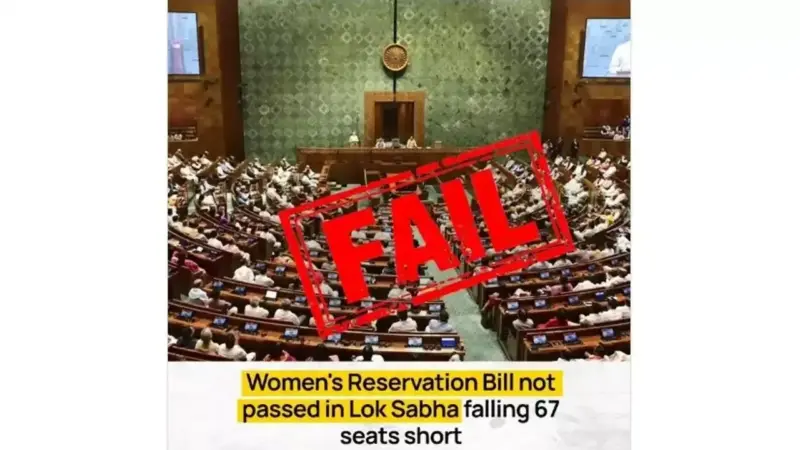

The passage of the Nari Shakti Vandan Adhiniyam should have closed a 30-year debate. Instead, it has exposed a familiar instinct in Indian politics-applaud reform in public, dilute it in practice.
The opposition resorted to support in public and stalling it in practice as it had been doing for past three decades preventing women from entering the Parliament? The opposition does not want a new history to be written and give up family first politics.
The opposition has walked straight into a political ambush scripted by the Bharatiya Janata Party (BJP), allowing the ruling party to lock in the narrative for the 2029 Lok Sabha battle a full 30 months in advance. Instead of setting the agenda, it is reacting, echoing, and amplifying the very storyline it claims to resist. Worse, it will now retreat into self-congratulatory rhetoric, patting its own back for "saving democracy" while the ground reality slips away. This isn't strategy-it's surrender dressed up as resistance, handing the BJP a psychological and political head start that could prove decisive.
The opposition, which was thundering for 50 per cent reservation for women and trying to haul the government into the dock, collapsed the moment it was called to act. When Amit Shah threw down the gauntlet-offering to move an official amendment and even urging the Speaker to adjourn the House for an hour if the opposition guaranteed passage-they blinked.
It is really matter of shame that all the opposition parties are resisting the move to give one third reservation dressing their objections by lacing it with conditions and stretch it with procedure with the aim of -delay without accountability. It is not the first time that they have done so. They did this when the 73rd and 74th Constitution amendment bill was introduced giving 33 per cent reservation to women in panchayats and municipalities.
It did not wait for perfect consensus. It moved ahead. The result was transformative, even if imperfect. Millions of women entered public life. The system adjusted.
The pattern of stone walling structural reforms is not new. Consider 1986, when N T Rama Rao moved to give daughters equal rights in ancestral property by amending the Hindu Succession Act at the state level. The backlash was immediate and intense. Political parties, social groups, and entrenched interests warned of the "breakdown of the family" and "fragmentation of land." The language was different, but the anxiety was the same, loss of control.
That reform, like today's reservation law, was impossible to oppose on principle. So, it was resisted through fear, delay, and quiet political discomfort. Yet it went through-because the leadership of the day chose to absorb the backlash rather than negotiate endlessly with it. That is the difference between intent and execution.
When the first Bill surfaced in 1996, leaders like Mulayam Singh Yadav, Lalu Prasad Yadav, and Sharad Yadav led the charge against it. Their argument was framed as social justice: that the quota would benefit elite women. It sounded principled. It also ensured the Bill went nowhere. Congress and opposition were against triple talak, Shah Bano case, abrogation of article 370, and Operation Sindoor, among others.
Three decades later, the script hasn't changed. The language has become more refined, but the intent looks eerily familiar. This was once again clear from the speech of Leader of Opposition Rahul Gandhi got himself in a puzzle. He also spoke of a magician and belittled operation Balakot and Operation Sindoor by saying it was Modi's magic. The only fact he was clear was that they are against women getting reservation even now.
The demand for an OBC sub-quota does have its own merit and linking implementation to delimitation raises legitimate concerns. But if these objections were truly about urgency and inclusion, the same political class would have built consensus long ago. Instead, what we see is perpetual hesitation masquerading as principle.
The Congress, which had demanded reservations for OBCs, was the one which stonewalled Mandal Commission report and put it in cold storage. When VP Singh executed it, Congress and other opposition parties opposed it.
The opposition has been exposed on how they are against women getting reservation. This narrative may cost them heavily in elections. The male members apparently feel that a 33 per cent reservation is not a structural disruption. It will push out sitting male legislators, dismantle entrenched caste calculations, and rewrite electoral arithmetic. For parties that have spent decades perfecting their social coalitions, this is not reform. It is a threat to their hold over the existing constituencies' which would be altered after delimitation. Hence, they want to keep the issue hanging fire for some more years.
I had in the past commented that if political parties, including the ruling BJP, are serious about empowering women, then they need not wait for the bill to be passed in the Parliament. They could have straight away given party tickets to women candidates and facilitated their grand entry into the Parliament. Rest of the issues like quota within quota etc could have followed.
When asked, the top leadership of these parties maintained, "Oh it's difficult to find the winning horses." This is nothing but an intangible excuse. Political parties never allowed women members to play active role in their decision-making bodies and grow. Now these leaders are searching for convenient tools to once again delay the entry of women into the portals of Parliament.
After nearly 30 years of debate, India does not suffer from a lack of arguments. It suffers from lack of political courage. Until that changes, women's reservation will remain what it has always risked becoming-a promise perfected in delay.
The Opposition must decide whether it wants to shape this reform or shadow it. Raising questions is legitimate. Recycling them endlessly is not. After 30 years, India does not lack arguments-it lacks political will.
(The author is former Chief Editor of The Hans India)