
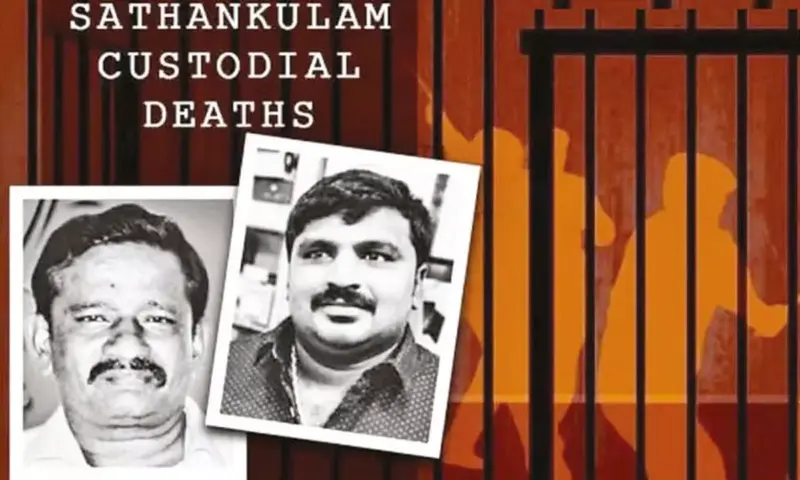

That police officers accused in the "lockup death" being sentenced - and that sentence being the death penalty - can only be described as a shocking development!
It isn't that they are being punished for insanity; rather, the way the crime was proved - witnesses protected for up to four years and a prosecution that secured a conclusive verdict in court - along with the competence and conduct of the investigating police officers, must be acknowledged with admiration. If higher courts uphold the same sentence on appeal in this case, which has become famous as the Sattan Kulam police station case (Tamil Nadu), it will go down in history as a case study in criminal jurisprudence.
In such cases, the victims' families and witnesses-having endured tremendous hardship and having overcome the coercive tactics used to silence them-deserve genuine praise for giving full cooperation in the case. The second point is the judiciary: by imposing the death penalty as a sentence that cannot be forgotten, there is a chance that "lockup deaths" at police stations will disappear. Police officers, seeing that taking the law into their own hands even with supposed precautions leads to catastrophic consequences, will learn that lesson too. Those supposed to protect should not become the predators. Deaths in custody can wipe out, in an instant, all the good reputation the police earned through their work and turn it into a stain. Because the investigators worked hard, collected evidence carefully and preserved it, and because the prosecution presented the evidence in court so convincingly that the defense could not overturn it, this rare punishment became possible. Six years ago, at Sattan Kulam police station (Tuticorin, Tamil Nadu), an innocent businessman Jayaraj and his son Benix were subjected to brutal physical torture. Both were overpowered by that violence, which was thus considered a "lockup death." When Jayaraj was taken into custody by the police during the pandemic for allegedly violating lockdown rules, his son Benix asked the officers why they were beating his father so senselessly. For asking that question, the officers tore off their clothes and savagely beat them in the middle of the night. Not only that, but they also forced the victims to wash away the blood from their bodies and clean themselves with their own clothes. Afterwards, an FIR was hastily registered, missing sections were wrongly inserted into the FIR, they produced them before a government doctor and falsely obtained a "fit for remand" report and then presented them before the magistrate. The judicial magistrate mechanically remanded them to judicial custody as well.
When they ultimately died, the Judicial Magistrate visited the Madurai police station and noted procedural lapses. Justice C N Prakash of the Madurai High Court took the case suo motu and issued an extraordinary order directing revenue officials to take the police station and the evidence under their control to safeguard them. The case took a dramatic turn when a head constable named Revathi testified against her fellow officers. Blood samples collected by the CBI during the investigation matched the victims' DNA. Call data records strengthened the case by showing that the two victims and the accused were at the same place at the time of the crime. One of the ten accused died during the Covid-19 pandemic before the death penalty could be imposed. The trial court sentenced the remaining nine. The court's notable approach was to punish all the accused without singling out individual degrees of guilt. Considering the evidence-scientific proof plus an eyewitness statement from Revathi-an investigating officer would say the circumstantial evidence was not weak. However, the medical report stating, "fit for custody," the magistrate's remand orders, and mechanical aspects of the remand process created some difficulties for the evidence. Even in stronger cases this can be an issue-for example, in the Rajiv Gandhi assassination case, the Supreme Court upheld the death sentence for four, while the trial court had sentenced 26 to death in 1999. Convictions and death sentences in police lockup death cases are very rare. That is why this case attracted so much attention. If higher courts confirm these sentences for some of the accused, police are more likely to act carefully in the future.
If punishments for crimes in the police department are handled like this - and in the judiciary many judges who are themselves defendants in cases seem to treat punishment as something that applies to the prosecution rather than to them - legal scholars and analysts are urging that such unnecessary excuses not be allowed to become widespread, since judges are supposed to act lawfully. To prevent deaths in custody, senior officers should carry out frequent surprise inspections of station lockups. Training should place special emphasis on this issue. Above all, the officers who are tasked with enforcing the law must not create situations in which that same law ends up imposing punishments on them.
In olden days many such incidents did not see the light of the day due to various reasons, one of them being the alleged cover up by the police fearing adverse public opinion. Gone are those days! Nowadays incidents like lockup deaths will attract the immediate attention of not only the media but everyone everywhere. Any delinquencies of individual police officers are generally taken to court by the people affected and whenever there is enough evidence, courts will act as per law.
There is a widespread feeling that in cases where members of judiciary are found with some material evidence against them, immediate action is not initiated as per law. As such the public would think that they are allowed to go scot-free. Such allegations are always thrown at the doorsteps of three organs of the government - legislature, executive and judiciary, sometimes recklessly by the people to benefit their own self interests. That being so, in the case of lockup death where extreme penalty is imposed by the judiciary, it is appreciated by one and all.
Such effective action is called for against any delinquent, as no one is above law.
(The writer is a retired IPS officer, who has served as an Additional DGP of Andhra Pradesh)