
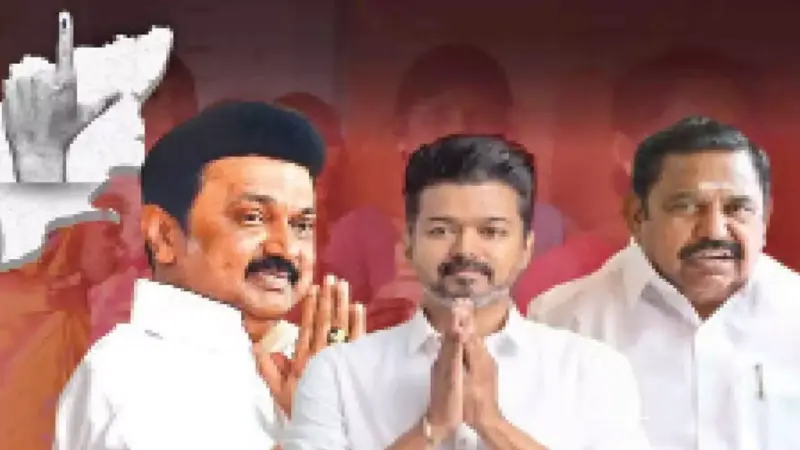

Tamil Nadu's electoral politics, defined for over five decades by a near-binary contest between the DMK and the AIADMK, is entering a phase of subtle, but significant, churn.
The Dravidian duopoly endures in structure and vote share, yet the political ecosystem around it is changing and is becoming more fragmented, more competitive, and in some ways, coarser.
The 2016 Assembly election marked a pivotal moment. Breaking the state's entrenched anti-incumbency pattern, the AIADMK under J Jayalalithaa returned to power-an exceptional feat in Tamil Nadu's cyclical political landscape. With around 40.88 per cent vote share and 136 seats, the AIADMK decisively outperformed the DMK-led alliance, which secured a comparable 39.4 per cent vote share but only 98 seats. The verdict underlined not just organisational efficiency, but the unmatched personal appeal of Jayalalithaa.
Equally significant, however, was what 2016 represented in hindsight: the last election dominated by towering figures like Jayalalithaa and M Karunanidhi. Their departure marked the end of two eras and set the stage for a more uncertain political transition.
That transition crystallised in 2021. The DMK, led by M K Stalin, returned to power after a decade, winning 133 seats, while its alliance secured 159 with a vote share exceeding 45 per cent. The AIADMK, now under Edappadi K Palaniswami, managed 66 seats with roughly 33 per cent vote share-reflecting both resilience and decline.
The 2021 verdict revealed three enduring trends. First, leadership transition within the DMK was largely stabilising; Stalin successfully consolidated Karunanidhi's legacy while projecting administrative continuity. Second, the AIADMK survived its post-Jayalalithaa vacuum but appeared structurally weakened, lacking a unifying mass figure. Third, electoral fragmentation began to deepen, with parties like Naam Tamilar Katchi (NTK) crossing the six per cent vote mark, signalling a growing appetite for alternatives.
As Tamil Nadu moves towards the 2026 Assembly election, the political battlefield is more crowded than at any point in recent history. The DMK-led alliance enters as the frontrunner, buoyed by its governance record and recent electoral successes. Yet, beneath the advantages lie familiar vulnerabilities-incipient anti-incumbency, governance critiques, and the perennial challenge of managing assertive alliance partners.
The Congress hardly matters here as it could win only 18 out of 25 seats with about four per cent vote share that too because it was in alliance with DMK in 2021. Though the alliance continues, it has not grown as a force to reckon with. BJP also is not in a very strong position though it has a good cadre and hence had to go in alliance with the AIADMK.
Actor Vijay formally launched his political party, Tamilaga Vettri Kazhagam (TVK), in February 2024 with a clear intent to contest the 2026 Assembly elections. The move marked the transition of Vijay from a cultural icon with a massive fan base into a full-fledged political contender. But he, like Pawan Kalyan in Andhra Pradesh, may have to wait for more time. Whether he has such resilience or not only time will tell.
The AIADMK, meanwhile, is attempting a calibrated comeback. Under Palaniswami, it seeks to consolidate anti-incumbency sentiment while leveraging alliances, particularly with the BJP. However, this alignment is a double-edged sword in a state where regional identity and federal autonomy remain politically potent themes.
What distinguishes the present moment is the emergence of credible third-force disruptors. Vijay's political foray aims to mobilise youth and urban voters, potentially altering the electoral arithmetic. NTK continues to consolidate a niche ideological base, particularly among first-time voters. Smaller caste-based and regional parties, too, are negotiating aggressively, complicating alliance equations.
Yet, the structural reality persists: no third force, as of now, appears capable of independently dislodging the Dravidian powerhouses. Their role is more likely to be that of vote-splitters and margin influencers, capable of tilting tightly contested constituencies.
For both DMK and AIADMK, the upcoming election is therefore not merely about power-it is about relevance in a changing political landscape.
For the former, the central question is whether governance can translate into renewed mandate. Can it sustain coalition cohesion? Will welfare delivery, economic management, and administrative performance outweigh anti-incumbency pressures?
For the AIADMK, the challenge is more existential. Can it overcome residual factionalism and the absence of a charismatic leader? Will its alliance choices expand its base or alienate traditional voters? Most importantly, can it present a compelling alternative narrative beyond opposition?
Unlike earlier elections that revolved heavily around personality, the next contest is likely to be more issue-driven. Governance outcomes-particularly welfare schemes, social justice initiatives, and economic performance-will be scrutinised more closely. Inflation, employment, and industrial growth are emerging as critical voter concerns. Tamil Nadu's longstanding emphasis on state autonomy and linguistic identity continues to shape political discourse, especially in the context of Centre-State relations.
A younger electorate is also reshaping priorities. Aspirations around education, jobs, and entrepreneurship are gaining prominence, and new entrants are attempting to tap into this demographic shift.
Yet, even as the political field evolves, a parallel and troubling trend is evident-there is decline in the quality of public discourse.
Tamil Nadu's political culture, historically marked by sharp ideological contestation, has increasingly witnessed lapses into personal and gendered attacks. The recent controversy involving Nayanthara illustrates this disturbing drift.
Senior AIADMK leader C Ve Shanmugam, while criticising a government initiative, wondered sarcastically whether the Chief Minister would fulfil someone's "dream" of marrying Nayanthara. The comment, made in a public forum ostensibly addressing governance issues, drew widespread condemnation for its sexist and objectifying undertone.
The episode is not an aberration. Tamil Nadu's political history is replete with instances where women-particularly actresses-have been dragged into controversy. In 2019, DMK's Radha Ravi made derogatory remarks about Nayanthara, triggering outrage and disciplinary action. Such comments are not political critique; they are manifestations of entrenched gender bias.
Even towering leaders like Jayalalithaa were not immune touch outbursts. Throughout her career, she was subject to insinuations and personal attacks that sought to undermine her authority through gendered narratives rather than political critique. Her evolution into the widely accepted "Amma" persona was, in part, a response to this persistent scrutiny.
The pattern persists across actors-turned-politicians as well. Khushbu Sundar, among others, has faced repeated sexist commentary, reflecting broader double standards. Male actors transitioning into politics are typically judged on leadership potential, while women are often reduced to their personal lives or cinematic past.
Such rhetoric is not merely offensive-it is politically corrosive. It shifts discourse away from governance, legitimises disrespect, and discourages women's participation in public life. More dangerously, it normalises misogyny as a tool of mass mobilisation, often rewarded with applause in political rallies.
For parties that claim adherence to social justice principles, this represents a fundamental contradiction. Tamil Nadu's Dravidian legacy is built on notions of equality and dignity. Allowing sexist rhetoric to flourish undermines that moral foundation.
There is also a tangible electoral risk. Women constitute a decisive voting bloc in Tamil Nadu. Increasingly assertive and politically aware, they are unlikely to remain indifferent to repeated displays of disrespect.
Ultimately, Tamil Nadu stands at the political crossroads. The duopoly of the DMK and AIADMK remains intact, but the nature of competition is changing. The battle is no longer just about alternating power; it is about adapting to a more fragmented, aspirational, and discerning electorate.
Will the DMK consolidate its dominance into a longer-term mandate? Can the AIADMK reinvent itself and mount a credible challenge? Or will emerging forces gradually erode the Dravidian duopoly?
Equally important is another question-can Tamil Nadu's political class restore dignity to its discourse?
The answers will shape not just the outcome of the next election, but also the future character of politics in one of India's most politically conscious states.
(The author is former Chief Editor of The Hans India)