
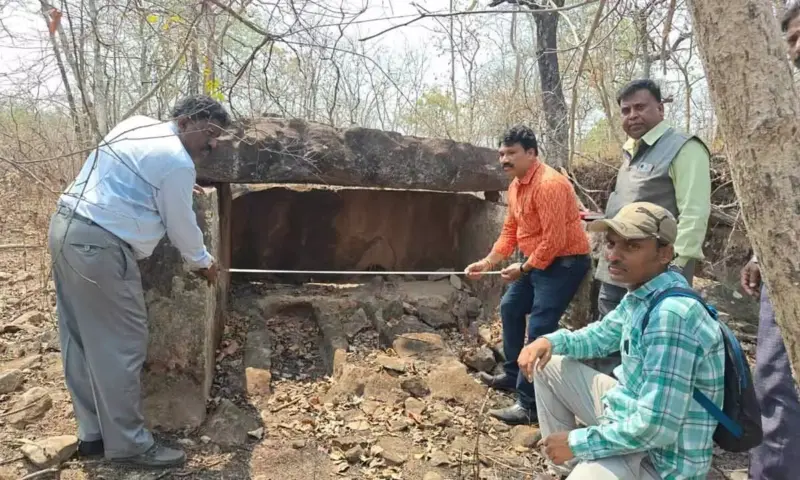

A team from the Department of Heritage, Government of Telangana, has identified a significant cluster of prehistoric burial sites in Mulugu district, following information provided by residents of Motlagudem village.
Acting on the directions of Special Chief Secretary Jayesh Ranjan, a technical team led by Acharya Arjun Rao (Director), Dr P. Nagaraju (Deputy Director) and A. Raju (OSD) conducted a field visit to the area.
The discovery, dating back to the Stone Age, offers rare insights into early human presence in the Godavari river basin. Officials noted that the burial sites provide valuable evidence of ancient lifestyles, customs, occupations and social organisation.
Situated around 120 kilometres from Warangal, the structures are located in and around Motlagudem village in Tadvai Mandal. Locally known as "Rakasi Bandalu" (giant stones) and "Rakasi Guhalu" (giant caves), these human-made burials have long been part of the region's landscape.
However, several of the sites have suffered damage over time. Some stone slabs have been removed by locals for house construction, while stone troughs found within the burials have been repurposed as water containers for livestock. Many of the sites have now become overgrown and resemble forested areas, serving as habitats for wildlife.
The team identified hundreds of such burial structures across the Eturnagaram agency area, including Damaravai, Jaggaram, Gangaram, Rangapuram and Kamaram, as well as parts of Mangapet Mandal such as Mallur Gutta, Motlagudem, Komuraram and neighbouring villages.
Particularly noteworthy are the dolmen burials at Kappalayi Gutta, which highlight the advanced craftsmanship of prehistoric communities. Constructed using roughly hewn sandstone slabs, these structures span between 4 and 25 metres. Each burial consists of four upright stone slabs supporting a massive capstone, weighing between 10 and 20 tonnes.
Inside the chambers, a stone trough resembling a sarcophagus has been found, along with a deliberately left vacant space in one corner. The entire structure is enclosed by a circular stone boundary wall with a radius of about 10 feet. The spacing between individual burials ranges from 5 to 100 feet, suggesting a carefully planned settlement akin to an organised ancient township.
Spread across nearly 100 acres, the Kappalayi Gutta site is believed to be one of the largest clusters of dolmen burials in India. Experts say these structures, comparable in symbolic significance to the pyramids of Egypt, indicate a strong belief among ancient communities in life after death and rebirth.
Similar burial traditions have been documented across South India, including in Tamil Nadu, Karnataka, Andhra Pradesh, Kerala and Telangana. Officials described the discovery as an important addition to the state's rich cultural heritage.