
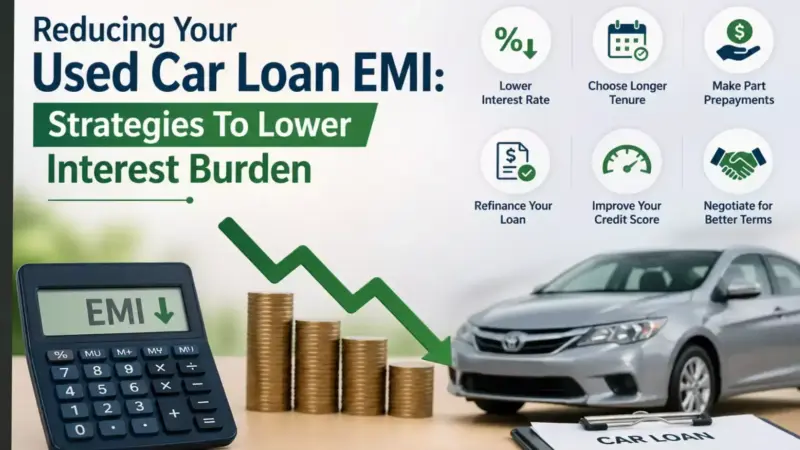

Buying a used car with a loan makes financial sense for a lot of people. The car costs less than a new one, and you avoid the steepest depreciation hit.
But here's the catch: used car loans almost always carry higher interest rates than new car loans. That means your EMI can feel heavier than expected, and over the life of the loan, you end up paying a surprising amount in interest. The good news is that you have more control over this than you might think.
Start With the Down Payment
The easiest way to slash the amount of your EMI is also the most obvious one. Simply pay more at the beginning! The bigger down payment you make, the smaller the main amount you need to borrow. And this will immediately reflect in you having to pay less both your monthly installment and the total interest over time.
Generally, lenders provide 75 to 85 percent financing based on the value of a used car. Let's say the vehicle costs five lakh rupees and you decide to put down 20 percent, then you will be borrowing four lakhs. But if you put down 30 percent, you will only be borrowing three and a half lakh. That difference of fifty thousand rupees with a rate of interest of 12 percent for five years will give you a saving of about eighteen to twenty thousand rupees in interest. Besides, it will also considerably reduce your monthly pressure.
Before you commit to a specific amount, run the numbers through a car loan EMI calculator. Plugging in different down payment amounts, tenures, and rates gives you a concrete picture of what each scenario actually costs per month and in total. This ten-minute exercise can save you from locking into an EMI that squeezes your budget for years.
Negotiate the Interest Rate
Negotiating the price of a car is a common practice. People talk with the dealers, check their price lists and bargain in order to get the lowest price. However, when it comes to the bank, the majority of them just accept the interest rate offered without any consideration. Really? This is a big mistake.
Interest rates on used car loans from different lenders can vary significantly. Even a 1% difference on a 400, 000 loan for 5 years can lead to thousands of rupees in extra payments. Banks, non-bank financial companies (NBFCs), and credit unions each have their own way of calculating the cost of loans which is based on their risk/pricing models, cost of funds, and positioning in the market.
The single most important factor affecting the cost of your loan is your credit score. In most cases, a credit score above 750 will get you to the lower end of a lender's interest rate range. Conversely, if your score is below 750, you might consider improving it for a few months before submitting your application, as the increase in the interest rate may be more than offset by the decrease in the loan cost due to the lower interest rate. Some of the steps to be taken include reducing credit card balances, settling any outstanding dues, and not applying for several loans in a short time since each loan application results in a hard inquiry being made on your credit report.
By all means, get at least three or four lenders to give you loan options. Also, take with you the recorded offers of the other lenders in case you want to use them as a bargaining chip. It is not so unusual for loan officers to offer a better rate if they see that you have other alternatives.
Choose the Right Loan Tenure
Longer loan durations result in lower EMIs, but on the other hand, they require you to pay more interest. For instance, a three-year term for a 4-lakh loan at 12 percent would mean paying approx. seventy-seven thousand as interest. If you extend it to five years, then the figure will be more than one lakh thirty thousand. The monthly EMI will go down, no doubt, but you'll be paying nearly twice the interest.
It makes most sense, therefore, to choose a loan tenure that is the shortest possible that your cash flow will allow comfortably. The caveat is "comfortably". In case a shorter tenure makes you miss payments, the late fees, penalties, and credit rating deterioration will end up costing you a lot more than the interest that you would have saved.
Let's set a fair limit: the sum of EMI commitments, including the car loan, should not go over 40% of your monthly net income. If you cross this limit, you will be exposed to the risk of any sudden expenses.
Refinance When Conditions Improve
Your used car loan interest rate isn't necessarily permanent. If your credit profile has improved since you took the loan, or if market rates have dropped, refinancing with a different lender can lower your EMI for the remaining tenure.
Refinancing is most effective when the difference in interest rates is significant, generally around 1.5 to 2 percentage points or more. Anything less than that, the costs of processing and the hassle of the paperwork could offset your savings. Furthermore, find out if your present lender imposes a prepayment or foreclosure penalty. Although RBI rules ban these penalties on floating-rate loans, a lot of the used car loans are fixed-rate ones where penalties might still be applicable.
Make Prepayments When You Can
Bonuses, tax refunds, freelance income. Whenever there is extra money in your pocket, you should think about using it for a partial prepayment of your car loan. The interest on your loan is calculated using your outstanding principal, so any step you make in reducing your outstanding principal will also reduce the interest component
The difference will be most visible if you make the payment at the start of the loan because that is the time when interest will make up most of your outgoing for a monthly installment. If you decide to do a prepayment of Rs 20, 000, then in the first year, it will help you save the total interest amount a lot more than if you do it in the fourth year.
Think Carefully About the Car Itself
This is a factor that often goes unnoticed. The vehicle you select decides the loan sum, which in turn determines the EMI. Choosing a slightly older model or a less popular variant can bring down the price of the vehicle by a lakh or even more, and this reduction will directly lead to a lower EMI.
Besides, lenders generally provide more favorable terms for cars that are newer and are able to retain their value well. A car that is three years old from a brand known for good resale value will be given a better rate than a car that is seven years old from a brand that is known to depreciate rapidly. The lender's risk is less, and that is why you benefit.
To sum up, the bottom line is transparent. A used car loan is not inherently costly if you manage it with a bit of discipline and math. Make a larger payment upfront, get a loan with the lowest interest rate that you can find, opt for a shorter tenure, and if you can, go for prepayment. None of these things are difficult. They just call for you to give the financing decision as much consideration as you give to the selection of the vehicle itself.