


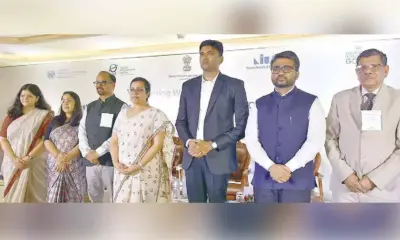

Vijayawada: The closing workshop of the Sustainable Cities Integrated Approach Pilot (SCIAP) project began in Vijayawada on Monday, drawing over 120 participants including policymakers, urban practitioners, technical experts, and city representatives.
The two-day event, organised by the United Nations Industrial Development Organisation (UNIDO) in collaboration with the Vijayawada Municipal Corporation (VMC), is supported by the Global Environment Facility (GEF), the ministry of housing and urban affairs (MoHUA), and the National Institute of Urban Affairs (NIUA).
The workshop aims to reflect on SCIAP's achievements, share key learnings, and explore pathways for integrated climate action in Indian cities. Inaugurating the programme, Surabhi Malik, director at MoHUA, emphasised the importance of integrated urban approaches for sustainable and climate-resilient city development. She presented the UNIDO GEM (Gender Equality Mobilisation) recognition to the Guntur Municipal Corporation, received by commissioner K Mayur Ashok. Malik noted that the workshop would strengthen the exchange of best practices among urban local bodies, accelerate progress toward sustainable development goals, and promote climate-resilient initiatives nationwide.
The inaugural session featured distinguished representatives including Dr P Sampath Kumar, commissioner and director of municipal administration; Paramita Datta Dey, head (resources and waste), NIUA; Dr Debolina Kundu, director, NIUA; Emani Kumar, executive director, ICLEI South Asia; VMC commissioner H M Dhyanachandra; and Guntur commissioner K Mayur Ashok.
Special recorded messages were shared by Cristiano Pasini, UNIDO sub-regional director; Riccardo Savigliano, chief of energy systems and industrial decarbonisation, UNIDO headquarters; and Aloke Barnawal, programme lead, Sustainable Cities, GEF Secretariat. All reaffirmed the importance of collaborative efforts in enabling sustainable urban transitions.
Dr Nand Pal Singh, senior technical advisor, and Dipika Lele, national project coordinator, presented an overview of SCIAP's journey, highlighting milestones and contributions toward integrated urban climate action. VMC commissioner Dhyanachandra outlined the corporation's initiatives in sanitation, solid waste management, waste segregation, public participation, Swachh Survekshan performance, urban greening, pond and canal protection, and renewable energy promotion.
Day one featured panel discussions on 'Waste Management and Decarbonising Cities,' with experts deliberating on solid waste management, carbon emissions reduction, and low-carbon strategies. Technical sessions showcased best practices from various cities, making the workshop highly engaging.
On day two, discussions will focus on scaling integrated climate action, exploring successful models and implementation strategies. Delegates will also visit the floating solar power plant and electric three-wheeler charging stations at Jagarlamudi in Guntur district, underscoring practical steps toward sustainable urban futures.