

Every year, Indian businesses pour significant capital into projects that do not deliver. Product rollouts that miss deadlines. Infrastructure expansions that exceed budgets.
Digital transformation programmes that stall midway. IT implementations that go live months late and underperform. The financial damage from these failures is visible in balance sheets. What is less visible, and arguably more damaging, is the cumulative cost of doing this repeatedly, at scale, across an entire organisation.
Global research by the Project Management Institute puts the number in stark perspective. Organisations with weak project management practices waste an average of 12 percent of every rupee invested in projects due to poor performance. In a company running dozens of projects annually, that figure results in significant losses. Globally, this issue results in approximately two trillion dollars in wasted project investment every year. India, as one of the fastest-growing project delivery markets in the world, contributes a huge chunk in that figure.
Why Projects Fail: The Real Reasons
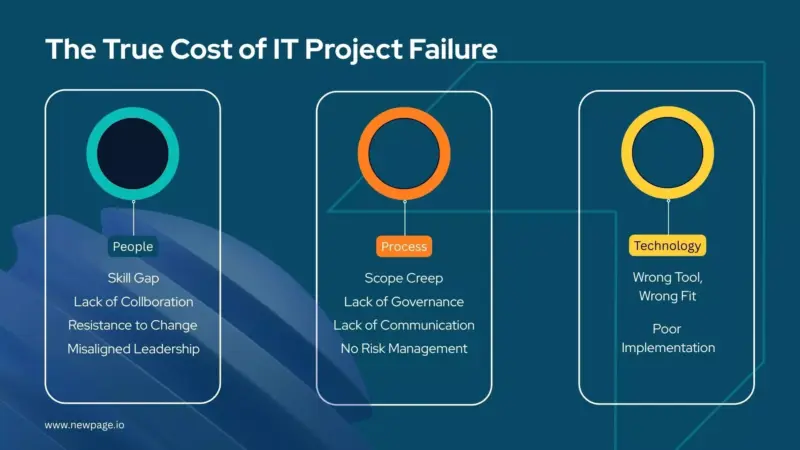
The reason why a project fails is due to external factors like changing market conditions, technology issues, and budget issues. Research tells a different story. According to PMI data almost 29 percent of project failures are linked to poor collaboration. A further 37 percent is because of unclear goals and objectives. Improper planning accounts for the largest single cause of failure.
These are not technical problems. They are management problems. They are failures of structure, process, clarity, and leadership. This is precisely the area that formal project management frameworks are designed to address.
The scale of this problem is huge in digital transformation. McKinsey research shows that 70 percent of digital projects do not meet their goals. Many Indian companies are increasing their technological investments.
What Certified Project Management Actually Changes
PMI's own research shows a clear picture, that organisations with mature, standardised project management practices save 28 times more money than those operating without structures. High-performing organisations with proven project management practices meet their original project goals 2.5 times more often than those without. These numbers show a fundamental difference in project outcomes and financial returns.
The Project Management Professional certification, known as the PMP, is the most widely recognised credential. It establishes that a professional has been trained in PMI's structured approach to project delivery. The course is used by over one million professionals across 214 countries, the PMP sets a standard for how projects should be initiated, planned, executed.
Completing a PMP certification training programme enables project professionals to have the frameworks and decision-making tools to manage projects with greater skill. This means clearer scope, more disciplined control during execution, and early risk identification before they become crises.
The Business Case for Investing in Certified Talent
For Indian organisations evaluating the return on professional development investment, the case is straightforward. The typical cost of certifying a project manager, including preparation training and examination fees, falls between Rs 30,000 and Rs 65,000. If you compare this with the cost of a single project overrun, you can see a huge difference. A mid-sized IT implementation running three months over schedule, at standard billing rates, can easily generate cost overruns exceeding Rs 50 lakh. The math favours investing in capability.
Indian companies in sectors including IT services, banking and financial services, pharmaceuticals, infrastructure, and e-commerce have noticed this calculation. Companies like Infosys, Tata Consultancy Services, and Wipro have made PMP certification a requirement, for senior roles. This institutional shift reflects a growing understanding that structured project management competence is not an overhead. It is a risk mitigation strategy with a measurable return.
Preparation and Access
For working professionals who want to pursue the PMP, eligibility criteria is either a four-year degree with 36 months of project leadership experience, or a high school diploma with 60 months of equivalent experience, combined with 35 hours of formal project management education. Choosing a PMP certification course that covers all three exam domains. It gives candidates the best preparation for a first-attempt pass.
The cost of failure is rising alongside it. Investing in certified project management talent is one of the clearest ways organisations and the professionals within them can reduce that risk systematically.