
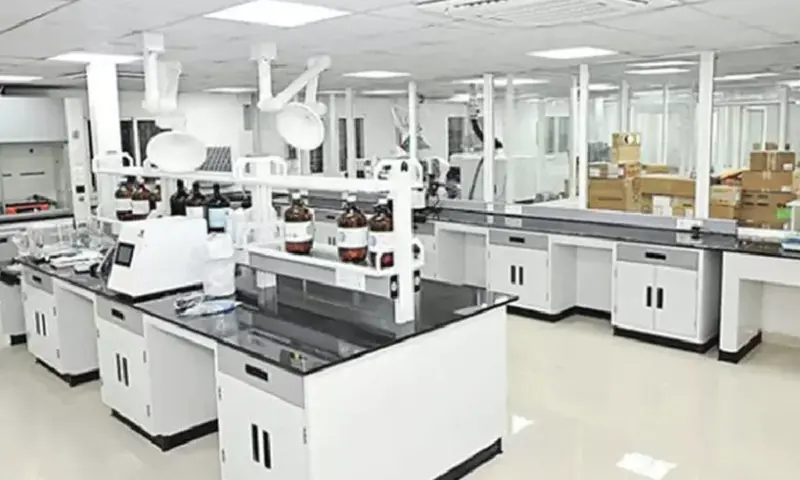

Tirupati: Strengthening food safety mechanisms at one of the country's busiest pilgrimage destinations, the Tirumala Tirupati Devasthanams (TTD) has set up a state-of-the-art food testing laboratory within the hill shrine premises.
Chief Minister N Chandrababu Naidu will inaugurate the facility on Saturday.
The laboratory has been developed with support from the Food Safety and Standards Authority of India (FSSAI) under the Central government, in coordination with the State Food Safety Commission. The facility is expected to enhance quality monitoring of ingredients used in preparing the Srivari laddu and annaprasadam served daily to lakhs of devotees.
Designed as an integrated testing centre, the laboratory houses both chemical and microbiological divisions, enabling on-site examination of food samples and eliminating the need to send materials to external laboratories.
Equipped with advanced analytical instruments such as LC-MS and ICP-MS systems, collectively valued at around Rs 2.5 crore, the laboratory can identify pesticide residues, antibiotics, aflatoxins and preservatives in food ingredients.
The ICP-MS technology is capable of detecting trace quantities of heavy metals including lead, arsenic and chromium. Supporting equipment like a bomb calorimeter and fat analyser will help assess nutritional energy values and ghee content in laddus.
Constructed over nearly 12,000 square feet, the facility was built at a cost of Rs 19.15 crore, with an additional Rs 60 lakh spent on strengthening power infrastructure, including transformers and backup generators. Officials noted that the laboratory marks a significant technological advancement, as it can detect impurities at parts per trillion (PPT) levels, compared to earlier systems that functioned only at parts per million (PPM) levels.
The ground floor houses chemical analysis units where raw materials used in temple kitchens undergo detailed scrutiny. Oils and ghee are tested for acidity and iodine values, grains are examined for infestation or spoilage, and drinking water samples are analysed for chemical parameters such as chloride, sulphate and magnesium.
Microbiological testing facilities have been established on the first floor to screen samples for harmful bacteria, including E coli and Salmonella. An advanced air-handling system maintains controlled temperature, humidity and pressure to ensure sterile testing conditions round the clock. A deep freezer capable of reaching minus 40 degrees Celsius has also been installed for long-term sample preservation.
Officials said two additional technologies, an electronic nose and an electronic tongue, will be installed within two months following a Rs 3 crore sanction from the Centre. These systems will scientifically evaluate smell and taste characteristics to further verify the purity and quality of ghee and other food items.
Completed in a record nine months, the project was expedited following concerns raised in recent years over the quality of ghee used in laddu preparation. Authorities said the new laboratory reflects TTD's commitment to strengthening internal monitoring systems and ensuring safe, high-quality food offerings for pilgrims visiting the sacred shrine.