
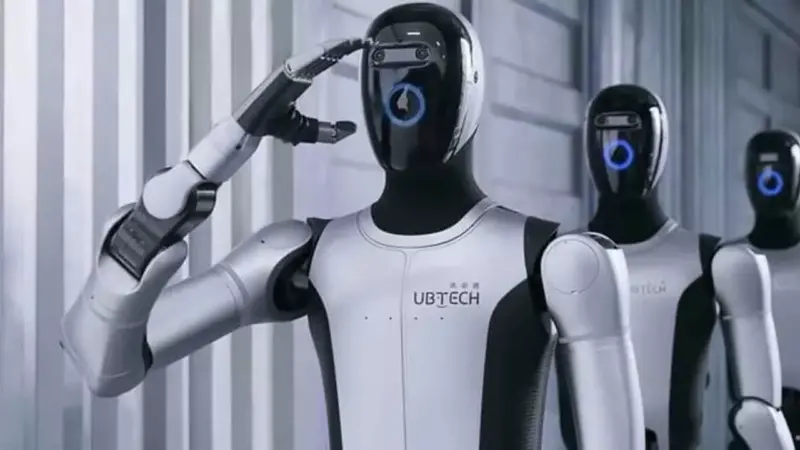

In a striking sign of how competitive the artificial intelligence space has become, UBTech Robotics is offering a staggering salary package to attract top talent.
The Shenzhen-based firm is reportedly ready to pay up to 124 million yuan (around ₹142 crore) annually to hire a chief AI scientist, underlining the growing demand for expertise in humanoid robotics.
UBTech Robotics is offering about Rs 142 crore in salary to hire a chief AI scientist as it deepens its push into humanoid robotics. The move shows how intense the race for top AI talent has become in a fast-growing industry.
The competition to build smarter humanoid robots is intensifying, and companies are now going to great lengths to hire the right talent. In a surprising move, UBTech Robotics has announced a job opening with a jaw-dropping salary: about 124 million yuan (roughly Rs 142 crore) a year, according to Bloomberg. The Shenzhen-based company is seeking a chief AI scientist to lead its next phase of innovation. While high salaries are common in the tech world, a package this large is still rare, especially in China's AI industry, where companies typically avoid offering such large payouts.
This is not just another senior position. UBTech wants someone who can guide the future of its humanoid robots and build the foundation for what it calls "embodied intelligence," a technology that allows machines to better understand and interact with the physical world.
The selected candidate will be responsible for developing advanced AI models and defining the company's long-term robotics strategy. Alongside this high-profile hire, UBTech is also planning to recruit dozens of engineers, signalling rapid expansion in its operations.
The Robotics Sector in China is growing
The robotics sector in China is witnessing renewed momentum in 2026, with humanoid robots gaining attention at global tech events and exhibitions. This surge in interest has also boosted investor confidence. Companies like MiniMax and Zhipu AI have recently made strong moves in public markets, strengthening the country's AI ecosystem.
Government backing is also playing a crucial role. Li Qiang has identified robotics as a key sector for future growth, signalling continued policy support.
UBTech itself has recorded impressive growth, with overall revenue rising by more than 50 percent last year. Its humanoid robotics segment has performed even better, with earnings from related products and services increasing more than 20 times.
The company's robots are gradually finding real-world applications. Earlier this year, Airbus SE purchased its Walker S2 humanoid robots for use in aircraft manufacturing, suggesting that industries are beginning to test these machines beyond controlled environments.
UBTech is not alone in this race. Tesla is developing similar humanoid robots for factory tasks, while Amazon is investing heavily in robotics infrastructure, including a new fulfilment centre in Australia capable of processing over 125 million packages annually.
As the competition intensifies, UBTech's record-breaking salary offer reflects a larger shift-where securing top AI talent is becoming just as important as building the technology itself.