




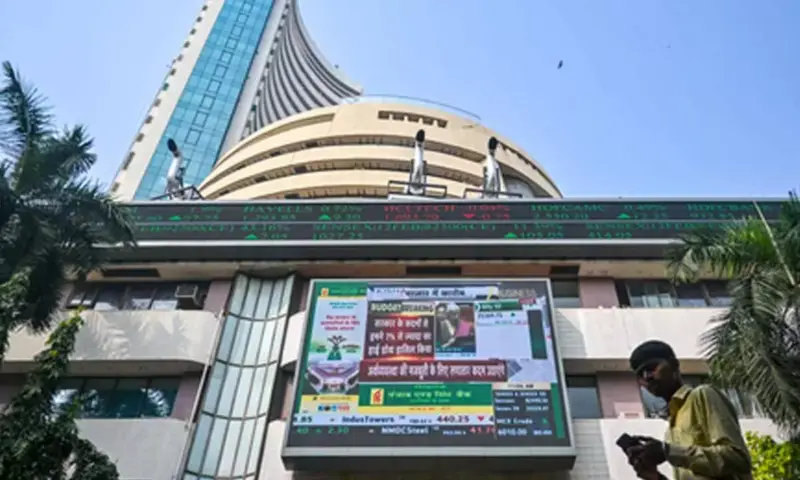

Risingcrude oil prices, a sharp rupee depreciation, persistent tensions in West Asia triggering energy crisis and mounting inflation concerns dragged Indian equities to their worst weekly performance in two months during the week ended.
The Nifty ended the week 2.2 per cent lower at 23,643.50, while the Sensex fell 2.7 per cent to 75,237.99.
Beyond the geopolitical uncertainty, domestic markets are currently reeling under worsening macroeconomic pressures as Brent crude continued to hover above the $100 per barrel mark during the week. April's rally was largely built on expectations that crude oil prices would quickly cool back toward $80 per barrel.
The pressure from elevated oil prices also continued to weigh heavily on the rupee, which weakened beyond the 96 per US dollar mark for the first time ever-further denting market sentiment. The Indian rupee's slide towards the psychologically crucial Rs 100 per dollar mark is no longer being viewed as an extreme possibility by market participants.
Observers expect that markets are likely to remain highly sensitive to crude oil prices, currency movements, and geopolitical developments in West Asia. Investors need to closely track management commentary during the ongoing earnings season. Markets are rewarding companies whose earnings beat market expectations and are also showing little tolerance for weak guidance or valuation concerns even in fundamentally strong companies.
India's merchandise exports rose 13.8 per cent year-on-year in April to a four year high of $43.56 billion, despite supply-chain disruptions linked to the crisis in West Asia. Still, the trade deficit widened to a three-month high of $28.38 billion as imports surged 10 per cent year-on-year to a six-month peak of $71.94 billion, driven by rising inflows of gold and silver.
The divergence between India's wholesale and retail inflation has returned with a vengeance. In April 2026, wholesale price index (WPI)-based inflation vaulted to a staggering 8.3 per cent, up from 3.9 per cent in March, while consumer price index (CPI) based inflation remained relatively steady at 3.5 per cent. This sharp decoupling, triggered by the West Asia conflict, highlights the differing composition of the two indices. The southwest monsoon is expected to set in early over Kerala on May 26 as per reports of the India Meteorological Department (IMD). The IMD has said that India might receive below normal rainfall this year during the monsoon season.
The country is likely to get 80 centimetres (cm) of rainfall in the monsoon months, with the long-period average (1971- 2020) of seasonal rainfall at 87 cm. The IMD said this could be due to the emergence of El Nino conditions, which cause less rainfall in the country.
Prime Minister Narendra Modi's austerity call and increase of fuel prices showcase the "tough" times of the economy. On the macro front, India's WPI inflation surged to 8.3 per cent YoY in April 2026 from 3.88 per cent in March, indicating rising wholesale price pressures, while retail inflation (CPI) edged up to 3.48 per cent YoY from 3.40 per cent.
Global markets took comfort from continued engagement between the US and China, with hopes that the talks may help ease broader geopolitical and economic uncertainties. Although the ceasefire remains in place, expectations of a quick reopening of the Strait of Hormuz have diminished sharply. Observers feel that the global oil market is now in "a race against time," warning that factors limiting a sharper rise in crude prices may weaken if the Strait of Hormuz stays shut into June.
Markets in the coming week are expected to remain highly volatile and intensely headline-driven, with investor sentiment continuing to hinge on developments surrounding the ongoing US-Iran conflict, diplomatic negotiations and movements in global energy markets. In markets, stories sell better than statistics. But over time, statistics decide which stories survive. That is another testament to the fact that investing without education and research will ultimately lead to regrettable investment decisions. Research is much more than just listening to popular opinion.
FUTURES & OPTIONS / SECTOR WATCH
Amidst heightened volatility and the shadow of PM's austerity call; derivative segment continued to witness sharp swings in stock futures and high premiums in option market. The Nifty ended the week with a loss of more than 2 per cent, while Bank Nifty underperformed and closed down over 2.5 per cent. On the sectoral front, Pharma, Healthcare, and Metal stocks ended in the red. Realty, IT, and Consumer Durable sectors also closed the week with losses. . In the options segment, strong Call open interest for Nifty was observed at the 23,800 and 24,000 levels while major Put open interest was concentrated at the 23,500 level. For Bank Nifty, significant Call open interest was seen at 54,000 level whereas notable Put open interest was placed at the 53,000 level. Implied volatility (IV) for Nifty's call options settled at 16.78 per cent while Put options concluded at 17.23 per cent. The India VIX, a key indicator of market volatility concluded the week at 18.61 per cent. reflecting growing nervousness and elevated risk perception among market participants. The Put-Call Ratio Open Interest (PCR OI) stood at 1.01 for the week. Traders continue to hold net short positions on both calls and puts, showing that option writers remain dominant. Resistance levels for Nifty are likely to come in at 23,850 and 24,000, while supports are seen at 23,350 and 23,150. The fall last week has turned the short-term picture slightly negative. Traders should focus on stock-specific opportunities with strict stop losses while avoiding excessive leveraged exposure. The coming week is best approached with a defensive bias and a preference for selective participation rather than broad-based aggressive positioning. Closely monitor geopolitical developments as they may continue to influence market direction. Stocks looking good are Biocon, Crompton, Indus Towers, Solar Inds, Tata Consumer and Vedanta. Stocks looking weak are Bajaj Finserv, Coal India, Exide Inds, KPIT Tech, VMM and Wipro.
(The author is a senior maket analyst and former vice-chairman, Andhra Pradesh State Planning Board)