
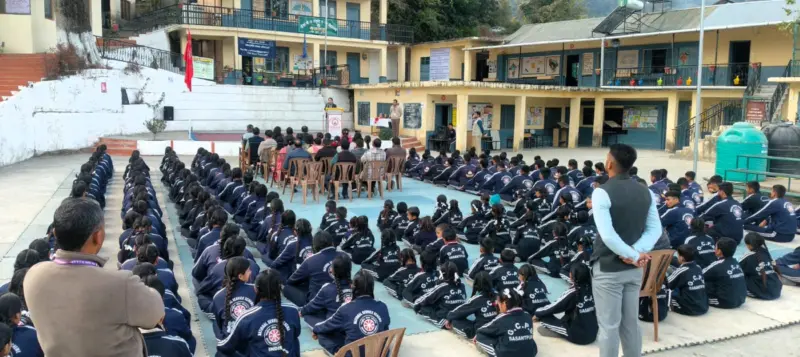

If the past two years were about reforms and new initiatives in the education sector, this year saw the results of those efforts coming through.
A remarkable improvement in national-level surveys like the Annual Status of Education Report (ASER) and National Achievement Survey (NAS), and the state becoming fully literate are some of the big achievements Himachal registered in the education sector.
Even while the state achieving full literacy is the result of multipronged efforts that started many decades back, the improved showing in the ASER and NAS is the direct outcome of the measures taken over the past couple of years to improve teaching and learning outcomes.
The state was ranked first in reading ability of Class III students and second in the reading abilities of Class V and Class VII students in the ASER report released at the start of the year. Also, the schoolchildren were ranked second in arithmetic abilities like subtraction and division of Class III and Class V students. In the previous ASER survey, a sharp decline had been noted in the reading and arithmetic abilities of the children.
The performance in the National Achievement Survey was even better - the state jumped 16 places from a lowly 21st in the previous NAS survey in 2021 to a creditable fifth place. Education Minister Rohit Thakur described these achievements as a vindication of the reforms undertaken by the government in the education sector.
In a significant decision this year, the government decided to affiliate 100 schools, affiliated to Himachal Pradesh Board of School Education until now, with the Central Board of Secondary Education (CBSE).
Officials feel the move would trigger healthy competition between the government schools and would offer the CBSE option to parents and students in the government sector. Most of these schools, if not all, will be affiliated to CBSE before the next academic session.
Besides, the Centre approved two Kendriya Vidyalayas for Himachal - one will be opened in Kotkhai and the other at Paonta Sahib. These schools will reduce the need for children to migrate for better schooling, open new opportunities for academic excellence and further strengthen the state's education and infrastructure network.
Structural reform
A big administrative reform carried out this year was the decision to bring the entire school education - from pre-primary to Class XII - under a single Directorate, the Directorate of School Education.
Earlier, the Directorate of Elementary Education oversaw education up to Class VIII, and the Directorate of Higher Education catered to classes beyond VIII to graduation. The decision is aimed at improving clarity of roles, efficiency and focus in different parts of the education system.
In addition, the consolidation and rationalisation efforts continued with the closure and downgrading of schools having inadequate enrolment.
Besides, the construction work for Rajiv Gandhi Day-Boarding Schools have started at various sites. The government plans to build one such school in every Assembly constituency. These day-boarding schools will provide children from rural areas access to quality education as well as improved sports infrastructure.
The Education Department laid significant thrust on creating digital infrastructure for better learning and administrative purposes. The Chief Minister recently inaugurated Vidya Samiksha Kendra, education gallery, etc at the Directorate of Samagra Shiksha to enhance administrative and academic efficiency and give a big push to digital education governance.
"Himachal has emerged as one of the leading states to adopt an integrated digital platform that provides real-time data related to teaching, learning outcomes, student assessment, attendance, resource management and school administration," the Chief Minister said while inaugurating the facility.
Besides, the consolidation and rationalisation efforts continued by closing or downgrading the schools without adequate enrolment. In another positive development, several stuck-up promotions were offered and the process to fill up several vacant posts was started.
Future concerns
The effect of all these initiatives and achievements is yet to reflect in the declining enrolment in government schools. Government schools continue to lose students to private schools. In 2025, just around 22,000 students took admission in Class I in government schools, making it clear that parents are increasingly preferring private schools to government ones. The significant improvements in ASER and NAS surveys and the introduction of English as a medium of instruction and the option of CBSE in government schools may stop the exodus to private schools in the coming years.
In a year of high achievements, the low points were the incidents of some teachers resorting to extreme corporal punishments and some turning up drunk at their schools. The video of a teacher thrashing a wailing child with a prickly bush was particularly disturbing. The other area where the government and department need higher transparency is the issue of transfers. The government has banned mid-session transfers of teaching staff to ensure students do not suffer, but the political pressure and connection are still not allowing proper rationalisation of teachers. There may not be any shortage of teachers if the department can transfer teachers on need basis, without any political and bureaucratic pressure.