
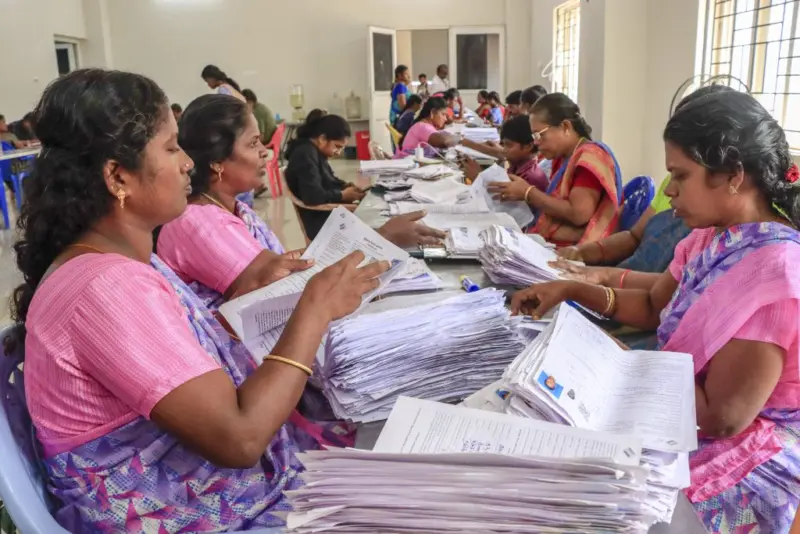

The SIR process is being conducted in 12 states and Union territories by the Election Commission of India.
Some salient features discussed already in the news is that those who wish to be on the 2025 voter list need to show their presence or link to the 2002 voter list.
By now, it is well known how people across 12 states have been facing huge problems in looking up their names in the 2002 voter list.
The cut off date was decided to be 2002 because the last SIR was conducted in 2001-02. However little is known about how the 2002 SIR was done. One of the authors of this piece, Santosh Sinh Rathod, filed a Right to Information request with the Election Commission to get a copy of the 2001-2002 guidelines and the way the exercise was carried out.
The answers reveal that the 2001-2002 process was more inclusive and called for more accountability from the authorities than the 2025 one.
| 2002 ‘Special Revision of Intensive Nature’ | 2025 Special Intensive Revision | |
| Stages | Schedule 1: 14 states and Union Territories Schedule 2: 6 states and Union Territories | Schedule 1: Bihar Schedule 2: 12 states |
| Stated objective | The ECI began the EPIC programme in 1994. Electors were given EPIC numbers as part of this programme. During verification of voters’ lists, an EPIC card verification has to also be done to identify discrepancies. To prepare clean and appropriate electoral rolls. To update the current electoral rolls by identifying and removing migrated and dead voters and to identify and add new voters. | It is necessary to update and improve electoral rolls before every election. It has been 22 years since the last SIR was conducted. Political parties have raised questions regarding changes in electoral rolls. Frequent migration. Registration of electors at more than one place. To remove electors who have died. Inclusion of foreign nationals in the electoral rolls. |
| Schedule and process | It started in August 2001 and the first 31 days were allotted to house numbering, appointment of enumerators, electoral registration officers, and district electoral officers, their training, and the consolidation of existing electoral rolls, including the supplements of 2001 revision. The preliminary list was prepared by integrating all supplementary lists. Electors of one area and one locality were brought into the same polling booth. In the next 30 days, the enumerator visited houses and verified each entry in the electoral rolls with the head of the household and noted down the corrections in the blank dotted line given below each centre in the preliminary list.
There was no enumeration form to be filled by electors. But each entry in the preliminary list was verified by enumerators. Also, details of migrated and dead persons were also noted down. | There is no mention of any training and preparatory phases in the SIR schedule. The electoral roll used for the current SIR is of July 1, 2025. There is an enumeration form which the Booth Level Officer (BLO) has to distribute and collect from the electors in 37 days, with extensions in some cases. An elector must fill the details by themselves in the enumeration form and hand it over to the BLO. |
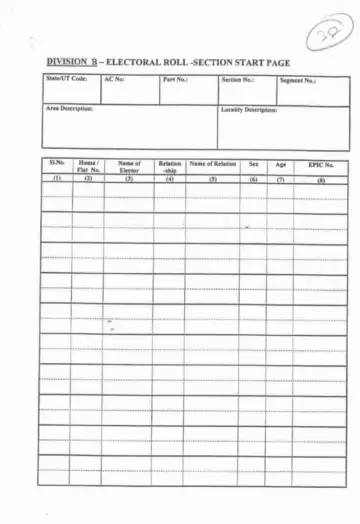
| Links to earlier SIR | There was no need for the elector to show any link of their names or their parents’ names to the earlier special revision. The earlier special revision was carried out in 1995. It was the responsibility of the enumerator to note down every change in the current preliminary list by interacting with the household. The enumerator was in charge of filling in details like name, EPIC number, address, relationship, whether currently residing in same house or migrated, destination of migration, etc. The changes were to be noted in the blank dotted line below each entry in the preliminary list (photo above). And entire exercise done on carbon paper, which was then given to the head of the household, with the enumerator's signature. Each EPIC card was verified and tallied with the entry in the preliminary list and noted down in the separate form. If members of a household did not have continuous serial numbers, then such corrections were also noted down, so that all members of households could be on the same page. | In the current SIR, electors have to mention relevant details in the 2002 list. If they were not a voter in 2002, then details of father, mother, grandfather, or grandmother need to be given. If electors cannot give such details in the enumeration form, then such electors will get a notice once the draft list is issued and they must give any one of the 11 documents as proof for their birth place or birth date. If they fail to do so, their names will not appear in the final list. If the enumeration form is not submitted by electors, their names will not be in the draft list even if they are existing voters. There is no scope in the EF to show corrections in spelling, name, address, etc. There is no interaction with household for such corrections. No verification or correction is noted down by BLO. There is no provision thanks to which electors can show that their names are appearing with different serial numbers. |
| Registration of new voters | This is a very important part of updating of electoral rolls. During the 2002 special revision, the following process was carried out to identify and register new voters.
| There is no provision of registration of those electors who have an EPIC card, but have had their names deleted from the current electoral rolls. No SIR form has been generated for such voters and thus after SIR process their names will be deleted from the voter's list. There is no provision in the current SIR process to record and register shifted electors in the respective part of the elector rolls. Electors have been getting SIR forms in their old address and they have to submit them at the old address itself. If they do not do so, BLO will record a voter as "shifted" and then with no SIR form, their names will be permanently deleted. There is a provision of registering new electors by giving them form 6. There is no provision for registering new voters in new areas and new buildings that have come up and are not included in the existing electoral rolls. There is no provision for registering temporary structures and registering them as voters in the entire SIR process. |
| Role and responsibility of the enumerator versus BLO’s role and responsibility | The enumerator’s role is to verify every detail of each entry in the preliminary list and note down all necessary changes by discussing it with the household. | The BLO has to distribute the enumeration form and collect filled forms, support electors to fill the form in the camps, and upload the forms. |
| Citizenship | It was not the responsibility of the enumerator to check the citizenship, but the enumerator had to check the age and ordinary residence of the elector. If an enumerator had a doubt, then they could ask for proof of the same. For age, proof can be birth certificate, school, college certificate, passport, baptism details, etc. For ordinary residence, proof can be certificate from panchayat, municipality, ration card, gas connection, bank account, delivered mail, telephone connection, etc. | As per SIR 2025 guidelines, electors who cannot show their details or their parents/grandparents' details in the 2002 list must give any one of the 11 documents listed by ECI. Panchayat/municipality certificate, ration card, gas connection, telephone connection, delivered mail, and bank account proofs are not valid documents for this SIR. The ECI clearly indicate that every elector must give proof of citizenship. |
| For shifted voters | In the 2002 special revision, there was a provision to register the details of the shifted voters and the District Electoral Officer was supposed to check the same at the destination of the migrant voter, once it is verified then the name of the electors from the preliminary list is deleted. | In the current process, if SIR form is received at one address, person must fill the same and hand it over. If not then they will be removed from the list. There is no provision to register the shifting from one part to another. Also, there is no provision for verifying the shifted address at destination of the shifted elector. |
| Existing voters | Electors already registered (with their names in the existing voter list) need not have given any proof of their presence in the 1995 list. | In the current SIR, it is compulsory for each elector to give proof of their presence in 2002 electoral rolls. If they are not in those rolls, then they must give proof of a parent or grandparent in the 2002 list. If an elector cannot give this proof, then, they will receive notice for documents showing birthplace or birth date - one of the 11 listed by the ECI. |
Santosh Sinh Rathod is an Ahmedabad-based electoral reform activist.
Mujaheed Nafis is secretary of PUCL, Gujarat.
Pankti Jog is state coordinator of ADR, Gujarat.