
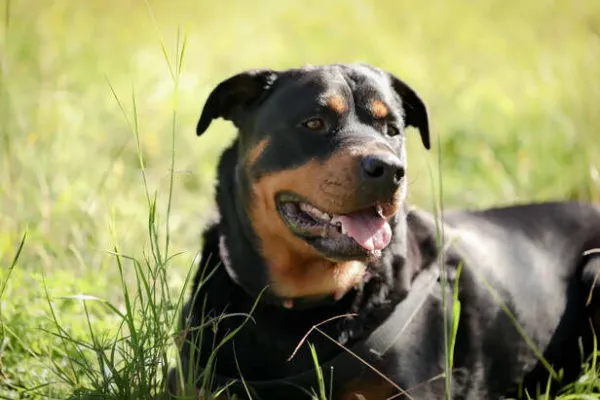

A Rottweiler showcasing its natural protective instincts while remaining calm and affectionate with its family members.
Introduction

Despite their powerful build, Rottweilers are loving and gentle with their families when properly trained.
History and Origin
The Rottweiler's origins can be found in ancient Roman times, when they were employed as guard and herding dogs. They were later referred to as "butcher's dogs" in Germany, where they were in charge of guarding valuables and livestock. Their disciplined behavior and innate guardian instincts are explained by their solid work experience. They were bred to be trustworthy and protective rather than naturally hostile.Temperament: Beyond the Myths

A well-socialized Rottweiler naturally protects its home while maintaining a calm and controlled behavior.
The idea that Rottweilers are inherently violent is one of the most common misconceptions about them. In actuality, they have a composed, assured, and self-assured temperament. A well-bred Rottweiler doesn't behave aggressively out of the blue. Rather, it is perceptive and only takes action when it perceives a genuine danger. Their environment, training, and upbringing all have a big impact on their behavior. Strong emotional ties between Rottweilers and their families are well known. In contrast to their tough exterior, they frequently display a softer, playful side. They are loving and love being near their owners. What distinguishes them is the harmony between strength and sensitivity. Protective Instincts and Guarding Nature Rottweilers are among the most dependable guard dog breeds because they are inherently protective. They can act swiftly in situations that call for protection because of their courage and alertness. But rather than being careless, their guarding instinct is deliberate and under control.
Key Traits of Their Protective Nature:
- Strong sense of loyalty toward family
- High intelligence and awareness
- Ability calm under pressure
- Natural instinct to guard territory
Rottweiler as a Family Companion
Training and Socialization: The Key to Behavior

Exposure to people and environments helps a Rottweiler grow into a confident and well-adjusted family dog.
Training plays a crucial role in shaping a Rottweiler's personality. Early socialization helps them become comfortable around different people, animals, and environments. Consistent and positive training methods bring out their best qualities. The Rottweiler is often seen as a powerful guard dog, but beneath its strong exterior lies a deeply loyal, intelligent, and affectionate companion. However, raising a well-mannered Rottweiler requires proper training and early socialization. Without guidance, their natural protective instincts can turn into unwanted aggression or stubborn behavior. This article explores how to shape a Rottweiler into a confident, obedient, and family-friendly dog.
Celebrate the bond with your pets, explore Health & Nutrition, discover Breeds, master Training Tips, Behavior Decoder, and set out on exciting Travel Tails with Times Pets!
Frequently asked questions (FAQs)
- Why is the Rottweiler often misunderstood?
They are often misunderstood due to media portrayal and their strong appearance. Incidents caused by poor training have also contributed to their negative image. - Do Rottweiler need special training?
Yes, they require consistent training, early socialization, and firm but positive leadership to develop into well-behaved and obedient dogs. - Can a Rottweiler be both a guard dog and a companion?
Absolutely. Rottweilers are naturally protective and, at the same time, deeply loving toward their families, making them ideal as both guardians and companions.