
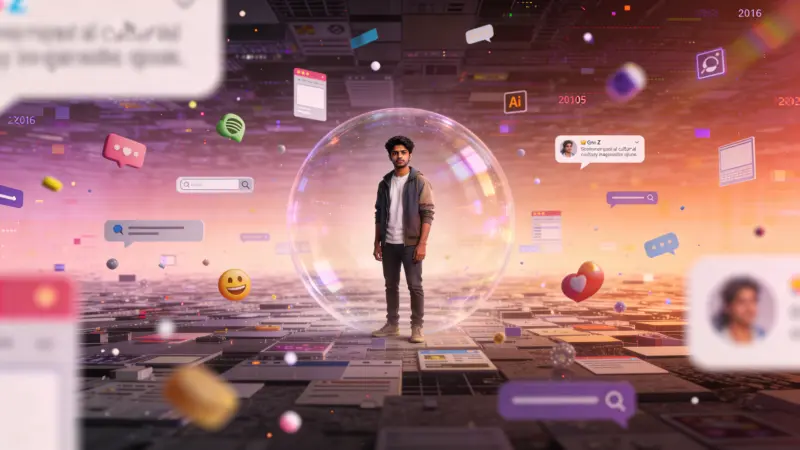

So. You decided posting filtered throwbacks from 2016 is a personality now. Fascinating. Sit down, darling because while you were busy slapping a rose-tinted Snapchat filter on a decade-old selfie and calling it healing, quietly mistaking aesthetic escapism for self-awareness, the rest of us were trying to understand what the 2026 nostalgia trend is actually doing to you.
And the answer is considerably less cute than your flower crown.
What is the 2026 nostalgia trend? The “2026 is the new 2016” trend is a social media movement in which Gen Z and millennials flood their feeds with throwback content Snapchat dog filters, skinny jeans, mid-2010s playlists as a psychological response to AI saturation, digital fatigue, and economic anxiety. It is not a phase. It is a symptom.
Here is the thing. This isn’t about Zara Larsson. It was never about Justin Bieber’s Purpose era or the Mannequin Challenge or the singular chaotic joy of Vine. What you are participating in is something researchers would call collective nostalgia as a regulatory strategy and what Sukanya is calling The Enshittification Escape Hatch the very specific Gen Z move of building a time machine out of oversaturated Instagram filters because the present is simply too optimised to be fun.
Think of it this way. Dil Dhadakne Do versus Kabir Singh. One is a film about a family performing happiness for the camera while quietly falling apart behind the scenes. The other is a film about a man who cannot cope with the present and mythologises a past that was never what he thought it was. You are Kabir Singh. You have always been Kabir Singh. The difference is that your nostalgia has better playlists.
The Pre-Algorithm Grief
The actual psychological mechanism operating here is something I’m calling The Pre-Algorithm Grief a mourning not for 2016 itself, but for the last moment the internet felt like it belonged to you rather than to a feed designed to monetise your attention span. Jianning Dang, Constantine Sedikides, and Tim Wildschut at the University of Southampton published research in British Journal of Social Psychology (2025) confirming that nostalgia actively spikes in the presence of AI-generated content not as rejection, but as a coping scaffold. The more the feed is optimised, the more the brain hunts for something that felt unoptimised.
This is why the numbers read the way they do. Searches for “2016” on TikTok jumped over 450% in the first week of January 2026 alone. More than 1.6 million videos. The scale is not a trend. It is a diagnosis.
The internet of 2016 had Harambe, Pokemon Go forcing people outdoors, and Vine jokes that swept across timelines because the algorithm hadn’t yet learned to segment us into monetisable micro-demographics. That version of collective virality where the same dumb video could reach a 16-year-old in Pune and a 24-year-old in Patna simultaneously no longer exists. LSI terms like digital fatigue, AI-era anxiety, and social media authenticity aren’t buzzwords here. They are the actual grief being aestheticised into a throwback post. And the aestheticisation is the whole problem.
The Zindagi Na Milegi Dobara Problem of Nostalgia
In Zindagi Na Milegi Dobara, the Hrithik Roshan character spends the entire film refusing to be present in the spectacular thing that is actually happening to him right now road trip through Spain, best friends, diving into the sea because he is too busy managing a story about his past. The film is not, it turns out, about adventure. It is about a man learning that nostalgia is a form of refusal. The 2016 revival is exactly this. A refusal to be present in 2026.
And here is what makes it structurally dishonest the move I’m naming The Retrograde Idealism Collapse. The year being mourned was objectively difficult. Brexit happened. A United States presidential election happened that nobody who lived through it in real time described as “chill.” The Pulse nightclub shooting happened. Jamie Cohen, assistant professor of media studies at Queens College, put it plainly: this longing is for the last moment before the “enshittification” of social media not for 2016 itself, but for the structural innocence it represents. You are not nostalgic for the year. You are nostalgic for an internet that hadn’t yet learned to disappoint you.
The fashion data makes this visible. Afterpay’s consumer behavior psychologist Shakaila Forbes-Bell confirmed in early 2026 that low-waisted skirts are up 369%, holographic luggage up 171%. People are not buying the past. They are buying a feeling of control that the past now symbolises because nostalgia, as a category of consumption, is a substitute for a future that doesn’t feel safe to plan for.
You’ve followed the argument this far, which means you already know something is off. Not about the trend about your own relationship to it. The question is whether you are using 2016 as a rest stop or a residence.
The Truthbomb: You Are Not Nostalgic for 2016. You Are Exhausted by 2026.
The research on this is clear and has been clear since Davis wrote about it in 1979: nostalgia does not occur because the past was better. It occurs because the present feels unmanageable. Cao S., writing in Frontiers in Psychology (2024), documented nostalgia as an adaptive mechanism that activates precisely when a person’s sense of self-continuity is disrupted when the world changes faster than your identity can update. You are not missing Snapchat filters. You are missing a version of yourself that existed before you understood how comprehensively the systems around you were designed to extract from you.
You are not nostalgic for 2016. You are exhausted by a present that was designed to be exhausting.
That is a different problem than nostalgia can solve.
The Math of the Escape Hatch
Spotify-linked data released in January 2026 showed user-created “2016” playlists surging over 790% since January 1. Over 1.7 million posts under #2016 on TikTok. And Tumblr the original Tumblr, the one millennials aged out of now counts Gen Z as 50% of its monthly active users and 60% of all new sign-ups, according to data shared with Business Insider in 2025. That last number is the telling one. You did not just look back. You moved in.
The math is not mathing toward resolution. It is mathing toward a generation that has collectively chosen to redecorate its anxiety as aesthetic.
Your Takeaway
"The Diagnostic Scroll"
Before you repost a throwback, ask yourself what specific thing about right now you are avoiding. Name it. Actually name it out loud. If the name surprises you, that is where the real work is.
"The Presence Tax"
Give the present one unfiltered documentation a week a photo with no filter, a voice note that captures ambient noise, a message that doesn’t get edited for tone. Not to post. Just to have. The reflex to aestheticise everything, including your own grief, is the algorithm’s most successful installation.
"The Retrograde Audit"
List three things that were actually terrible about 2016. Not globally personally. Notice how quickly the nostalgia softens. The past you miss isn’t a place. It is a feeling of not yet knowing what you know now. You cannot go back to not knowing. You can only decide what to do with knowing.
"The Enshittification Exit"
Find one non-algorithmic space this week. A group chat. A physical notebook. A phone call with bad audio. Recreate the texture of 2016 without the filter. The problem was never the year. It was always the feed.
Now close this tab. I have a Spotify playlist from 2026 to build and unlike you, I am doing it without the flower crown.
What is the 2026 nostalgia trend?
The “2026 is the new 2016” trend sees Gen Z and millennials posting throwback 2016 content filters, fashion, music as a psychological response to AI saturation, digital fatigue, and the enshittification of social media. It began in late 2025 and peaked across TikTok and Instagram in early 2026.
Why is Gen Z nostalgic for 2016 specifically?
2016 sits at the intersection of being recent enough to be personally felt and distant enough to be idealised. It predates the AI content explosion, the TikTok algorithm, and the full monetisation of online identity making it the last moment the internet felt communal rather than extractive.
#Nostalgia #SocialMedia #Trend #GenZ #Millennial #Snapchat #Tiktok #Vine #Throwback #2026 #2016 #Instagram