
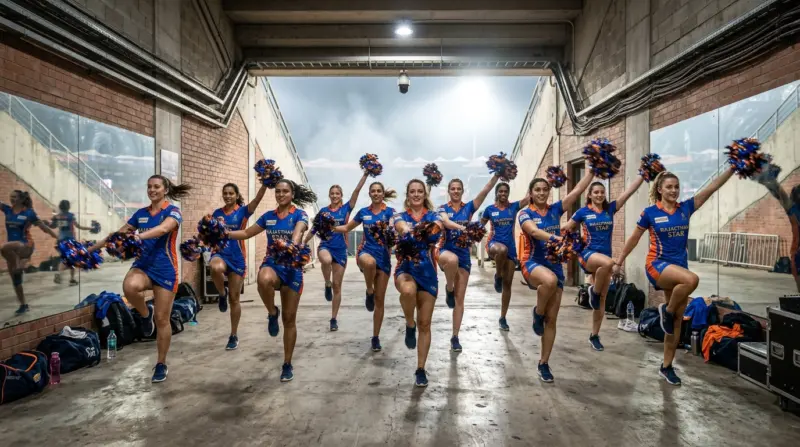

Nobody knew what to make of the IPL cheerleaders in 2008. The women in team colours dancing beside the boundary rope were a concept borrowed wholesale from American sports and that borrowed quality showed in every awkward early season, right up until the moment it stopped mattering.
The IPL was designed from its first season as an entertainment product that happened to feature cricket, not the other way around. Cheerleaders were part of the original blueprint every franchise was assigned a squad, dressed in team colours, performing at boundaries and wickets during strategic timeouts. Eighteen seasons later, all ten IPL teams maintain active cheerleading squads for IPL 2026. The squads are drawn from both Indian performers and international dancers, primarily from Eastern Europe Ukraine, Russia, Belgium, Norway who come to India specifically for the tournament window each year.
The business logic is unchanged from 2008. Fill the dead time between deliveries with movement and sound. Keep the stadium atmosphere high for the broadcast camera, which cuts to the crowd far more than traditional cricket coverage ever did.
The specific detail that most coverage of IPL cheerleaders misses is that the entertainment architecture was never built around them. It was built around three specific triggers: the boundary four, the maximum six, and the wicket. Each had its own music cue the DLF Maximum branding through IPL's first several seasons is the most recognisable and each produced a specific choreographed response. Cheerleaders were the visual element of a sound-and-light system designed for television. The primary audience was always on the other side of the broadcast camera, not in the stadium seats.
What changed between 2008 and today is the performer composition. The inaugural season drew almost entirely from international squads. Subsequent seasons introduced more Indian performers, partly in response to the cultural controversy that began in 2008, and partly because trained Indian dancers were available in sufficient numbers to be competitive. By the 2020s, the standard IPL squad was a mixed composition foreign performers in the majority at some franchises, Indian-led at others, with no uniform policy across the league.
The controversy that shaped how India understood IPL cheerleading came in the very first season. Two London-based performers, Ellesha Newton and Sherinne Anderson, working for Kings XI Punjab through the event company Wizcraft International Entertainment, returned to London after the 2008 season and raised racism allegations claiming they had been told the crowd did not want to see dark-skinned performers. Newton, whose father was a UK racial equality officer, described being addressed with racial slurs and told the franchise only wanted white performers. The allegations were made to The Sun newspaper on their return. They were never formally adjudicated, but the incident became the lens through which the early cheerleading controversy was understood not just about cultural fit, but about the specific racial hierarchy being imposed in the casting of the entertainment package.
That controversy ran alongside a broader cultural debate: whether cheerleaders belonged in cricket at all. Critics in 2008 and 2009 described the presence of dancing women at the boundary as inappropriate, westernised, and disrespectful to the sport. The debate produced no formal BCCI policy change. Cheerleaders stayed. The controversy faded. What remained was a profession that had, by the 2020s, become normalised in Indian sports entertainment.
What nobody mentions is what happened before that debate ended which is that the audience stopped having it.
The transformation of IPL cheerleading from controversy to wallpaper happened faster than the critics predicted. By IPL 2018 when CSK returned after the ban and Dhoni's comeback produced the most emotionally charged season in the tournament's history nobody was writing articles about whether cheerleaders belonged at Chepauk. The entertainment format had embedded itself so completely that removing it would have felt like an absence. The strategic timeout, the music between deliveries, the colour-coded performers at fine leg and third man these became the grammar of how an IPL match sounds and looks. They were not the reason people attended. But they are the reason a stadium at 7.30pm feels different from a stadium at 2.30pm in a Test match.
In IPL 2026, the cheerleading business operates at a professional scale that 2008's critics could not have anticipated. Auditions are held, contracts are signed, accommodation and travel are covered by franchises. A performer who completes a full season 14 home matches plus any playoff appearances earns a total approaching ₹3 to ₹3.5 lakh. This is not substantial by IPL standards. It is substantial by the standards of performance work in India, where a two-month engagement with guaranteed accommodation, broadcast visibility, and team affiliation represents a career credential that many in the profession seek specifically.
The IPL cheerleader of 2026 is not the western import of 2008. The role has been indigenised, professionalised, and stripped of most of its original controversy. What remains is a job: show up at the stadium, perform at the boundary, be visible on broadcast, represent the team's colours. Not Wankhede in the afternoon quiet. Wankhede at 7.30pm when the lights are on and the crowd is ready and the first four of the match is about to bring forty thousand people to their feet.
Q: How much do IPL cheerleaders earn per season?
A: IPL cheerleaders earn between ₹2 lakh and ₹3.5 lakh per season, depending on the franchise. KKR pays around ₹25,000 per match the highest in IPL. A full season covers approximately 14 home matches plus playoffs if the team qualifies.
Q: Were IPL cheerleaders controversial?
A: Yes. In the 2008 inaugural IPL season, two British performers working for Kings XI Punjab made racism allegations on returning to London. A broader cultural debate also ran from 2008 to 2010 about whether cheerleading was appropriate for cricket. Both controversies faded without formal resolution.
#Cheerleaders #Entertainment #Earnings #Franchise #Cricket #Business #Cricket #IPL2026 #Controversy #Boundary #Performance #Dance