




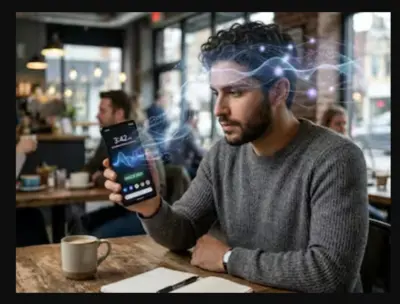

Logging into apps and websites remains a daily but often frustrating task, even when tools like password managers or biometrics are used.
While fingerprint and facial recognition methods offer some convenience, they still raise concerns about data security and privacy.
The Ongoing Struggle of Secure and Convenient Digital Logins
In response, researchers have introduced a new idea that relies on internal body signals, specifically subtle vibrations within the skull.
This innovation, called VitalID, aims to change how users access digital platforms, particularly those offering immersive experiences.
Instead of passwords or facial scans, it uses natural body-generated movements to verify identity.
The project was developed through collaboration between the New Jersey Institute of Technology, Temple University, and Texas A&M University.
The system works by detecting vibrations produced by breathing and heartbeats that travel through the neck to the skull.
Since each individual's bone structure and tissue differ, these vibration patterns are unique to every person.
As a result, these patterns function similarly to fingerprints for identification.
The technology was presented at the 2025 ACM Conference on Computer and Communications Security and is mainly intended for extended reality environments.
Importantly, it does not require extra hardware and instead uses motion sensors already available in modern headsets.
Researchers confirmed this by stating, "We do not need to add any device or additional hardware… It requires only software."
Extended reality, or XR, includes virtual reality, augmented reality, and mixed reality, blending digital elements with the physical world.
Although commonly associated with gaming platforms, XR is expanding into healthcare, finance, education, and remote work.
As its use grows, the demand for secure and seamless authentication methods becomes more critical.
Researchers emphasised this shift, noting, "Extended reality will play a major role in our future… authentication has to be secure, continuous, and effortless."
Strong Accuracy Results Demonstrate Effectiveness of VitalID Authentication System
To test the system, 52 participants were studied over 10 months using two XR headsets.
The results showed over 95% accuracy in recognising legitimate users and over 98% success in blocking unauthorised access.
Additionally, the system filters out larger movements like head shifts to focus only on subtle internal vibrations.
Further analysis revealed that these vibration patterns are extremely difficult to imitate, even if someone attempts to copy another person's breathing.
Meanwhile, traditional XR login methods remain inconvenient, involving gestures and disruptive two-factor authentication.
In contrast, VitalID works passively in the background without requiring user input.
Although not yet commercially available, the technology is positioned as a future solution for secure and natural authentication. It is currently open for licensing, ready for further research collaboration, and has already received a provisional patent.