
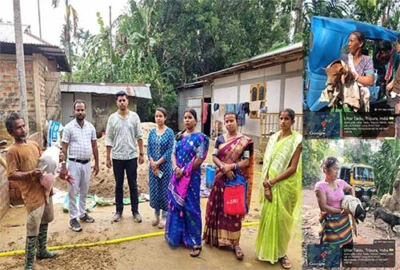

A significant grassroots-level livestock procurement drive has been successfully carried out across several rural locations in Tripura under the Tripura Rural Economic Growth and Service Delivery Project (TRESP), a World Bank-supported initiative implemented by the Tribal Welfare Department, Government of Tripura.
The initiative is aimed at strengthening livelihood opportunities for rural communities, particularly women members of Producer Groups (PGs), through sustainable piggery development.
Across different RD Blocks, women-led piggery Producer Groups have actively participated in the procurement of healthy piglets and essential inputs, marking an important step toward enhancing income generation and self-reliance in tribal and rural areas.
In Pecharthal RD Block, under the BPMU TRESP unit, the Sadak Piggery PG and Ujjei Jei Piggery PG successfully completed piglet procurement and insurance coverage for the livestock. The process also included feed procurement to ensure proper nutrition and healthy growth of the piglets during the crucial early rearing phase. The entire activity was conducted under the close supervision of the BPMU team, DPMU officials, and technical experts from the Animal Resources Development Department (ARDD), ensuring transparency, quality control, and strict adherence to TRESP guidelines.
Similarly, in Hezamara RD Block, the Hamkwrai Piggery Producer Group under Dumrakaridak VC successfully procured 14 piglets from the Government Pig Farm located in Khumulwng. The piglets, belonging to improved breeds, were procured following proper health examinations and precautionary measures to ensure better productivity and disease prevention. The procurement activity was facilitated with the active support and guidance of concerned officials and technical personnel.
Another successful distribution programme was conducted at Thumsa Piggery PG in Ompi RD Block, where piglets were distributed among Producer Group members under the TRESP livelihood initiative. The event witnessed enthusiastic participation from PG members and strong support from field functionaries, reinforcing the community's commitment to sustainable livestock-based livelihoods.
The Animal Resources Development Department (ARDD) has been playing a crucial supporting role in this mission by facilitating piglet procurement, providing technical guidance, and ensuring that healthy and improved breed piglets reach the beneficiaries. Their involvement has strengthened the implementation framework and helped maintain quality standards across all procurement activities.
Officials associated with the project stated that these coordinated livestock procurement drives are designed not only to promote piggery as a viable livelihood option but also to build the capacity of rural women Producer Groups in managing livestock enterprises. The initiatives further incorporate risk management measures such as livestock insurance and technical monitoring to safeguard the investments of PG members.
With active coordination among Producer Group members, BPMU and DPMU teams, field-level functionaries, and ARDD technical experts, the initiative has successfully demonstrated the impact of collaborative efforts at the grassroots level. These interventions under TRESP continue to empower rural women, enhance household incomes, and promote sustainable economic development in tribal areas of Tripura.
The ongoing piggery initiatives are expected to significantly contribute to strengthening rural livelihoods and expanding livestock-based economic activities across multiple districts of the state.