
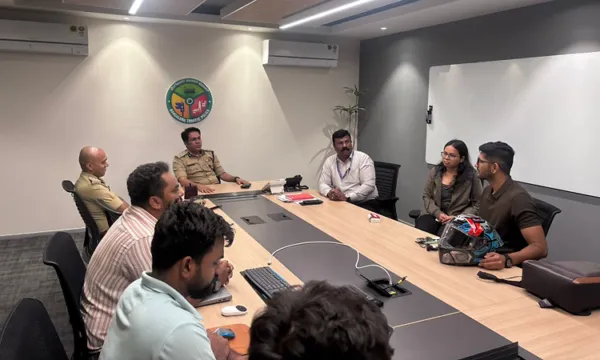

A prototype helmet designed by a Bengaluru-based software engineer to detect traffic violations has sparked debate about whether citizen-built technology could support road safety enforcement.
Pankaj Tanwar, who developed the prototype, said the idea emerged from daily frustration while navigating city traffic. "I ride to the office daily and often see people violating traffic rules very casually. One day, it became frustrating enough that I decided to build something out of it," he said.
Tanwar said he spent a weekend developing the initial prototype. The helmet carries a small camera that captures an image every three seconds while the rider is on the road. Using a fine-tuned YOLOv8 detection model running on a Raspberry Pi, the system scans the images to identify vehicles and detect traffic violations such as riding without a helmet, wrong-side riding or driving in the wrong lane. When a violation is detected, the system extracts the vehicle license plate using optical character recognition, verifies the violation using AI models, and then generates a report. He added that the system currently operates with about 82% detection accuracy.
Officials say citizens can already report traffic violations with proper evidence. Abhishek Gowda M, a traffic police constable, said that citizen-generated reports are accepted if they are submitted through proper channels and supported by clear evidence. "Citizens can report violations by capturing clear photo or video evidence and submitting it through the BTP ASTRAM mobile app or official traffic police platforms along with details such as the location, time of violation and the vehicle registration number," he said.
He added that the submissions are reviewed by traffic police staff before any action is taken. "The report is checked for authenticity by verifying the vehicle registration data, confirming the location and time, and reviewing whether the violation is clearly visible. Only after verification, an e-challan may be issued to the registered owner of the vehicle," Gowda said.
According to him, Bengaluru Traffic Police currently use several automated technologies under the Intelligent Traffic Management System (ITMS) to identify violations. "At present, AI-based systems already help detect multiple offences such as riding without a helmet, red-light violations and speeding through automated cameras installed at key junctions across the city," he explained.
Tanwar believes citizen-built tools could complement such systems in the future. "If similar systems run on thousands of dashcams or personal devices, it could create a distributed network helping identify violations in real time across the city," he said.
However, Abhishek Gowda cautioned that while citizens may record violations in public spaces, they should not attempt to stop vehicles, detain drivers or confront offenders. "Citizens must report violations respectfully and through official channels. They should not harass drivers or invade anyone's privacy while collecting evidence," he said.
Police officials also note that while innovations like Tanwar's prototype show promise, any integration of citizen-built technologies into enforcement systems would require regulatory approvals and safeguards to address concerns related to privacy, misuse and data verification.
Software engineer Pankaj Tanwar demonstrates his AI-enabled helmet prototype designed to detect traffic violations in Bengaluru.
Diana Saldehna S
School of Communication and Media Studies