
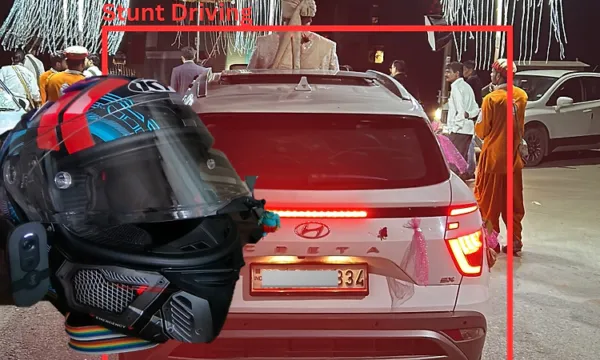

Bengaluru: Frustrated by the "chaotic" driving habits on the city's roads, Pankaj Tanwar, a 27-year-old software engineer, has turned his helmet into a high-tech traffic watchdog.
Using a combination of a webcam, a Raspberry Pi, and artificial intelligence, Tanwar's "hacked" helmet identifies traffic violations in near real-time and automatically reports them to the authorities.
How the "AI Helmet" Works
The device, which cost less than ₹4,000 to build, uses a Logitech webcam mounted on the helmet connected to a Raspberry Pi compact computer. The system runs AI models (including GPT and Gemini for cross-verification) to detect specific violations such as:
- Riding without a helmet
- Driving on the wrong side of the road
- Jumping red lights and dividers
- Stunt driving (e.g., sticking heads out of sunroofs)
When the system detects a violation with over 96% confidence, it automatically generates and sends an email to the Bengaluru Traffic Police. The report includes GPS coordinates, time stamps, vehicle number plates, and photographic evidence.
Police Interest and Public Reaction
The innovation quickly went viral, described by netizens as a "peak Bengaluru" moment. While some users raised concerns regarding mass surveillance and privacy, many praised the initiative, even suggesting that the technology be adapted to report the city's infamous potholes.
The impact reached the highest levels of city administration. The Office of the Commissioner of Police reached out to Tanwar via social media, calling the idea "innovative and interesting from a road safety perspective." Joint Commissioner of Police (Traffic), MN Anucheth, has scheduled a meeting with Tanwar to evaluate how the system might be integrated or scaled to assist the department's existing citizen-complaint platforms.
The Future of the Project
Originally from Rajasthan and now a resident of Kadubeesanahalli, Tanwar believes the device is highly scalable. He estimates that mass production could bring the cost down to ₹2,000 per unit, making it an affordable alternative to expensive fixed traffic camera networks. He is currently exploring potential collaborations with developers and investors who have shown interest in turning his prototype into a commercial hardware product.