
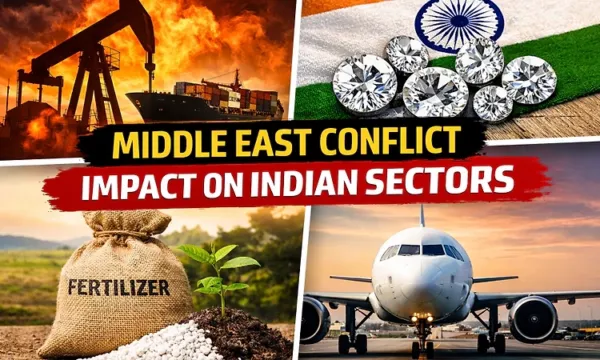

New Delhi: A prolonged conflict in the Middle East could affect several Indian sectors with direct trade links to the region, according to a report by Crisil Ratings.
With the Strait of Hormuz remaining a critical route for crude oil and LNG supplies, the impact is likely to extend beyond energy and into industries such as agriculture, aviation, diamonds, ceramics and travel.
Here is a sector-wise breakdown of the likely impact:
Oil and gas
India imports around 85 per cent of its crude oil requirement and nearly half of its LNG needs, with a significant portion routed through the Strait of Hormuz.
Crisil said most shipping vessels have halted movement through the strait since March 1, 2026, due to heightened risks.
Brent crude prices have already increased to USD 82-84 per barrel, compared to USD 66-67 in January-February 2026. Asian spot LNG prices have also surged from USD 10 per mmBtu to USD 24-25 per mmBtu.
A further rise in prices could widen India's current account deficit, increase inflation and impact corporate profitability.
Fertilisers
The fertiliser sector is among the most exposed, as India imports nearly 30 per cent of its requirement, with the Middle East supplying around 40 per cent of imports.
The region is also a major source of raw materials such as rock phosphate and phosphoric acid.
Any supply disruption or LNG price rise could push up production costs and increase the government's fertiliser subsidy burden.
Basmati rice exports
West Asia accounts for nearly 70-72 per cent of India's basmati rice exports.
If tensions continue, exporters may face shipment delays and slower payments, which could affect cash flow and stretch working capital cycles.
Diamond polishing and gems
The Middle East is a key trading hub for India's diamond industry.
Israel and the UAE together account for around 18 per cent of India's diamond exports.
While disruptions may impact trade volumes, Crisil noted that alternate centres such as Belgium and Hong Kong may partly reduce the impact.
Airlines
Around 10 per cent of Indian airline flights pass through Middle East airspace.
Airspace restrictions, airport closures and route diversions are already affecting operations.
Longer routes to Europe and the US may also lead to higher fuel costs and increased ticket prices.
Travel and tourism
Travel operators may witness cancellations and postponements for Middle East-bound travel.
However, the financial impact may remain limited due to insurance coverage.
Crisil said demand may shift to alternate destinations such as Southeast Asia.
Ceramics
The ceramics sector, which depends on LNG and LPG for manufacturing, may face near-term production disruptions.
Limited fuel availability could force plants to reduce capacity utilisation.
The sector may also see export pressure, as the Middle East contributes over 15 per cent of shipments, while exports account for about 40 per cent of total revenue.
City gas distribution
LNG supply disruptions are likely to mainly affect industrial customers, who depend heavily on imported gas.
This may reduce sales volumes for city gas distribution companies.
Tyres, paints and specialty chemicals
These sectors are directly linked to crude-based raw materials.
Higher crude prices may increase input costs, leading to margin pressure as companies may not be able to immediately pass on the costs to consumers.
Flexible packaging and synthetic textiles
The impact on these sectors is expected to be moderate.
Crisil said improved demand-supply dynamics and partial cost pass-through may help cushion the pressure.
Potential beneficiaries
Some sectors may benefit from the crisis.
Upstream oil companies could see higher revenues as crude prices rise while their costs remain largely fixed.
Shipping companies may also gain due to higher charter rates, reduced vessel availability and longer shipping routes.
Broader economic impact
Crisil cautioned that prolonged geopolitical tensions could intensify supply-chain disruptions, keep oil and gas prices elevated and increase inflationary pressure in India.
The rating agency said it will continue to monitor developments and assess the impact on individual companies.
(With inputs from PTI and Crisil Ratings report)