
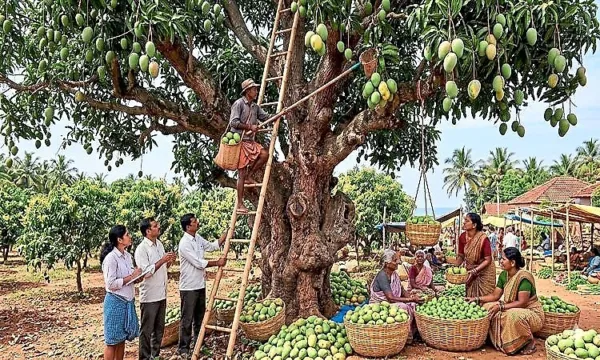

Kota: Favourable weather conditions this season have led to a good flowering and formation of tender mangoes. Mango trees are currently filled with flowers and young fruits.
Tender mangoes used for making pickles have started arriving in the market. Compared to last year, the prices are lower, which has encouraged more consumers to buy them.
In previous years, the region experienced good cold weather only for about 10 to 20 days. However, this time, nights remained very cold for nearly one and a half months, while the days were quite sunny. Scientists from the Brahmavar Agricultural Science Centre say this combination of cold nights and warm days has created favourable conditions for a good mango crop.
In Udupi district, about 4,573 metric tonnes of mangoes are produced through horticulture. Karkala taluk records the highest production at 1,436 metric tonnes. However, a large quantity of tender mangoes suitable for making pickles is also obtained from wild mango trees. In addition, several varieties used for pickles, including Appe Midi from other districts, are sold in the district, said Anant Patkar, a tender mango seller from Udupi. Despite the availability of ready-made pickles in the market, the trend of preparing pickles at home remains popular.
Experts say that if similar weather conditions continue for the next two months, the mango fruit harvest could also be good. However, if rainfall occurs by the end of March, there is a higher chance of tender mangoes and fruits falling from the trees.
Difficult to harvest
Although the mango yield is good and tender mangoes needed for pickles are available around homes, it has become difficult to find people willing to climb trees and harvest them. Tender mangoes used for pickles must be plucked carefully without letting them fall to the ground. Pushpa Shetty, who was buying tender mangoes at the Kota market, said that even if trees are nearby, people often cannot harvest them and instead buy 100 or 200 tender mangoes from the market to prepare pickles.
Reason for tender mango drop
Agricultural scientist Dr. Dhananjay from the Brahmavar Agricultural Science Centre explained that dew in the atmosphere can cause tender mangoes to fall. Apart from this, when a tree produces a large number of flowers, it may not have enough nutrients to support all the fruits, which leads to the dropping of tender mangoes. Once the dropping starts, it continues until the number of fruits matches the nutrient supply of the tree. Therefore, if dropping is noticed, some tender mangoes should be harvested immediately and used for making pickles to avoid them falling and getting spoiled.
Favourable weather conditions
Dr. Dhananjay said that the extended cold weather for about one and a half months along with strong daytime sunshine has helped the mango crop grow well this season. Mango trees across the region are now filled with flowers and fruits, creating new hope for mango cultivation.