
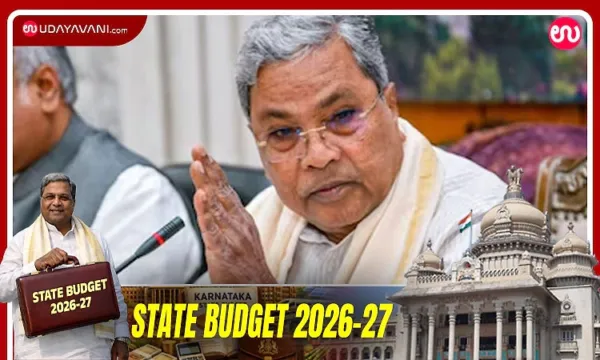

Bengaluru: The Karnataka government has increased the share of its non-loan net own revenue allocated to local bodies from 48 per cent to 50 per cent, Chief Minister Siddaramaiah said while presenting the state budget on Friday (March 6).
According to the budget, 35 per cent of the revenue will be distributed to Panchayat Raj institutions, while 15 per cent will be allocated to urban local bodies. The decision follows the submission of the Fifth State Finance Commission report for the period 2026-2030.
Concerns over new rural employment scheme
The budget also raised concerns over the Union government's move to replace the Mahatma Gandhi National Rural Employment Guarantee Scheme (MGNREGS) with the VB-G-RAM-G scheme.
The state government said the change weakens the rights-based approach that formed the core of the earlier programme and goes against the concept of village self-governance envisioned by Mahatma Gandhi.
MGNREGS, introduced by the UPA government in 2004, aimed to provide livelihood security to rural households and encourage decentralised planning in villages. Under the scheme in Karnataka, around 182 crore person-days of employment were generated, with Rs 61,000 crore paid as wages and nearly 77 lakh community assets created. Around 71 lakh rural families benefited from the programme in the current year.
The state government said replacing the scheme could lead to several issues, including a shift away from demand-based employment guarantees, greater central control in project planning and execution, and possible reduction in direct job opportunities for rural workers.
It also warned that the new system may weaken the decision-making powers of gram panchayats and increase administrative control from the Centre, potentially affecting the timely implementation of projects.
The Karnataka government urged the Union government to restore the earlier framework that strengthened village panchayats and supported rural livelihoods. It also said the state is committed to protecting the rights of rural workers and may consider legal measures if required.
Jal Jeevan Mission funding gap
The budget noted that projects worth Rs 69,488 crore have been approved under the Jal Jeevan Mission in the state. Of this, the Union government's share is Rs 30,888 crore, while the state's contribution stands at Rs 38,600 crore.
So far, the Centre has released Rs 11,786 crore, leaving Rs 19,102 crore pending. The state government has already released Rs 27,098 crore of its share and has Rs 11,502 crore remaining to be paid.
Despite no funds being released by the Centre in the 2025-26 financial year, the state government said it provided an additional Rs 15,500 crore to continue the programme. For 2026-27, Rs 10,433 crore has been allocated for the scheme.
Road development initiatives
Under the Kalyana Patha programme aimed at road development in Kalyana Karnataka, works covering 1,125 km are being carried out at a cost of Rs 1,000 crore. So far, Rs 238 crore has been spent, and the remaining works are expected to be completed during the current year.
Under the Pragati Patha project, supported by the Asian Development Bank, the government has approved the development of 1,292 rural roads covering 7,110 km at a cost of Rs 5,190 crore. Surveys for 783 roads have been completed and detailed project reports have been prepared for 655 roads. The budget has allocated Rs 500 crore for the project in 2026-27.
Drinking water and village infrastructure
To improve the functioning of overhead drinking water tanks, the government plans to clean, repair and upgrade 1,000 overhead tanks across the state at a cost of Rs 30 crore.
A separate project costing Rs 125 crore has been proposed to provide safe drinking water to Bannikoppa and 23 villages in Yelburga and Kukanoor taluks of Koppal district.
Renaming of gram panchayats
The budget also announced that all gram panchayats in the state will be renamed as "Mahatma Gandhi Gram Panchayats" to commemorate the national leader.
Local economy accelerator programme
The government plans to introduce a Local Economy Accelerator Programme to monetise and improve assets owned by gram panchayats. As part of a pilot project, income-generating units with essential rural facilities will be established in five gram panchayats in each division at a cost of Rs 25 crore.
Solar micro grid plan
The state also proposed the "Ananta" project, which aims to install solar micro-grids in all gram panchayats under a public-private partnership model. The project is intended to help panchayats become self-sustainable in paying electricity bills and support the generation of an estimated 4,000 MW of power annually.