
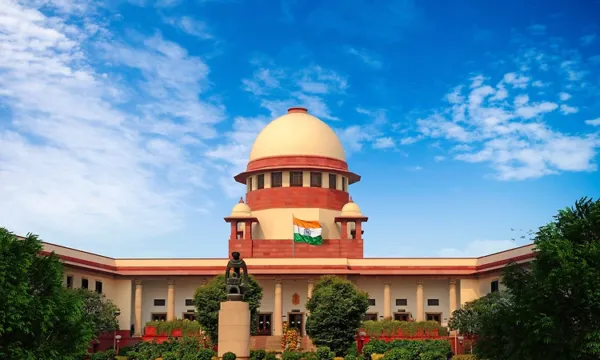

Marking a judicial milestone invoking Article 21 of the Indian Constitution, the Supreme Court granted a family's plea to withdraw life support of their son.
While being legally shielded from jail for following protocols in such cases, psychiatrists opine that doctors cannot escape the moral weight of pulling the plug.
On March 11, the Supreme Court upheld the 'Right to die with dignity' for Harish Rana, a 32-year-old Ghaziabad man who remained in a vegetative state for 13 years following a catastrophic accident. "Death with dignity and life with dignity is what matters," said Dr Lahari Ravikumar, senior resident at BGS Medical College and Hospital, Bengaluru, who had been closely following the case. She also noted that Rana's prolonged survival had ceased to serve him medically, becoming a liability for his family with endless hospital bills.
For physicians performing court-sanctioned withdrawal of life support, the law provides protection, but only under defined conditions. Swarnith S. Prasad, an advocate at the Karnataka High Court, explained that doctors gain immunity from charges of culpable homicide under IPC Sections 299 and 304 when they secure dual medical board confirmations of futility and court approval before proceeding.
While the ruling provides a path to closure, legal experts warn of the hidden pressures on India's healthcare system. "Guidelines counter socio-economic euthanasia by requiring hospital and external government boards to verify irreversibility, affidavits excluding financial motives, and palliative care alternatives," noted Prasad. He explained that, with over 65% of India's healthcare funded out of pocket, these rigorous institutional checks are designed to prioritise medical necessity over economic pressure.
However, Prasad cautioned that the legal framework still faces a significant gap in addressing the financial realities of the poor. "The lack of built-in economic audits or subsidised care makes low-income families vulnerable to indirect coercion, calling for laws to set clear affordability limits," he said.
Passive euthanasia (the withdrawal of life support) has been legal in India since 2018 under strict, court-monitored conditions. Dr Ravikumar backed the existing legal framework but insisted on institutional safeguards. "It should be the decision of a few doctors and the family… Every hospital should have a board with someone like a retired judge who agrees. It should not be a single person's call," she said.
Prasad weighed in on the ethical dimensions: "Passive euthanasia proves humane in extended vegetative states like Harish Rana's 13-year ordeal, upholding ethics of non-harm and dignity over pointless life extension. Still, global misdiagnosis risks and vague 'best interest' tests demand tighter protocols to avoid abuse against the defenceless."
The case also highlights the friction between medical consensus and family beliefs. Dr Ravikumar recalled a separate case where a family refused a lifesaving blood transfusion on religious grounds. "They don't take blood transfusions… So, what is this belief? Where is this decision coming from?" she asked, calling for mental health review boards to guard against "hatred or delusions or wrong belief" influencing such decisions.
Yet legal immunity does not erase moral conflict. Dr Ravikumar drew a firm distinction between passive euthanasia and active measures such as administering lethal drugs legal in some European countries, calling the latter a clear moral boundary. "This raises moral and professional dilemmas for doctors," she said. For her, passive euthanasia is defensible only when it means withdrawing life support that prolongs a comatose existence after years of exhausted effort, not as a first resort.
For the Ghaziabad family at the heart of this case, the Supreme Court's order brings a painful chapter to a close. For the many families who sit by unresponsive loved ones in ICU wards across the country, this landmark ruling may mark the beginning of a path toward closure.
Kishan SG
School of Communication and Media Studies
St Joseph's University, Bengaluru.