
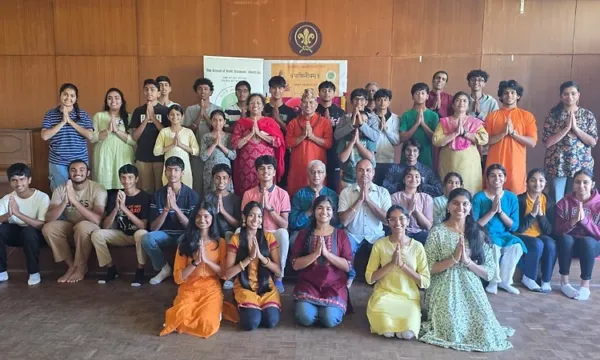

SYDNEY - The Sydney Sanskrit School recently concluded its annual Paniniyam Sanskrit Grammar Camp, a rigorous four-day event held from 9-12 April 2026. Since its start in 2015, this camp has become a key tradition for advanced students and future teachers to deepen their knowledge of classical grammar and Hindu values.
Under the leadership of Principal Meena Arye, the school has grown from a local initiative in 2006 to a national community reaching Victoria, Queensland, and South Australia. This year's camp focused on academic excellence, restricted to those who had completed the international Dwitiya exam and were ready for high-level linguistic study.
Day 1: Wisdom and Heritage
The camp opened with an inauguration filled with tradition. Pandit Narendra Dhave from the Australian Hindu Clergy spoke about life values and the importance of Sanskrit, while Sai Paravatusu, President of the Hindu Council of Australia, blessed the children for their future success.
The first day balanced heritage with modern well-being. MP Karishma Kalyanda gave a moving talk on mental health and stress management, while Yoga Acharya Rajan Sharma led a session on Hindu astrology and celestial systems. Students studied the complexities of Bhava and Grahas with Skanda Arya and practiced concentration with a state award-winning yoga teacher. The day ended with high energy Sanskrit games and a soulful Aarti.
Day 2: Creativity and the Arts
The second day focused on the connection between the mind and body. It began with a revitalising Vyayama (yoga) session and Maha Mantra meditation led by Narasimha Ji. Academically, students revised Samasa (compounds) and tackled new grammatical concepts.
In a creative session, eight groups of students designed and performed Sanskrit advertisements for everyday items. The afternoon was dedicated to Bharatanatya Shastram, where students explored complex emotional states (Sthayi Bhava) and characters (Nayaka), ending with a beautiful Gita Govindam performance. The evening featured a brainstorming session for teachers to develop new ways of helping students learn.
Day 3: Strengthening the Foundation
The third day continued the rhythmic balance of the camp, mixing information-dense study with interactive activities. These sessions were designed to reinforce grammar knowledge, improve the teaching process, and develop the confidence necessary to lead younger learners. Through competitive activities, plays, and enactments, the students built trust and camaraderie, turning difficult subject matter into a meaningful and invigorating learning experience.
Day 4: Deep Study and Graduation
The final day of the intensive camp began with a rejuvenating yoga session led by Narasimha Ji. This was followed by an in-depth study of Muttuswamy Dikshitar's "Navagraha Stuti." Students mastered the systematic decoding of the composition through Pada Vibhaga, Tatparya, and Anvaya Krama. They also learned to incorporate the Hindu calendar-including Samvatsara (year), Rutu (season), and Masa (month)-through practical exercises.
The program concluded with a formal valedictory ceremony where students showcased their hard work to parents and guests. Distinguished visitors, including Dr. Vyas Ji, Usha Garg Ji, Sewa Singh Ji, Bobby Singh, and Jagadesh Ji, were present to bless the participants and distribute certificates.
Principal Meena Arye noted that the camp is not just about studying a language, but about building character and discipline. By mixing difficult grammar with games and teamwork, the 2026 Paniniyam Camp proved to be a resounding success.