




Depending on which numbers you look at, rural India is having either a great festive season or a difficult one. Why? Well, here's what the sales data tells us:
- A dealership owner will tell you bikes and cars are flying: rural vehicle registrations rose 33% in September, as fast as in the cities.
- A tractor dealer in Vidarbha, on the other hand, will tell you a different story: his sales are down by a fifth.
In our recent article, Urban India might head into Diwali with a smaller wallet. Why?, we saw why urban India is expected to spend less this Diwali. But what about rural India, where the festive season has always followed the harvest? This year the harvest came up short: the monsoon ended 12.6% below normal, the weakest in over a decade, and about 1.6 million fewer hectares were planted. Farm households, in other words, are heading into Diwali with less to spend.
The good signs and the difficult ones
Rural demand isn't uniformly strong or weak, so it helps to separate what is working from what isn't. Let's start with the good signs:
- Rural FMCG sales grew 10.6% in value between July and September, faster than urban sales.
- Rural vehicle registrations rose 33% in September, in line with the cities.
- Companies such as Marico and Dabur are reporting healthy rural growth.
Now, the difficult ones:
- Mahindra's tractor sales fell 21%, and dealers reported weaker demand for seeds and fertilisers.
- The number of FMCG packets sold in villages declined 5%, even as value grew.
- The RBI's September survey puts rural consumer confidence at 90.6, below the 100 mark that separates optimism from pessimism, and the reading has fallen for six surveys in a row.
Sentiment doesn't tell us everything, but together these numbers suggest that some households are still buying vehicles and everyday goods, while others are cutting back. So, what is squeezing the second group?
Why the harvest side is hurting
The monsoon ended 12.6% below normal, the weakest in over a decade, with drought declared in five states. Real rural wages fell 1.5-2% in July and August, and the new rural jobs scheme that replaced MGNREGA on 1 July generated 50% fewer days of work in its first month and 9% fewer in August, exactly when drought-hit labourers needed it. With rural inflation at 6.08%, well above urban, and microfinance still 6.9% smaller than a year ago, cash is tight.
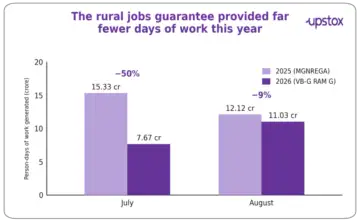
Source: Ministry of Rural Development
Add it up and the households that live off farm income and daily wages, the bottom half of rural India, have less cash this October than last. That is who the tractor numbers, the fertiliser numbers and the packet counts are picking up.
So, what are companies doing to keep sales going?
Discounting harder, financing more and shrinking the pack. The festive season is being bought.
Festive discounts are an annual ritual, but this year they are carrying more of the load. Vehicle makers have rolled out their biggest benefits in years. October's advertised festive packages run up to ₹3.35 lakh on select Tata models, ₹3.1 lakh at Maruti, ₹1.71 lakh on the Honda City and ₹2.05 lakh at Renault, stacked with exchange bonuses, loyalty rewards and financing from 4.99%, with some brands adding a separate rural allowance. With incomes under pressure, cheap EMIs, not fatter wallets, are doing much of the lifting in that 33% registration growth.
FMCG companies are holding prices until the season ends. Parle has told PTI that most price-hike decisions will wait until after the festive season; in the meantime, companies are cutting grammage in ₹5 and ₹10 packs rather than touching the price printed on them, and pushing premium brands into ₹10 packs so a stretched shopper can still trade up. Dabur credits its rural growth partly to a deeper distribution push into villages, and Marico's update talks of rural pickup and festive restocking. Jewellers are letting customers pay with old gold.
At Senco, more than half of purchases in the September quarter were funded by exchanging old jewellery, which is how a village household buys at ₹1.5 lakh gold without fresh cash.
The implication: headline festive sales can look healthy even where incomes are not, because companies are renting the demand, with discounts, zero-cost EMIs and smaller packs. The bill for that lands on their margins, and on the quarters after Diwali, when the offers are withdrawn and the EMIs are still being paid.
Rural India's split dashboard, autumn 2026
| Paid for by the harvest | Latest reading | Paid for by salary, business or EMI | Latest reading |
|---|---|---|---|
| Tractor retail sales (FADA) | −12.6% in Sep vs Aug; rural −13.3% | Rural vehicle registrations (FADA) | +33% YoY in Sep |
| M&M / Escorts tractor sales | −21% / −16.7% YoY | Rural two-wheeler registrations | +33% YoY in Sep |
| Seeds, fertiliser, pesticides | Dealers report weaker sales | Rural FMCG sales in rupees (Bizom) | +10.6% YoY, Jul-Sep |
| Rural FMCG packets (NielsenIQ) | −5% YoY | Dabur / Marico rural commentary | Growing ahead of urban |
| Jobs-scheme person-days | −50% in Jul, −9% in Aug | Microfinance book (the swing factor) | −6.9% YoY, still shrinking |
Source: FADA, company filings and updates, Ministry of Rural Development, Bizom, NielsenIQ, MFIN
Three reasons rural India could recover
First, not all rural income comes from the farm any more: FADA points out that rural sales of two-wheelers and cars grew about 33% in September, in line with cities, because non-farm businesses and jobs now matter more in the countryside; part of that jump, though, is a weak base, since buyers froze in September 2025 waiting for GST cuts.
Second, the companies that sell into villages are not alarmed: Marico reported double-digit volume growth for the September quarter and Dabur expects double-digit revenue growth.
Third, the RBI survey's forward-looking index is still above 100, which means rural households expect next year to be better than this one, and foodgrain stocks are comfortable, so a bad harvest will not mean empty shops.
Now, what should we watch?
The interesting part comes after the sales numbers. FADA's October and November data will show whether tractor demand catches up with two-wheelers, helping distinguish a wider recovery from one concentrated in certain purchases. The October inflation print on 12 November and person-days under the rural jobs scheme will add another piece of the puzzle: are rural households getting more breathing room, or are budgets still under pressure?
Company results will offer a different clue. December-quarter margins can show whether the extra sales came with a healthy return or required companies to sacrifice profitability. That matters because higher sales are good news only if they also make business sense.
The bigger story, then, isn't just how much rural India bought this festive season. It's whether the recovery is strong enough to benefit both the people buying and the companies selling.
Disclaimer: Views and opinions expressed in the article are the author's own and do not reflect those of Upstox. Stocks and securities mentioned are illustrative and not recommendations. Please consult a registered financial advisor before making any investment decision.