
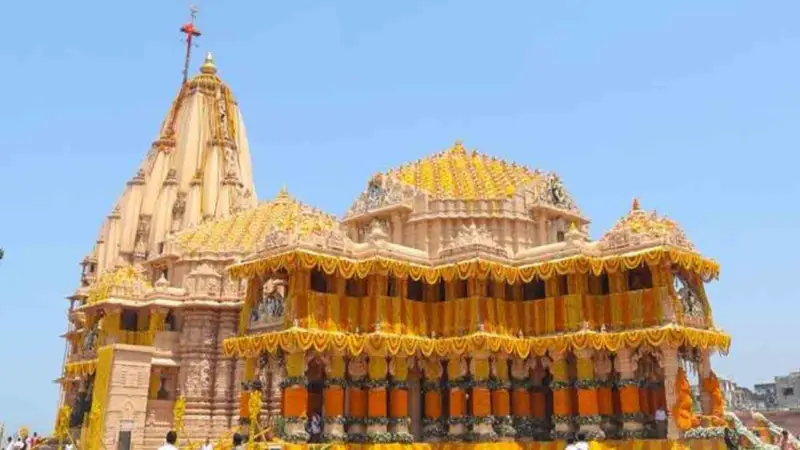

Located in Gujarat's Saurashtra region, the Somnath Temple is one of the holiest and most ancient shrines dedicated to Lord Shiva. Revered as the first among the 12 Jyotirlingas, the temple attracts millions of devotees every year who come seeking blessings, peace, and spiritual strength.
More than just a place of worship, Somnath stands as a timeless symbol of faith, resilience, and rebirth in Indian history.
The Mythological Story Behind Somnath
The origins of Somnath Temple are deeply connected to Chandra Dev, the Moon God.
According to Hindu mythology, King Daksha Prajapati married his 27 daughters to Chandra Dev. However, Chandra loved only one wife, Rohini, and neglected the others. Hurt by this discrimination, the remaining daughters complained to their father.
Daksha tried to reason with Chandra, but when his behaviour did not change, he cursed the Moon God with Kshaya Roga, causing him to gradually lose his brightness and power.
As Chandra weakened, darkness and drought began spreading across Earth. Worried gods and sages approached Lord Brahma for help. Brahma advised Chandra Dev to perform intense penance to Lord Shiva in the Prabhas region, now known as Somnath.
The Mythological Story Behind Somnath
The origins of Somnath Temple are deeply connected to Chandra Dev, the Moon God.
According to Hindu mythology, King Daksha Prajapati married his 27 daughters to Chandra Dev. However, Chandra loved only one wife, Rohini, and neglected the others. Hurt by this discrimination, the remaining daughters complained to their father.
Daksha tried to reason with Chandra, but when his behaviour did not change, he cursed the Moon God with Kshaya Roga, causing him to gradually lose his brightness and power.
As Chandra weakened, darkness and drought began spreading across Earth. Worried gods and sages approached Lord Brahma for help. Brahma advised Chandra Dev to perform intense penance to Lord Shiva in the Prabhas region, now known as Somnath.
It is believed that Chandra chanted the Mahamrityunjaya Mantra ten crore times to please Lord Shiva. Moved by his devotion, Shiva freed him from the curse partially, blessing him with the cycle of waxing and waning during the lunar phases.
At Chandra's request, Lord Shiva also manifested himself there as a Jyotirlinga. Since Chandra is also known as 'Som,' and he accepted Shiva as his lord or 'Nath,' the shrine came to be known as Somnath.
First Among the 12 Jyotirlingas
Somnath holds a special place in Hindu scriptures and is considered the first among all 12 Jyotirlingas. Ancient texts like the Skanda Purana, Shrimad Bhagavatam, and the Mahabharata mention the temple's divine significance in great detail.
Devotees believe that taking a holy dip and offering prayers at Somnath helps wash away sins from many lifetimes and brings spiritual liberation.
A Temple Rebuilt Through History .
Throughout history, Somnath Temple became a target of repeated invasions because of its immense wealth and grandeur. In the 11th century, Mahmud of Ghazni attacked and looted the temple, destroying much of its structure.
Despite repeated destruction over the centuries, the temple was rebuilt several times, symbolising the unwavering faith of devotees.
After India's independence, the modern Somnath Temple was reconstructed under the leadership and vision of Sardar Vallabhbhai Patel. Today, it stands proudly as one of India's most magnificent spiritual landmarks.
Special Beliefs and Spiritual Significance
Ancient legends say the original Shivling of Somnath was suspended in the air due to magnetic forces, making it one of the wonders of its time.
The sacred confluence of the Hiranya, Kapila, and Saraswati rivers is also believed to exist near the temple. Mondays and festivals like Ganga Dussehra are considered especially auspicious for worship at Somnath.
Devotees believe that visiting the temple brings peace, removes negativity, and opens the path toward spiritual growth and divine blessings.