
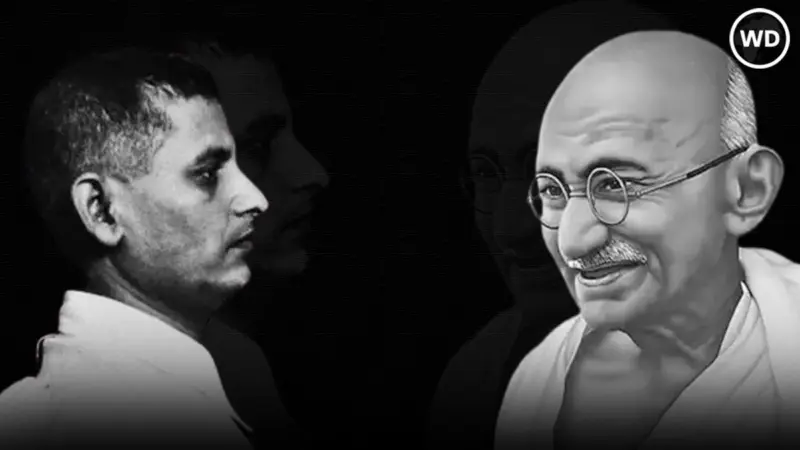

1. Godse's Arrest and Public Anger
Immediately after firing the shots, Nathuram Godse did not attempt to flee. He raised his hands and called for the police. Onlookers overpowered him and began assaulting him before police intervened. He was taken into custody and shifted to the Tughlaq Road police station under heavy security.
2. Gandhi's Death and Nehru's Address to the Nation
Gandhi was rushed inside Birla House, where he was declared dead soon after. That night, Prime Minister Jawaharlal Nehru addressed the nation on All India Radio, delivering one of the most emotional speeches in Indian history:
'The light has gone out of our lives, and there is darkness everywhere…'
3. Anti-Brahmin Violence
Following the assassination, violence broke out in several parts of the country, particularly in Maharashtra, as Godse belonged to the Chitpavan Brahmin community. Reports emerged of targeted attacks, arson, and forced displacement. Thousands of Brahmins were reportedly killed or compelled to flee their homes amid the unrest.
4. Allegations Against the RSS
Rumours spread that Godse was associated with the Rashtriya Swayamsevak Sangh (RSS). Amid rising tensions and to prevent further violence, then Home Minister Sardar Vallabhbhai Patel imposed a ban on the RSS on February 4, 1948. The ban was later lifted after investigations and assurances.
5. Trial and Court Proceedings
The Gandhi assassination trial was conducted at Delhi's Red Fort.
Accused: Nathuram Godse, Narayan Apte, Vinayak Damodar Savarkar, and six others
Savarkar Acquitted: Savarkar was acquitted due to lack of evidence
Godse's Statement: Godse delivered a lengthy courtroom statement, accusing Gandhi of appeasing Muslims and holding him responsible for India's Partition
6. Death Sentence
On February 10, 1949, the court pronounced its verdict. Nathuram Godse and Narayan Apte were sentenced to death, while others received life imprisonment. Both Godse and Apte were executed by hanging on November 15, 1949, at Ambala Jail.
7. Immersion of Ashes
Over one million people participated in Mahatma Gandhi's funeral procession. His ashes were immersed in several sacred rivers across India. Godse's last wish was that his ashes not be immersed until the dream of an 'undivided India' was fulfilled; his ashes are reportedly still preserved in Pune.
8. Appeal for Clemency
Gandhi's sons, Manilal and Ramdas Gandhi, appealed to the government to commute Godse's death sentence, stating that their father, a firm believer in non-violence, would not have supported capital punishment. The government rejected the plea.
9. Who Was Nathuram Godse?
Birth: May 19, 1910, Pune district, Maharashtra
Ideology: Hindu nationalism
Political Affiliation: Hindu Mahasabha
RSS Link: Godse was never a member of the RSS
Godse blamed Gandhi for the Partition of India and accused him of favouring Muslims. He believed that allowing Muslims to remain in India after Partition endangered Hindu interests. Even after the assassination, Godse reportedly stated he had no regrets and believed he had done his duty.
10. Nathuram Godse: Martyr or Terrorist?
After his execution, some supporters hailed Godse as a martyr, while many others strongly condemned his actions, branding him a terrorist. His ideology and actions remain deeply controversial, continuing to divide public opinion in India to this day.