
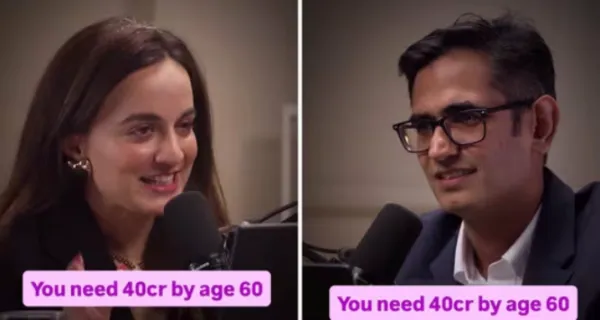

The ₹40 crore retirement estimate
During the discussion, Sonia Shenoy presented a personal scenario as a "live case study," explaining that she is approaching 40 years of age and currently spends around ₹2 lakh per month.
She asked how much wealth would be required by age 60 to sustain a similar lifestyle.
Jethwani responded that the required retirement corpus would be approximately ₹40 crore, assuming a monthly expense range of ₹1-2 lakh.
He clarified that this estimate excludes the value of the primary residence and personal vehicles, but includes all other expenses such as lifestyle costs, healthcare, and family needs.
According to him, this figure accounts for inflation, rising living costs, lifestyle changes, and unexpected medical expenses that typically increase significantly with age.
He also added that for a "mid-sized family in a metro city," this amount would be a "reasonable" retirement benchmark.
A reality check on rising costs
Sonia Shenoy expressed surprise at the figure, noting that she had expected a retirement corpus closer to ₹10 crore based on her assumptions.
Jethwani, however, disagreed, emphasizing that most people underestimate long-term inflation and lifestyle inflation, which can drastically increase future expenses.
He also acknowledged that even building a net worth of ₹1 crore remains difficult for a large portion of India's population, highlighting the gap between financial advice and ground reality.
Social media reaction
The clip quickly went viral after being shared on Instagram, triggering a wide range of reactions online. Many users questioned the practicality of the ₹40 crore estimate.
Some argued that retirement needs were being overstated, especially since expenses like children's education would no longer apply after a certain age.
Others criticized the discussion as disconnected from average Indian income levels, pointing out that a majority of people may not even earn ₹1 crore in their lifetime.
One user commented that the estimate felt unrealistic for middle-class households, while another remarked that the conversation reflected a "lack of ground reality."
A section of users also questioned the assumptions behind the calculation, including life expectancy and post-retirement spending habits.\
The bigger debate
The discussion has reignited a broader conversation about retirement planning in India-particularly in metros where costs of living continue to rise rapidly.
While some financial experts argue that high corpus figures reflect long-term inflation and healthcare costs, others believe such estimates may feel overwhelming or unattainable for most individuals.
The debate ultimately highlights a widening gap between ideal financial planning models and the economic realities faced by the majority of Indian households.