

According to the World Meteorological Organization (WMO), El Niño conditions are likely to return between May and July 2026, which could further intensify heat patterns.
The Indian Meteorological Department (IMD) has also issued warnings of prolonged heatwaves from April to June, with temperatures consistently remaining above normal. In several regions, the mercury has already crossed 45°C, making survival without artificial cooling increasingly difficult.
Yet, in the face of extreme conditions, many Indians-especially in rural areas-are turning to traditional, resourceful solutions. In Rajasthan, where summers are particularly harsh, locals have found relief in nature itself.
The Natural Cooling Power of Mithi Jal
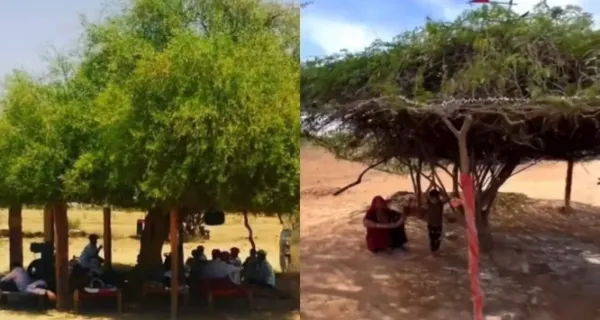
In the arid landscapes of western Rajasthan, people are seeking shelter under the dense canopy of the mithi jal tree, scientifically known as Salvadora oleoides. This tree, commonly found across Rajasthan, Haryana, Punjab, Gujarat, and Maharashtra, thrives in dry climates and has become an essential part of the region's natural ecosystem.
Districts like Jodhpur, Barmer, Bikaner, Jaisalmer, Churu, Jhunjhunu, and Nagaur are home to large populations of these trees. Beyond their ecological importance, they are now gaining attention for their remarkable cooling effect.
A "Desi AC" in the Desert
The mithi jal tree's thick, clustered foliage creates a dense shade that significantly lowers the temperature beneath it. Observations and local experiences suggest that areas under its canopy can be 5-8°C cooler than the surrounding environment-even during peak afternoon heat.
For travelers, farmers, and villagers without access to air conditioning, this natural cooling system acts as a lifesaver. Families and livestock gather under these trees to escape the scorching sun, turning them into communal spaces of relief during extreme weather.
More Than Just Shade
The benefits of the mithi jal tree go beyond temperature control. It is a multipurpose species known for its medicinal properties and oil-producing capabilities. The tree also bears sweet, edible berries, and its twigs have traditionally been used as natural toothbrushes.
Nature's Answer to Modern Challenges
As climate change continues to intensify weather extremes, such traditional practices highlight the importance of sustainable and locally adapted solutions. While air conditioners provide immediate comfort, they are not accessible to all and contribute to environmental concerns.
In contrast, the humble mithi jal tree stands as a reminder of how nature, combined with human ingenuity, can offer effective and eco-friendly ways to cope with rising temperatures.
In a country known for its "jugaad" spirit, this natural "desi AC" is proving that sometimes, the simplest solutions are the most powerful.