
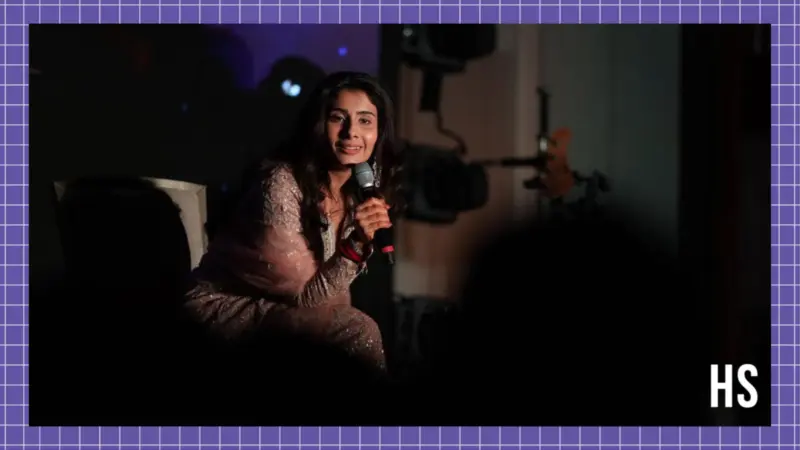

Last month, while shopping for souvenirs in a mall in Auckland, Nayab Midha was approached by a 60-year-old man who had attended her show the night before.
"You changed my life yesterday. I feel like I have gone back 40 years. I feel a fresh burst of energy today," he told her.
This is not an unusual occurrence for the spoken word artist who has performed over 200 shows of her special, Rajkumari, across India and abroad. Midha's medium is poetry, her stories are deeply personal, and her impact has been phenomenal.
Midha rose to fame in 2023 after her poem Muskurao went viral. The words, though simple, strike a chord.
Muskurao agar tum kise se haar gaye ho
Kisiko uss jeet tumse zyaada jarurat thi shayad
(Smile, if you lost to someone. Perhaps they needed this victory more than you.)
Muskurao agar kucch kho gaya ho
Jiska naseeb ka tha, usko mil gaya hai shayad
(Smile if something slipped away from you, what was written in their fate
may have finally reached them.)
Born in Sri Ganga Nagar, a town in Rajasthan that borders Pakistan, Midha's chaotic childhood home-with one parent absolutely fun-loving and the other responsible and not so funny-became a turning point for her to try poetry.
"I started journalling when I was very young to figure myself out. Both my parents are amazing people, but there were so many emotional issues; they didn't have the courage to accept the abnormalities in their relationship," Midha tells HerStory.
Speaking up loud
The first time she spoke out loud was during the Nirbhaya case.
"My blood was boiling so bad that I got up on a loudspeaker rickshaw in my hometown and started speaking my poetry because that was the only way I knew how to raise a voice," she says. This led her to start writing about women and transformed into thoughts about love, friendship, and her parents.
Eager to leave home, Midha left Sri Ganga Nagar at 16 to Kota to prepare for engineering entrance exams. After completing her engineering degree, she landed a job at Infosys in 2018, becoming "a trained labourer in the IT sector."
"But I couldn't be a good labourer so I left the job when I got an offer to join the events space, but Covid-19 happened and I lost both jobs," she admits.
But the love for the spoken word continued throughout. While in college, she would ace all the competitions and stood out for being the only "engineering girl."
The Muskurao moment
May 8, 2023. Before this date, Midha was struggling to pay rent, and after, she was being recognised at airports.
"Muskurao" (Smile) went viral, BBC called her "the Muskurao girl" and she turned into a household name. "It was that moment when your world changes in one night," she says.
"I would very honestly say that Muskurao changed the space of poetry a lot. If there's ever anything written about spoken word in history, Muskarao is a big milestone," she adds.
Before Muskurao, Midha did small shows-50-seater or 30-seater. As soon as Muskurao happened, tickets were sold out for 100, and then 200 people.
When 250 tickets were sold, the team quickly booked an auditorium in Ahmedabad.
The birth of a princess
But Midha decided that she didn't want to stick to what she was doing in her show so far-just songs and poetry without a set pattern or list or a story around it.
In a week, she quickly wrote a show on all the things she wanted to talk about. What emerged was Rajkumari, a three-hour exploration of modern womanhood, marriage, dreams deferred, and the gap between fairytale expectations and lived realities.
"Rajkumari asks: What happens when the princess realises no prince is coming? What happens when she discovers she must rescue herself?
"No one told her she has to rescue herself," Midha says. "She was told that one day a prince will come and the world will become a fairytale. So she marries, thinking she will do what her mother used to do. You don't want to do that. Your own dreams are incomplete. Every chaos that unfolds with these miscommunication gaps, we unfold them one by one," she explains.
That first Ahmedabad show changed everything. "I performed for three hours and people were laughing, crying, feeling. That day I realised I can make people laugh, tell a story, and engage people. I just didn't know it, but I did have it in me."
A shorter version of Rajkumari is Nayab Live, a one-and-a-half-hour show where Midha experiments with new forms of the spoken word, new stories, and everyday happenings.
In a country where poetry has traditionally belonged to the realm of Urdu shayari and literary festivals, Midha has made contemporary Hindi spoken accessible and commercially viable. Senior actor and storyteller Roshan Abbas calls her the "female Zakir Khan." There's no doubt that Midha is doing for poetry what Khan did for Hindi storytelling-making it relevant, relatable, and heartwarming.
"Why Abbas Sir used the word "female Zakir Khan" was because Zakir bhai has a male POV of women - he understands well what girls want from men. What I'm talking about on stage is a very female POV of life, of what we go through. I'm trying to detangle the relationship between me and my boyfriend, my parents, through storytelling," she elaborates.
The dark side of being viral
Midha made history as the first female spoken-word artist to break the one million+ viewers mark on Instagram. Her verified social media reach now stands at a commanding 2.4 million. But the social media journey has not been easy.
Recently, Midha posted a reel explaining that daughters are told not to talk about marriage, even though they are waiting for it to unlock basic freedoms like a night out or a trip.
"I said freedom should be the bare minimum. It should be yours," she explains. The comment section exploded, reflecting the double-edged sword that social media portrays.
"Men wrote that my body count must be more than 10, that my husband has no dignity. I just said women wait for weddings to unlock freedom. What did I say?" she asks.
She has developed thick skin, and the personal attacks don't affect her like they used to. What troubles her is what it represents about society. "I expected better from this generation. When I was growing up, I thought we were headed to a cooler world. I didn't know it would worsen," she says.
As a poet, a performer, and a woman claiming her space, what kind of legacy does she want to build?
"I want to be known as a person who actually changed lives. I think that's the job of art. I want to perform shows all over the world, I want to have an English set. I want to make sure poetry is everywhere," Midha concludes.
Edited by Affirunisa Kankudti