




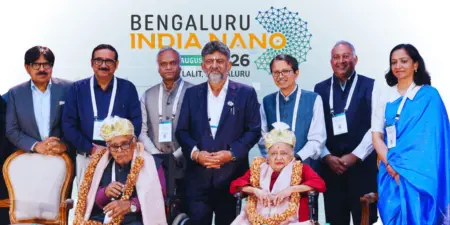

India's flagship nanotechnology conference returned to Bengaluru this week with a sharper question at its centre: what happens when the science of the very small collides with artificial intelligence?
The 14th edition of Bengaluru INDIA NANO was inaugurated on Tuesday at The LaLiT, Bengaluru, by Karnataka Chief Minister D.K. Shivakumar, under the theme "Nanotech's Next Frontier: AI & Beyond, Conceive, Converge, Commercialize." The event is organised by the Department of Science & Technology, Government of Karnataka, the Karnataka Science and Technology Promotion Society (KSTePS) and the Jawaharlal Nehru Centre for Advanced Scientific Research (JNCASR).
A felicitation for the man who built India's nano ecosystem
Bharat Ratna Prof. C.N.R. Rao, FRS, Honorary Chairman of the Vision Group on Nanotechnology, Government of Karnataka, was felicitated for his contributions to science and his pioneering role in advancing nanotechnology in India and beyond.
The Prof. C.N.R. Rao Bengaluru INDIA NANO Science Award was presented to Prof. B.L.V. Prasad, Director of the Centre for Nano and Soft Matter Sciences (CeNS), Bengaluru.
Also present were Priyank Kharge, Minister for Home, IT & BT and e-Governance; Rangesh Raghavan, Managing Director, Lam Research India; Rizwan Arshad, MLA, Shivajinagar; Prof. Navakanta Bhat of IISc, who chairs the Vision Group on Nanotechnology; Dr. N. Manjula, IAS, Secretary, Department of Electronics, IT, BT and Science & Technology; Prof. P.S. Anil Kumar, Chair of the conference organising committee; and Bharath S, IAS, MD, KSTePS.
From lab bench to product line
Karnataka's pitch at the event was explicitly commercial.
"Karnataka has established itself as India's technology capital, and today we are laying the foundation for the next era of scientific leadership," Shivakumar said. "The future belongs to those who can translate research into real-world impact. We want Karnataka to lead not only in digital technologies, but also in nanotechnology, advanced materials, semiconductors and deep-tech innovation."
Kharge framed it as a convergence play. "The next wave of innovation will be driven by the convergence of AI, nanotechnology, biotechnology and semiconductors. Karnataka is uniquely positioned to lead this transformation because of its strong research institutions, thriving startup ecosystem and progressive policy environment," he said.
Dr. Manjula added that the objective is to "build partnerships that translate scientific excellence into scalable technologies and sustainable economic growth."
What is on the agenda
The main conference opened with plenary lectures and multi-track technical sessions across three sector tracks: Nano in Semiconductors, covering next-generation electronics; Nano in Agriculture & Health, spanning climate-smart agriculture and advanced healthcare; and Nano in Energy & Environment, focused on sustainable energy and environmental resilience.
A dedicated Global Innovation Alliance (GIA) track features country sessions from Germany, France and the Netherlands, built around collaborative research and technology transfer. A pre-conference Tutorial Day on 3 August covered Advanced Semiconductor Manufacturing, AI and Machine Learning for Sciences and Engineering, and Advances in Nano Characterization.
Speakers include Prof. Umesh V. Waghmare, Secretary, Department of Science & Technology, Government of India; Prof. Chennupati Jagadish of the Australian National University; Prof. Akshay Rao of the Cavendish Laboratory, University of Cambridge; Prof. Radha Boya of the University of Manchester; Prof. Arghya Bhowmik of the Technical University of Denmark; Pradeep Ramachandran of KLA's Advanced Computing Lab; Dr. K.S. Subramanian, founding head of the Center for Agricultural Nanotechnology at TNAU, Coimbatore; Dr. Pushplata Singh of the TERI-Deakin Nanobiotechnology Centre; and Dr. Paramita Kar Choudhury of TCS Research.
Scale, and who is showing up
This year's edition has drawn 26 conference sessions, over 80 speakers, 800+ delegates, 150+ scientific posters, participation from 10+ countries, 50 exhibitors and more than 4,000 attendees, making it one of India's largest nanotechnology platforms.
An International Exhibition runs alongside, bringing together industry, startups, research labs and technology providers. The Nano for the Young programme, a Nanotech Quiz and poster presentations round out the schedule.
Partners include Applied Materials, Visvesvaraya Technological University, Indian Oil (Sprint Ahead 2026), Detroit Engineered Products, Ramaiah University of Applied Sciences and ACT Enterprise, alongside international session partners from Denmark, France, Germany and the Netherlands.
For startups building in materials, semiconductors, agritech and climate hardware, the message from the LaLiT was direct: the science is ready, and the state wants to see it shipped.