





As organizations race to adopt AI, a quieter but more decisive shift is under way: data has emerged as the real source of competitive advantage.
In a Snowflake panel discussion titled 'Future-ready Startups: Data, Product Innovation & Capital Strategy for 2026', leaders across fintech, healthcare, investing, and cloud infrastructure unpacked what it takes to turn fragmented, sensitive, and often imperfect data into systems that scale with trust.
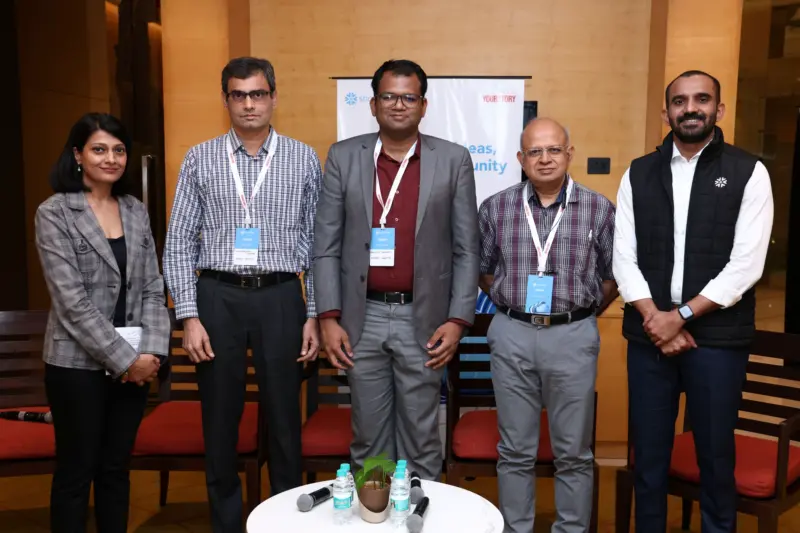
Panel discussion participants included Govindarajan Kadambi, Co-founder and CPTO, Dvara Holdings; Aravind Ganesan, CTO, Kauvery Hospitals; Guruswamy Ramasubramanian, General Partner at Sirius One Capital; and Sunith Chacko Philip, Manager - Commercial & Digital Natives (India), Snowflake. The panel was moderated by Shivani Muthanna, Senior Director, Content Partnerships, YourStory.
The state of data: challenges, opportunities and trust
Kadambi opened the discussion by explaining how Dvara Holdings serves overlooked and underserved customers with products including savings, investments, and income tax filing. He identified the primary data challenges as acquiring and using data effectively to prioritize key factors such as affordability, reliability, and trust.
Affordability evaluates if customers can afford services long-term for lifetime value and cross-selling. Dvara assesses this via income benchmarks and personal factors like spending patterns, family size, and age. Reliability focuses on service consistency, while trust is critical-especially for a segment exploited and skeptical of digital tools and unknown entities.
Standard fintech models falter due to income unpredictability. "For us, fintech or banking models do not really work as income data is irregular. Take fruit vendors or cab drivers, we need to understand their flow of income. Some months, expenses match their incomes; in other months, their expenses exceed income. A lot of the challenge has been around getting this data and fitting it into affordability," Kadambi said.
He also noted that where fully digital solutions fail despite cost benefits, phygital approaches succeed. Incorporating physical touchpoints like in-person interactions, phone availability, or partnerships with trusted self-help groups is critical when handling hard-earned money.
Ganesan, of Kauvery Hospitals, distinguished healthcare data into two realms: highly sensitive clinical patient information and standard administrative data, generated differently. Most clinical data remains non-digital, as doctors often use paper records, even during hospital admissions. Kauvery Hospitals has prioritized digitizing this sensitive data amid regulatory and hospital-driven pushes. Now advanced in this journey, the hospital views clinical data - not administrative - as a strategic asset for unique patient insights and intellectual property.
Over the past couple of years, Kauvery built a data platform and digitization ecosystem, now harnessed into a lakehouse or data lake architecture, which lets the organization identify relevant AI use cases. "AI has commoditized intelligence. There is no strategic value in that anymore. Although we have an investing arm focused on AI, we are no longer differentiating based on just AI capabilities. We look at how intelligently startups are using data. Data is the strategic asset," Ganesan said.
Ramasubramanian, of Sirius One Capital, emphasized that data lies at the heart of innovation-what organizations make of it matters most. Existing startups hold a slight edge, having accumulated vast datasets across retail, ecommerce, marketplaces, and beyond. He noted that previously they lacked tools to derive intelligence or monetize this data effectively. Now, with advanced AI capabilities, they have a prime opportunity to unlock its value.
Data foundations: the infrastructure of intelligence
"There's no AI strategy, without a data strategy," said Sunith Chacko Philip of Snowflake. He discussed evolving data foundations in the AI era. Unlike past efforts to break internal silos, today's AI revolution necessitates a robust data strategy as the prerequisite for any AI initiative.
According to Philip, startups often launch minimal viable products (MVPs) to solve specific concerns, achieving rapid adoption and "escape velocity" via the hockey-stick growth pattern. However, this is the stage where backend infrastructure often becomes brittle, causing breakages, support overload, and rating dips. Snowflake enables startups to build applications on a scalable core data foundation, whether it is from MBs or GBs of data. This eliminates infrastructure management issues during hypergrowth, allowing focus on feature rollout.
Philip cited a recent example: A retail intelligence platform, akin to supply chain optimization for kirana stores, automated manual inventory tracking that was previously handled through paper and Excel sheets. However post-launch, data volumes exploded, overwhelming the slow legacy systems. By leveraging Snowflake as a data foundation, the platform can now handle mammoth workflows, speeding up feature development and accelerating market rollout faster. "What we evangelize over and over again is to have a very strong data foundation that essentially becomes an enabler for your business. AI can then become a catalyst to help startups move forward," he said.
Ganesan concurred, describing Kauvery Hospitals' goal of pursuing a unified "golden journey" for patients across digital and physical interfaces-from app/WhatsApp bookings and AI-transcribed doctor visits to ICU IoT monitors, scans, and images. This generates diverse data modalities, which require a robust data foundation.
He shared that the organization is building a data lakehouse architecture to source, consolidate, sanitize, and standardize data. While regulations continue to evolve in India, this setup will unlock data's full potential.
A human in the loop: The guardrail of agentic AI
The conversation turned to agentic AI as a key differentiator for AI-native startups and panellists agreed with the idea while advocating for a cautious approach.
Ganesan stressed that healthcare remains a "human-in-the-loop" ecosystem, even with agentic AI. Due to agentic AI's non-deterministic nature, regulations prohibit granting AI full agency when it comes to clinical decisions. According to Ganesan, this is a barrier that is unlikely to be lifted soon. Kauvery Hospitals has deployed agentic AI on the non-clinical side, using it to streamline administrative workflows such as purchase orders, invoice processing and easy automation. Another successful use case involves using AI to transcribe doctor-patient interactions, freeing up doctors from typing or maintaining eye-contact with patients. Doctors can review and approve transcripts, enhancing efficiency without replacing oversight.
Ramasubramanian added that recent portfolio additions leverage the AI and agentic wave, primarily automating end-to-end business workflows. He concurred with Ganesan on the "human-in-the-loop" model, sharing that critical decisions always require human oversight as opposed to fully autonomous actions.
The discussion covered a wide range of topics, from data pipelines to investment criteria and strategic shifts necessary for 2026.
Philip highlighted investor confidence in Snowflake-backed startups and their tech stacks, and revealed how the organization reached out to venture capitalists to invest in seed/pre-seed ventures to build MVPs directly on the platform.
Kadambi explained that despite standard unit economics for mature products like bank accounts, investments, and insurance, serving underserved segments requires Dvara to adapt to unique situations. When fully-digital models failed, the company had to pivot, re-architecturing into a customer-facing, agent-assisted organization.
Finally, Ramasubramanian advised healthcare startups on key hurdles. Sales cycles drag for 6-8 months, not weeks; while quality data/IP stays locked in institutions amid uncertainties around sharing personally identifiable information (PII) and sensitive personal information (SPI). To build a good healthcare product, startups must partner with institutions and doctors, and onboard clinicians by offering equity, as they will be crucial in validating a product and finding product-market fit.