
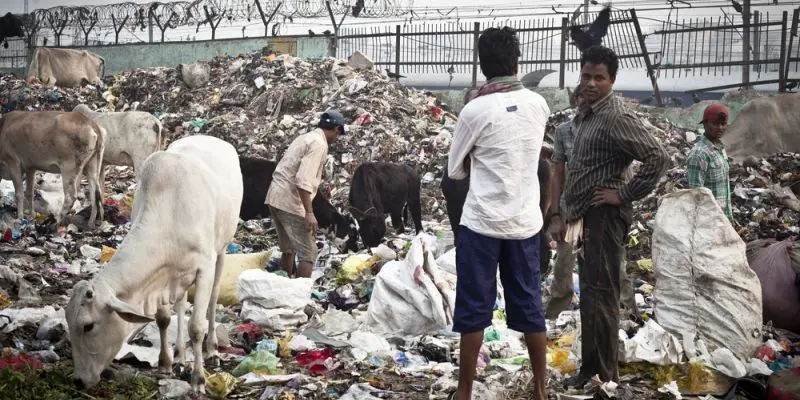

Every morning, the waste collector comes and clears the garbage we put outside our homes. Discreet and all but invisible, this waste collector is part of a larger ecosystem, comprising kabadiwallas, small-scale recyclers and others, that handles a significant portion of the 130,000 to 150,000 metric tonnes of municipal solid waste that India produces daily.
Despite providing an essential service, the ecosystem remains largely informal and unrecognised, leading to inadequate access to financial security, social stigma, and exposure to hazardous working conditions for over 4 million workers.
Moreover, the absence of integration between informal workers and formal waste management systems leads to inefficiencies and environmental degradation.
Government initiatives addressing the problem
Solid Waste Management Rules, 2016 outline guidelines for Urban Local Bodies (ULBs) to recognise and integrate organisations of waste pickers into the municipal solid waste management strategy, include them in decision making, and provide them with training and ID cards. They also advocate for organising waste workers into Self Help Groups (SHGs) or cooperatives for better management and advocacy.
NAMASTE (National Action for Mechanized Sanitation Ecosystem), an initiative launched last year by the Union government, provides for enumeration of informal waste pickers, safety measures, linkage with social security benefits, and information, education and communication campaigns.
These measures, though ambitious and well-intentioned, often fall short in implementation due to over-reliance on municipal bodies which are under-staffed and under-resourced.
Social enterprises, private players are changing the landscape
The private sector is a key player in filling gaps of policy implementation, and bringing innovative technology into the sector.
Mobilisation of waste workers is an important step towards formalisation and better management. SwaCH, a pro-poor public-private partnership in Pune, has successfully organised over 3,500 waste pickers into a formal workforce, providing them with training, steady incomes, and social dignity. They are the frontrunners in the roll out of NAMASTE in Pune. SHGs in Odisha are pioneering community- based decentralised waste management systems through their Swacch Saathis. They collect, segregate and manage solid waste, locally and systematically. Outputs like manure, recyclable and combustible waste generate revenue, completing a circular economy model. They also run innovative door-to-door awareness campaigns to ensure citizen participation.
Technology can bring dignity and safety by reducing physical risk without displacing workers, ensuring it's supportive and not extractive.
Startups like Bintix are revolutionising waste segregation and processing through AI/ML based data collection and synthesis, diverting waste away from landfills and oceans. ScrapUncle leverages technology to formalise the scrap sector, connecting households with verified scrap collectors and ensuring fair pricing. Recykal offers a digital platform facilitating waste collection, processing, and recycling, enhancing traceability and efficiency.
These innovations are changing how workers engage in waste management activities, reducing manual involvement in hazardous and unhygienic practices, and upskilling them so that they can add more value to waste.
Completing the chain of circularity are startups like Sirohi, which transforms plastic and textile waste into premium lifestyle products such as furniture, bags, and home décor, and The Good Doll, a social enterprise that creates handcrafted dolls using textile waste. They train and employ women artisans from underserved communities, giving new economic value to waste while building sustainable, dignified livelihoods. Through these initiatives, over 2000 women from marginalised communities are earning higher wages with the flexibility to work at a time and place of their choice, getting access to medical insurance, learning new skills, and benefitting from sophisticated enterprise management technologies that enhance their productivity and earning potential.
These startups not only address environmental concerns but also create employment opportunities, contributing to the formalisation of the informal sector.
Integrating the informal waste sector into formal systems is crucial for sustainable waste management in India. While technology and policy initiatives have shown promise, systemic challenges must be addressed to scale these solutions effectively. Empowering informal workers through recognition, access to social security, and inclusion in formal frameworks will not only improve their livelihoods but also enhance the efficiency and sustainability of waste management practices.
By closing the loop between informal workers and formal systems, India can move towards a more equitable and sustainable waste management ecosystem.
(Aditi Jain is the Associate Sector Lead, Inclusive Livelihoods & Entrepreneurship, Villgro)
(Disclaimer: The views and opinions expressed in this article are those of the author and do not necessarily reflect the views of YourStory.)