
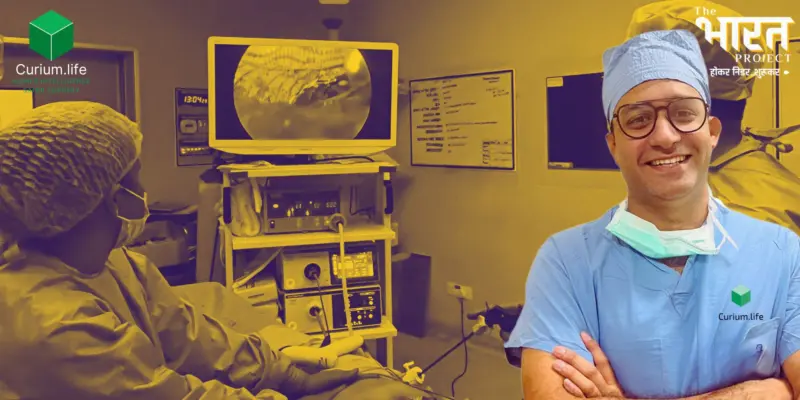

Surgery produces a constant stream of data. Every procedure involves decisions, movements, and visual inputs that could inform the next case.
Its first product, SurgiMeasure, focuses on real-time intraoperative measurements. It is used in procedures such as bariatric surgery, hernia repair, and bowel cancer surgery, where measurements are often estimated or derived indirectly.
The system operates within the operating room, providing measurements during the procedure itself. The aim is not to replace clinical judgment, but to support it with additional information. The approach is hardware-agnostic and designed for monocular laparoscopic systems, which remain the most widely used format in minimally invasive surgery.
Early validation in the field
Moving from concept to clinical use has required building trust. Curium works with more than 50 expert surgeon collaborators across India, the United States, and other regions, and has secured over 20 letters of intent for structured data acquisition.
Clinical studies are underway with various hospitals in India and US In a controlled setting, SurgiMeasure has been used in four cases at a hospital in Chennai. Feedback from these deployments has shaped the product's development.
After one demonstration, a senior surgeon said, "I wish I had this when shit hit the fan during a surgery 10 years ago" For the company, that response captures the problem more directly than technical benchmarks.
Building around the operating room
Curium's founding team combines clinical and technical roles. Alongside Dr. Vinayak Rengan, the company is led by Balu Seetharam on the business side and Mani R on technology. The clinical and research effort is supported by collaborators and advisors, including Prof Ganapathy Krishnamurthi from IIT Madras.
The company spans clinical, research, engineering, and business teams. Its customers include hospitals, surgical departments, and training institutions. SurgiMeasure is a SaaS product deployed on-premise in operating rooms, priced as a monthly subscription.
Go-to-market starts with surgeons and surgical societies, using a freemium model to drive early adoption before paid rollout. The market is still fragmented. The global surgical AI space is about $10 billion, but intraoperative measurement tools remain limited, especially for minimally invasive procedures.
Competition comes from software firms building custom solutions for equipment manufacturers, robotic platforms with integrated measurement systems, and large medical device companies developing internal AI capabilities. Many of these approaches are tied to proprietary hardware. Curium is building for systems already in use.
Scaling data and validation
The company has raised around Rs 2.3 crore from individual investors, mostly surgeons, and is now raising a $200,000 bridge round to fund operations through December 2026. Next comes regulatory approval in India for SurgiMeasure, then fresh capital to scale, expand clinical data, and enter global markets.
The hurdles are familiar. Regulations take time. Validation needs close collaboration. Data runs on trust. That is exactly why surgeons are not just users here; they are part of building the system. The long-term goal is simple. Build an AI layer for surgery that supports decisions across procedures and specialities. The data already exists. The real question is whether it can be used.