

Progress rarely begins with certainty. More often, it begins with discomfort, questions, and the unsettling feeling that what we once believed may not be entirely true.
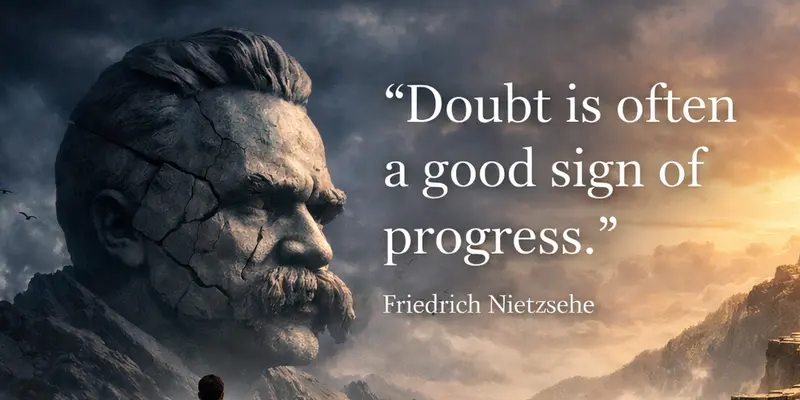
The German philosopher Friedrich Nietzsche captured this idea succinctly when he wrote, *"Doubt is often a good sign of progress."*
At first glance, doubt may seem like an obstacle. In reality, it is often the engine that drives intellectual, personal, and societal growth.
Why doubt matters in the journey of growth
Human progress has historically been rooted in questioning existing beliefs. Every major breakthrough in science, philosophy, and social change began with someone doubting the accepted norm.
When individuals begin to question assumptions, they open the door to discovery. Doubt pushes people to examine evidence, rethink solutions, and challenge outdated ideas. Without it, society would remain locked in rigid traditions and unquestioned authority.
Consider how scientific discoveries often begin. Researchers rarely start with certainty. Instead, they begin with questions: *What if this assumption is wrong? What if there is a better explanation?* These doubts lead to experiments, observations, and eventually new knowledge.
In this way, doubt is not a weakness. It is a sign that thinking is evolving.
The difference between destructive doubt and productive doubt
Not all doubt leads to progress. There is an important distinction between destructive doubt and productive doubt.
Destructive doubt paralyses action. It manifests as excessive self-criticism or fear of failure, preventing individuals from moving forward.
Productive doubt, however, works differently. It encourages reflection and improvement. Instead of asking, "Can I do this?" it asks, *"How can this be done better?"
Productive doubt drives curiosity. It encourages learning, experimentation, and intellectual humility. When people accept that they may not have all the answers, they become more open to new perspectives and better solutions.
Doubt as a catalyst for innovation
Innovation thrives in environments where questioning is encouraged. Many transformative ideas have emerged because someone dared to challenge the established order.
Technological revolutions, for example, often arise when entrepreneurs doubt the limitations of existing systems. Similarly, social movements begin when people question whether prevailing norms truly serve justice or equality.
In many ways, doubt acts as a catalyst. It creates tension between the present reality and the possibility of something better. That tension motivates individuals to search for new answers.
Embracing doubt in personal development
On a personal level, doubt can also signal growth. When individuals step outside their comfort zones-whether learning a new skill, changing careers, or pursuing ambitious goals-they often experience uncertainty.
This feeling is natural. It indicates that a person is encountering unfamiliar territory and expanding their capabilities.
Instead of fearing doubt, individuals can treat it as feedback. It can highlight gaps in knowledge, reveal areas for improvement, and encourage deeper learning. Over time, the process of confronting doubt builds resilience and confidence.
Progress begins with questions
Nietzsche's observation remains deeply relevant in a world defined by rapid change. In an era of evolving technologies, shifting economies, and complex global challenges, unquestioned certainty can be more dangerous than doubt itself.
Doubt compels societies to reassess assumptions, improve systems, and refine ideas. It keeps intellectual progress alive.
Rather than viewing doubt as a sign of weakness, it may be wiser to recognise it as a signal that thinking is advancing. After all, progress rarely starts with absolute certainty-it begins with the courage to question what we thought we already knew.