

Artificial intelligence is rapidly moving from experimentation to enterprise implementation. Across industries, organizations are deploying AI to optimize supply chains, automate financial processes, strengthen analytics, and power customer-facing applications.
Yet while pilots and proof-of-concepts are becoming increasingly common, scaling these initiatives into reliable production systems remains far more complex.
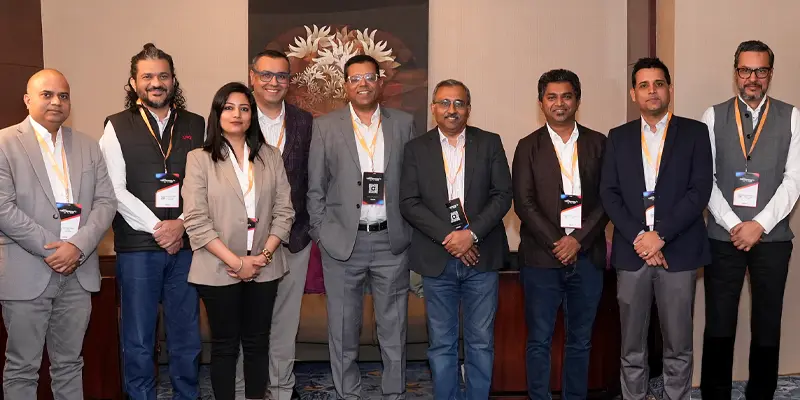
That challenge formed the focus of a recent YourStory roundtable titled 'Operationalizing AI in GCCs From Pilots to Production'. The discussion explored how global capability centers (GCCs) are navigating the transition from early experimentation to enterprise-scale AI deployment.
The closed-door session, moderated by Shivani Muthanna, Senior Director of Strategic Partnerships and Content at YourStory, brought together industry leaders, Santosh Kulkarni (Vertiv), Shammi Prabhakar (NielsenIQ and GCC Pros), Sameer Shaikh (XPO India), Sandeep Poddar (Kimberly-Clark), Deepak Arora (Ecolab), Durgaraje Virendra Bheda (Quess Corp), Saurabh Gupta (Sulzer), Amod Deshpande (Allvue Systems), and Prabhakar Vijayaprakash (Kyndryl).
Representing sectors ranging from logistics and manufacturing to financial platforms and analytics, participants reflected a shared reality: while AI experimentation is widespread, integrating these systems into everyday enterprise operations is where the real challenge begins.
From support centers to strategic hubs
Many GCCs were set up to deliver operational efficiency. Today, that mandate has expanded significantly. Many centers now own product engineering, global data platforms, and digital transformation initiatives.
AI is accelerating this shift by raising the bar for what strategic contribution looks like. Panelists noted that the conversation has moved from how much work can be delivered from India to how much innovation can originate here. For that shift to be credible, AI cannot remain confined to pilot projects.
Infrastructure: the constraint few are discussing
Most discussions around AI in GCCs begin with models or use cases. At this roundtable, however, the conversation started with infrastructure, specifically power density and cooling.
AI workloads are GPU-intensive and far more power-hungry than traditional enterprise systems. Rack densities are climbing toward 500-kilowatt levels, specialized cooling systems can take months to deploy, and inference workloads at the edge require facilities that many GCCs are not yet equipped to support.
The panel agreed that this readiness gap needs to be addressed before large-scale AI use cases can move forward.
Why AI stalls between pilot and production
The discussion also surfaced a clear reason many AI pilots fail to scale. In most organizations, accountability for AI initiatives sits primarily with engineering teams, even when a business leader sponsors the use case.
That approach may work in a controlled pilot environment. It begins to break down once systems encounter real-world complexity: variable invoice formats, fluctuating load volumes, and noisy or incomplete data.
"If a POC fails to reach production, it is not just an engineering failure. It is the business owner's failure too," Sameer Shaikh said.
Without genuine business ownership, pilots often struggle to survive the transition into operational environments.
Capital allocation presents another challenge. Enterprises typically require clear ROI before committing large investments, yet meaningful returns often emerge only after deployment at scale. In sectors where global growth has slowed, GCCs frequently make their strongest case through measurable cost reductions rather than innovation ambitions.
Governance and trust
In regulated industries, governance concerns are just as critical as technical ones. Most enterprise governance frameworks were built for traditional systems, and integrating AI often requires re-engineering workflows rather than simply extending them.
Human oversight remains essential in areas where AI outputs influence financial decisions, compliance reporting, or customer-facing processes.
Prabhakar Vijayaprakash pointed out that his organization processes trillions of data points weekly across 90 countries. "I don't see AI operating without human oversight in the next five years, for most of us," he said.
Where AI is already delivering
Despite these challenges, several production-level use cases are beginning to emerge.
One example discussed involved an AI system that generates virtual 3D load maps for freight trailers, optimizing configuration based on both space and weight. Another example focused on reducing safety cassette configurations across industrial pump portfolios with dozens of models.
In another case, an intelligence center reported a significant improvement in its Total Value Delivered metric after implementing faster response systems for adverse customer events.
Participants also highlighted two products developed entirely in India: an AI-driven fund lifecycle management platform and a market intelligence product built on $9 trillion in annual transaction data.
The talent gap
Workforce readiness was another recurring theme. AI is reshaping skill requirements across engineering, analytics, and operations faster than most hiring pipelines can adapt.
Panelists noted that for every 10 open AI and data roles today, only a small pool of qualified candidates is available -and that gap continues to widen.
Several organizations are responding by retraining domain experts in AI rather than relying only on specialized AI hires. This approach helps bridge the gap between technical capability and operational understanding.
A shift in how enterprises view AI
The conversation closed with a broader perspective on how GCCs will scale AI in the coming years.
AI initiatives cannot succeed in isolation; they require coordinated investment across infrastructure, governance, and application layers. Many programs stall because AI is added onto existing workflows rather than embedded into core value streams.
Bolt-on AI may deliver incremental productivity gains. Embedded AI, however, can fundamentally reshape the economics of a business function.
Panelists agreed that organizations already seeing meaningful returns are those that treat AI not simply as a technology deployment, but as an operating model transformation.