
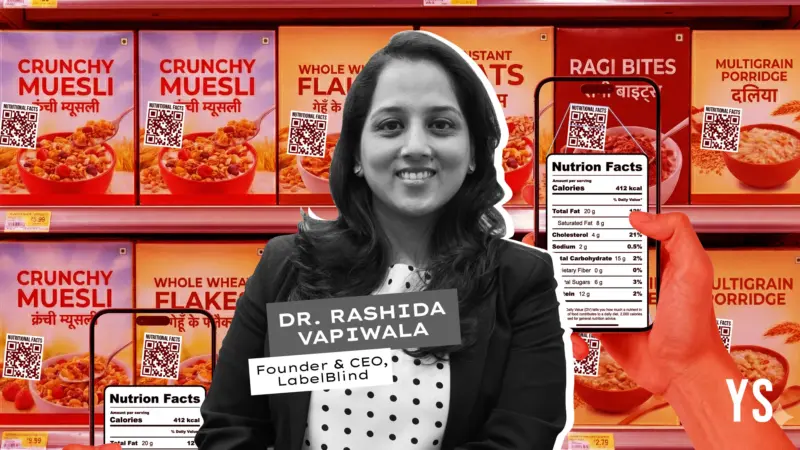

The next time you pick up a packaged food item off a supermarket shelf, notice the maze of nutrition facts, ingredient lists, regulatory symbols, and tiny disclaimers.
What is invisible are the weeks or months of manual work that go behind the label: nutritionists checking formulations, regulatory teams ensuring compliance, designers adjusting the label art, and legal teams proofreading every word.
For decades, labelling remained a slow and error-prone manual process, even as India's packaged-food market boomed. That is, until 2018, when nutrition expert Rashida Vapiwala decided to start LabelBlind.
With a master's in food science and nutrition from Mumbai University, followed by a PhD from Shreemati Nathibai Damodar Thackersey Women's University, Vapiwala worked in companies like Health Total, Diet for Health India, and Mahindra & Mahindra.
Even as she built a stable corporate career, Vapiwala felt unsettled, the lack of clarity around everyday food choices. "I noticed how deeply food affects lives, and how often labels misled or confused consumers," says the founder and CEO of LabelBlind, adding that she believes companies and consumers both deserve clarity.
As packaged food became more prevalent, she observed a growing disparity between regulations, companies, and consumers. This disconnect prompted her to leave her corporate life behind and start LabelBlind in 2018 in Mumbai.
The startup began as a food-rating website that scored products based on their healthiness. However, real momentum came when the Food Safety and Standards Authority of India (FSSAI) recognised its work, appointing LabelBlind as the principal investigator for a nutrient-threshold study that would later inform India's front-of-pack labelling rules.
Through the study, Vapiwala met 30 of India's largest food companies and realised something striking: "Processes even in the top companies remained manual, led by Excel sheets and documents. There was an urgent need for digitisation."
Enter FolSol, the full-stack food labelling SaaS
FolSol, LabelBlind's main cloud-based software, simplifies the entire food labelling process that earlier took weeks or months. Companies enter their product formulation, and FolSol creates a complete, compliant label with the nutrition table, ingredients, and all required declarations.
"In 60-100 seconds, our AI validates an entire artwork and generates a compliance report," Vapiwala claims.
The system is powered by LabelBlind's proprietary ingredient database, custom image-reading models, LLMs enhanced with in-house features, and rule sets built from Indian and global regulations. It works across many categories, like dairy, bakery, snacks, cereals, and beverages, adjusting checks based on each category's specific rules.
Between 2021 and 2023, FolSol worked with restaurants, hotels, and quick-service restaurant (QSR) chains with menu labelling, as well as supported packaged-food manufacturers across India.
In 2023-24, it expanded further to cover international labelling rules across 12+ countries. Today, FolSol has become a core tool for food companies looking for faster, more accurate, and globally compliant labelling.
Trusted by big names and export-ready
LabelBlind gained trust early with major clients, including Tata Starbucks, ITC Hotels, Tim Hortons India, and PVR, all of whom continue to be active users of its menu-labelling solution. Starbucks was among LabelBlind's first enterprise clients, coming on board when FSSAI introduced its first menu-labelling regulation in 2020.
Its packaged-food clients now include Bikano, Bikanerwala, Everest Spices, Mother's Recipe (Desai Brothers), Goldie Masala, Amul, and Theobroma.
Today, LabelBlind works with over 40 Indian customers, many of whom export to regions such as the US, UK, Middle East, Canada, Australia, the EU, Southeast Asia, and Africa. Because FolSol supports both Indian and international regulations, it has become a preferred labelling and compliance tool for companies that sell in multiple markets.
Business model, funding, and team
LabelBlind follows an annual subscription model based on cloud storage slabs rather than per-label billing. "A 2GB plan is suitable for a 400-SKU portfolio, 5GB for 1,000 SKUs, and higher slabs for large companies," Vapiwala says. However, pricing varies by configuration, modules, and portfolio size.
The startup has raised $500,000 from high-net-worth individuals, including Vinay Mittal and Gaurav Chaudhary. It runs with a tight team of 21 people, about half of whom are engineers and AI developers. Its infrastructure rests on AWS cloud services.
Market opportunity and competition
India's packaged food sector is large and growing fast. Vapiwala claims non-compliance is a very costly affair: products get rejected, penalties are levied, and the intangible loss of brand reputation is huge. "But we're aiming to onboard 500-600 companies in the next three years," she says.
Globally, she identifies equivalents in the US, UK, Ireland, and the Middle East, with companies like Recipe, Nutritives, and Food Label Maker, but none address Indian and international regulations within a single product.
"[We are] India's first and only company to digitise labelling regulations for both domestic and international markets; that depth is our advantage," Vapiwala tells YourStory.
LabelBlind's early challenges were understanding the complex world of food regulations and building the right team. Vapiwala pointed out that the rules across India and other countries were difficult to map at first, and learning every category and requirement felt 'daunting.'
"Finding skilled people in both technology and food regulation was also tough, but our team that came together eventually turned these challenges into our strengths," she says.
What's next: QR labels, translation, global expansion
LabelBlind is now building several new features beyond static packaging. It will launch QR-based dynamic labels this financial year, allowing brands to update export details, plastic waste information, and manufacturer data without changing the packaging.
The team is also creating tools for quick sticker generation, real-time translations for markets like Canada (French), the EU, and the Gulf (Arabic), and front-of-pack labelling formats for Australia, the EU, the UK, and Latin America.
It is adding support for nutraceutical compliance and developing a system to check advertising and health claims against Indian and global rules.
FolSol currently supports around 12 markets. LabelBlind plans to expand to 22 markets this month to reach 50 countries by the end of the financial year.
As Indian food brands scale globally, LabelBlind aims to remain a behind-the-scenes partner, helping companies manage compliance accurately and with less effort as it enters new markets.
Edited by Suman Singh