
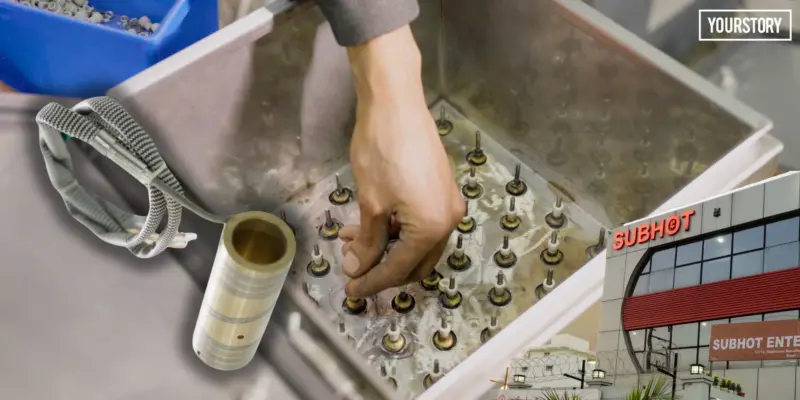

In Uttar Pradesh's Ghaziabad district, engineering products such as industrial heating elements are produced for applications where reliability inside machines matters more than retail visibility.
These components are used in furnaces, ovens, die-casting systems, and other industrial setups, where buyers evaluate them through heat output, insulation stability, and operational life rather than appearance or catalogue variety.
Demand in this segment is shaped by machine uptime and replacement cycles. Industrial users place repeat orders when a component performs consistently across batches and continues to operate reliably within their equipment. In such environments, performance inside the machine becomes the real measure of product value.
The production ecosystem behind these products operates through specialised technical steps including fabrication, filling, shaping, testing, and assembly. Unlike consumer-facing manufacturing sectors, output here is designed for industrial buyers who prioritise process reliability and technical accuracy. As units grow, production is often organised by product line so teams can build expertise in specific manufacturing stages and maintain consistent quality.
Under Uttar Pradesh's One District One Product (ODOP) framework, Ghaziabad's engineering products sector operates within a more structured ecosystem that highlights the district's manufacturing strengths while supporting cluster visibility and development.
Dhaval Gupta manages a Ghaziabad-based manufacturing unit producing industrial heating elements for furnaces, ovens, and die-casting applications. He describes himself as the second generation in the business, building on his father's experience while reorganising the factory floor around clearer production roles and specialised product lines.
A unit organised by product lines
The unit manufactures several types of industrial heating solutions, including tubular heaters, furnace heaters, ceramic mica band heaters, cartridge heaters, and thermocouples. According to Gupta, the shop floor is divided product-wise so teams can focus on specific heater categories and maintain technical consistency.
For example, in the tubular heater production line, resistance wire forms the heating element while magnesium oxide is used as the filling material that provides electrical insulation and supports heat transfer. After filling, the components pass through processes such as squeezing, rolling, and annealing before the heater is shaped into its final form and prepared for installation in industrial equipment.
Gupta explains that the accuracy of filling and insulation plays a crucial role in determining heater performance and durability in actual industrial conditions.
Scale built through consistent process control
Over time, the unit has expanded from a small setup to a larger manufacturing floor organised into separate departments for different product categories. Within this structure, maintaining consistency in materials, calibration, and process settings remains critical.
Industrial buyers typically judge heating elements through field performance rather than marketing materials. Stable output across batches and reliable behaviour during operation help build long-term relationships with customers.
Shop-floor specialisation also contributes to quality control. When workers repeatedly perform specific manufacturing steps within their product lines, the chances of variation in filling, shaping, and finishing are reduced.
In Ghaziabad's engineering products cluster, the flow of repeat orders depends largely on how well these components perform in real industrial environments. When process discipline, material calibration, and team-level execution remain aligned, manufacturers can steadily expand production while continuing to meet the performance expectations of industrial users.