
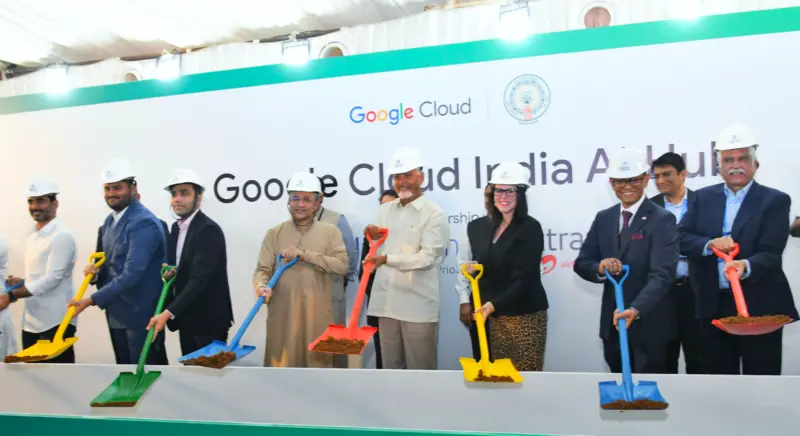

Google broke ground on an AI hub in Visakhapatnam, marking what executives and policymakers described as a pivotal step in India's bid to build large-scale digital infrastructure to power its next phase of economic growth.
The project is developed in partnership with AdaniConneX and Nxtra by Airtel.
The groundbreaking marks a significant milestone in the company's $15 billion investment over five years (2026-2030) to establish a comprehensive gigawatt-scale AI ecosystem in India, said the company.
Senior government officials, including IT minister Ashwini Vaishnaw and Andhra Pradesh Chief Minister N. Chandrababu Naidu, attended the groundbreaking ceremony.
'An inflection point for India's AI-native future'
The AI hub, first unveiled in October last year, will comprise three data centre campuses designed to deliver high-performance computing capacity for AI workloads.
Executives say the facility will anchor a broader industrial corridor, linking subsea cable infrastructure, fibre connectivity, and renewable energy supply, positioning India as a competitive destination for global AI infrastructure.
"This is an inflection point for India's AI-native future," said Thomas Kurian,Google Cloud CEO, adding that the project reflects a deepening alignment between Big Tech investment and the government's ambitions under the 'Viksit Bharat 2047' vision.
Unlike earlier waves of foreign tech investment in India-largely centered on software and services, the Visakhapatnam project highlights a shift towards capital-intensive infrastructure, where control over compute power, energy, and connectivity is becoming central to technological leadership.
Jeet Adani, a director at the Adani Group, described the effort as foundational. "India's AI moment will be defined by infrastructure," he said, pointing to the nearly one-gigawatt capacity planned at a single location,
an unusually large deployment even by global standards.
The project will also integrate an expanded fibre-optic network under the 'America-India Connect' initiative and a clean-energy strategy aligned with India's goal of achieving 500 GW of non-fossil fuel capacity by 2030.
A broader industrial ecosystem
Beyond the data centres, Google and its partners are positioning the investment as a catalyst for a broader industrial ecosystem. A supplier-focused conference held alongside the groundbreaking ceremony-the Bharat AI Shakti Conclave-aimed to bring local manufacturers, contractors, and service providers into the project's value chain.
Executives said the company plans to prioritise local procurement and integrate small and medium enterprises into global operational frameworks, a move that could help upgrade regional industrial capabilities.
To address the environmental footprint and social impact of large data centres, Google outlined a series of community initiatives tied to the project. These include watershed management programmes, digital tools for fishing communities, and workforce training efforts spanning construction, cloud computing, and AI.
The company said it aims to train thousands of workers and support local entrepreneurship. Efforts include programmes targeted at women-led businesses and rural communities.
For Andhra Pradesh, the investment represents a chance to reposition Visakhapatnam as a major node in the global digital economy-beyond its traditional identity as a port and industrial city.
Naidu called the project a "cornerstone" of the state's emerging tech corridor, arguing it would create high-value jobs and attract further investment.
Whether the bet pays off will depend on execution, particularly around power availability, regulatory stability, and the ability to attract complementary industries. But the scale of the commitment signals a broader trend: as AI gains significance, infrastructure, and not just software, will determine where investments will go.
Edited by Swetha Kannan