

India's justice system is under heavy strain, with over 4.6 crore cases pending in various lower courts, over 86,000 in the Supreme Court, and over 63 lakh cases in High Courts across India.
The country has only around 21 judges per million people. The result is a system stretched thin, where delays are not exceptions, but the norm.
Files stacked from floor to ceiling, most courts are drowned in paperwork
It is in this context that justice tech is emerging as a pragmatic response where technology can make legal processes faster, clearer, and more accessible.
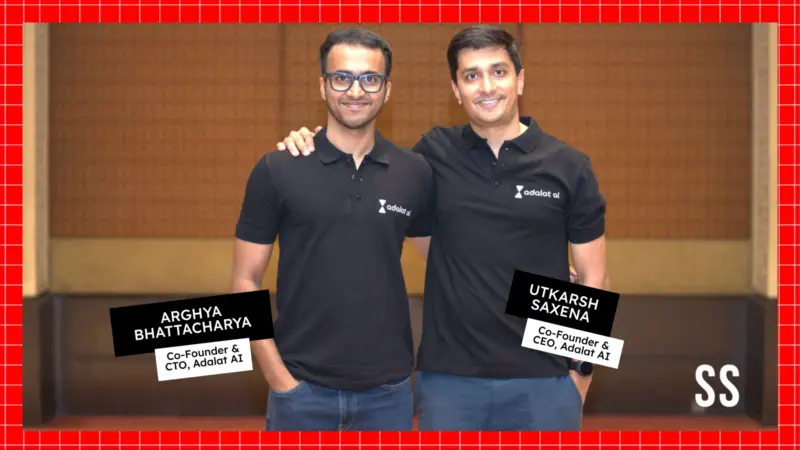
Utkarsh Saxena and Arghya Bhattacharya are bringing artificial intelligence to India's overburdened justice system through Adalat AI, a non-profit started in 2023 to offer an end-to-end justice stack to eliminate delays, streamline workflows, and ensure timely justice.
After completing law school from Delhi University, Saxena clerked at the Supreme Court, completed his LLM from Harvard Law School, and returned to India to start litigation. But he was in for a reality check.
"I practised for five years across the district, high courts, and the Supreme Court. But I realised that it was frustrating to handle one case at a time when an entire ocean of cases was pending," he says.
He also briefly worked with the Ministry of Law and the Ministry of Finance, writing reports on delays and backlogs, but not much came from them.
AI for swifter justice systems
A screen grab of Adalai AI's tool
In 2018, Saxena took a break from legal practice to pursue a second master's degree in development economics from Harvard Kennedy School, and then spent two years at Boston Consulting Group (BCG) in the US, before beginning his PhD at Oxford.
During a one-year fellowship at MIT under Esther Duflo in the summer of 2023, he witnessed the AI boom take off with OpenAI's Whisper speech-to-text release.
"My first reaction was: this needs to be in Indian courts. Lawyers are basically language models, and here are large and small language models doing what we do at much faster speeds. That's when the idea for Adalat AI started-it was incubated at MIT and Oxford," Saxena explains.
A computer science graduate at IIIT Hyderabad, Bhattacharya completed his master's in computational linguistics. He built AI systems for Indian languages at early-stage startups.
The duo met in a WhatsApp group, a selective community of ML engineers that requires three rounds of interviews to join and kicks you out if you don't help someone every month. Somehow, Saxena, the lone lawyer, had made it in.
When Saxena posted a call for a CTO and co-founder to work on the justice problem, Bhattacharya was intrigued but sceptical. "I was expecting he'd say, 'Let's build a for-profit business around lawyers.' But he told me we need to build speech-to-text, because there are no stenographers, and judges are writing things by hand," he recalls.
The turning point came when Bhattacharya visited his first court. "As a technologist, it was an absolute shock. I saw towers of paper everywhere. I saw people taking chits of paper and searching for files manually. Google does that for you."
That day, he found his calling. "All my skills of building for India, Indian languages, AI-everything had found the right channel to unleash."
A fellow at MIT at the time, Saxena enlisted Research Associates to build a basic prototype. They worked closely with judges and court staff to show how AI tools like speech-to-text systems that understand Indian languages and accents, and offer real-time translation, could transform court proceedings.
"We asked them to explore building something for courts together. Initially, there was hesitation around security. Our work is very confidential. How can we give you access to our databases? This can't be on the cloud," he recalls.
There was initial scepticism, but also curiosity. Adalat AI's earliest state partners were Kerala, Karnataka, and Delhi.
The venture operates on a "twin-engine" model. The first engine is building custom speech-to-text models that understand legal jargon like "res judicata," and also variations in Indian accents and dialects.
"The way a judge in Kerala speaks English is different from how a judge in Delhi speaks English," Bhattacharya notes.
Since they can't use OpenAI or Google's models for security reasons, everything had to be built in-house. The team scraped legal data from the internet, particularly court hearings that went online during the pandemic, to create their own proprietary datasets. They hired world-class ML talent. The second engine is equally crucial: training.
"This is not a very tech-savvy audience. You have to train judges to get comfortable with technology," Saxena emphasises.
Between them, Saxena and Bhattacharya have travelled to over 2,000-3,000 courtrooms across India. Their programming includes virtual workshops, in-person training sessions with small groups of judges, partnerships with state judicial academies to make Adalat AI part of the official curriculum, weekly office hours for basic tech questions, and WhatsApp communities for peer-to-peer support.
End-to-end technology stack
After deploying speech-to-text, the team realised it addressed only one small pain point-reducing the burden of handwritten work.
The larger challenge lies across the entire lifecycle of a case, where manual processes dominate everything from case onboarding and file handling to translations between lower and higher courts.
This led to an end-to-end technology stack for managing courtroom workflows. Judges now began asking for tools for summarisation, grammar correction, and better drafting.
The focus expanded to developing a full suite of AI systems for the legal domain, built by teams of linguists, researchers, engineers, and lawyers working closely together.
What Adalat AI offers
The platform addresses the shortage of skilled stenographers through an AI-powered legal transcription tool that allows judges to dictate proceedings instead of writing by hand, with accurate real-time transcription across multiple Indian languages.
It also streamlines case management by bringing case files, histories, and court calendars onto a unified platform, replacing fragmented systems.
To tackle paperwork overload, Adalat AI is building LLM-powered scanning and search tools that allow users to query thousands of pages of legal documents conversationally and instantly locate relevant information.
Its upcoming national WhatsApp helpline will enable litigants to track case updates, view orders, and receive summaries and translations in their preferred language, bridging critical information gaps in the justice system.
"We are identifying the journey of a case from when one files the document, it enters the court, and is finally disposed of-automating all the clerical pain points with technology solutions," says Saxena.
After working closely with the Kerala High Court to improve the performance of the Malayalam language, the state passed a pilot mandate in January 2024, selecting certain courts to use Adalat's platform. Then, in November 2024, Kerala mandated that every court in the state use Adalat AI's platform.
Today, Adalat AI collaborates with nine states through official Memoranda of Understanding (MoUs)-Kerala, Karnataka, Delhi, Bihar, Madhya Pradesh, Punjab, Haryana, Odisha, and Andhra Pradesh.
Andhra Pradesh has recently identified four districts for a pilot mandate, while pilot programmes in other regions bring the total number of states engaged to 15.
Challenges and solutions
Bhattacharya points out that language is highly specialised and poorly handled by general AI models trained on internet data. India's linguistic diversity across languages, dialects, and accents adds to the complexity. Courtrooms are also noisy environments, with overlapping speech that makes audio recognition particularly difficult.
Adalat AI focused on four solutions: hiring top ML talent motivated by impact; creating proprietary legal datasets from publicly available online hearings; building a linguist team across states to capture language nuances; and embedding lawyers at every stage of testing.
Legal experts vet every tool and then trial it with judges in a controlled beta environment before rolling it out to a wider audience.
Adalat AI has worked with The/Nudge Institute's accelerator and incubator to build and scale its offerings. Its funding comes from philanthropic capital, CSR, and family foundations. It is supported by the Ministry of Electronics and Information Technology and is part of the India AI mission, a cohort of 30 startups supported by the government.
Measuring impact
Tracking general usage shows that for every minute that's directly transcribed and not handwritten or retyped saves the system three to four minutes in the real world.
"So, one million minutes of transcription on the platform means three million minutes of court time saved," says Utkarsh.
Adalat AI is also undertaking a large Randomized Controlled Trial (RCT) in partnership with J-PAL, the Poverty Action Lab at MIT to measure whether Adalat AI reduces judicial delays and backlogs. Early indicators are striking: judges who earlier examined just two-three witnesses a day can now examine six-seven witnesses, a 2-3x productivity increase that compounds across weeks and years.
"We are hoping to be in half of India's courts in another year. Besides covering more courts, we will look at how we can drive more usage per court," says Saxena.
(The story is updated to include details of OpenAI's Whisper release.)
Edited by Megha Reddy