


From a young age, women in India are not just advised but conditioned to be vigilant in public spaces. For generations, advice on personal safety has been about not doing things, with restrictions often cloaked in protection.
We can't be blamed. The statistics are alarming. According to data available from the National Crime Records Bureau (NCRB) that dates back to 2022, 4,45,256 cases of crimes against women were recorded across the country.
Sindhuja Sura
As a result, personal safety has become an individual responsibility, and safety devices have become the norm. But most safety tools (pepper sprays, self-defence sticks, etc) available today are used after an incident occurs. And there is a gap between precaution and reaction in a country where crimes against women are climbing year after year.
Sindhuja Sura, a young entrepreneur from Bengaluru, wants to change this. Her startup, BoomBird, launched India's first rechargeable personal safety alarm brand in May 2024. It emits a 130-decibel siren, loud enough to disorient an attacker, create panic, and buy a woman the critical seconds she needs to escape.
Sura's path to BoomBird began on a street in Andhra Pradesh when she was in the 10th grade. "I faced a chain snatching incident, and I froze. It happened right in front of my house. I couldn't move till my mum came," she recalls.
At the time, she didn't fully comprehend what had happened. Years later, she understood the science of it. The freeze response is one of the body's three involuntary reactions to threat.
"When you are in a stressful situation, you either react or freeze. Most of the time, you react impulsively. I would freeze, and it has happened more than once. When you freeze, you cannot break out of it without a split move from your end," she explains.
This insight became the founding principle of BoomBird.
Sura describes how Indian women are taught to think about safety in two categories: precaution and reaction. The precaution is to call home once you have arrived safely, or to share your location. Reaction is reaching for pepper spray after something has already happened. What's missing, she argues, is the middle ground-what to do at the first sign of discomfort, before an incident escalates.
"This is least spoken about in the community, in society and in our families," she says.
That's where a safety alarm comes in. Pull a pin or press a button, and BoomBird emits a piercing 130 dB siren (a gunshot is 135 db), and activates a flashing strobe light, instantly drawing attention and, crucially, disorienting anyone nearby.
"Even if nobody hears it, the attacker will always think, what if somebody hears? What if somebody sees? That itself is a deterrent. It could de-escalate a potentially dangerous situation most of the time. That's why we are positioning safety alarms as the first line of defence," says Sura.
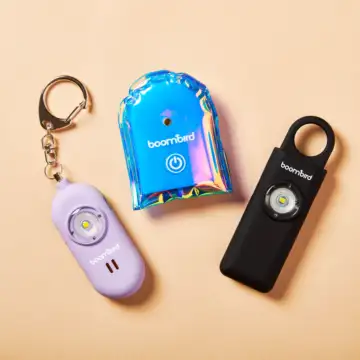
The Boombird range
She is careful to distinguish this from self-defence tools like pepper spray, which she sees as used only when a situation has already escalated. The alarm comes first.
BoomBird comes in three variants-BoomBird Echo, BoomBird Aero, and BoomBird Pebble. These can be easily clipped onto handbags or clothing without drawing attention.
Safety alarms were not new to India when BoomBird launched. But Sura identified a critical flaw in every existing product on the market: they all used replaceable batteries.
"If you have a safety alarm and you have to depend on a battery, it's like trusting a toy. It could work for 30 minutes and then just run out in an emergency. You don't have a way to know," she says.
BoomBird's alarm is rechargeable, with a low-charge indicator and up to 120 minutes of siren time on a full charge. For a woman heading out for a trek, solo travel, or a late-night shift, knowing the device is charged-confirmed by a green indicator light-is a meaningful difference.
The product was built by modifying an existing Chinese prototype, specifically by changing the internal PCB to enable rechargeability. This made it viable for a bootstrapped company to execute without overhauling the entire product mould. Safety alarms are available from Rs 1699, and safety tools start at Rs 299.
The founder and her vision
Sura completed her Master's in Computer Science from the University at Buffalo, New York, before returning to India. She went on to serve as the Managing Director of Rockwell School in Markapur, Andhra Pradesh, where she ran educational programmes for primary and secondary school children.
As of early 2026, she is transitioning out of her school role and into a full-time role at BoomBird.
BoomBird was launched commercially in May 2024. The products are sold through its own website and Amazon India. It has sold thousands of units since launch and considers itself in early traction.
The team follows up with customers 15 days after purchase to understand whether the product is actually being integrated into daily life.
"If a safety tool is purchased out of concern or fear, and it doesn't integrate into your daily routine, it tends to be left at home. But if we can get the user to integrate it into their lifestyle, personal safety becomes a part of everyday routine," Sura elaborates.
BoomBird products are currently used by young working professionals and women living independently, choosing their own space.
Sura admits that awareness remains a big challenge. Getting consumers to think about personal safety proactively rather than reactively requires shifting a deeply ingrained cultural mindset.
BoomBird currently has three product categories in development: safety alarms, safety tools (including visibility and emergency-fix products such as their 'Omni-Key'), and self-defence tools, including pepper spray.
The vision is for all three to coexist as layers of a complete personal safety ecosystem-not to replace one another.
Sura concludes with a pertinent question-"We carry essentials all the time. Why not personal safety?"
Edited by Megha Reddy