
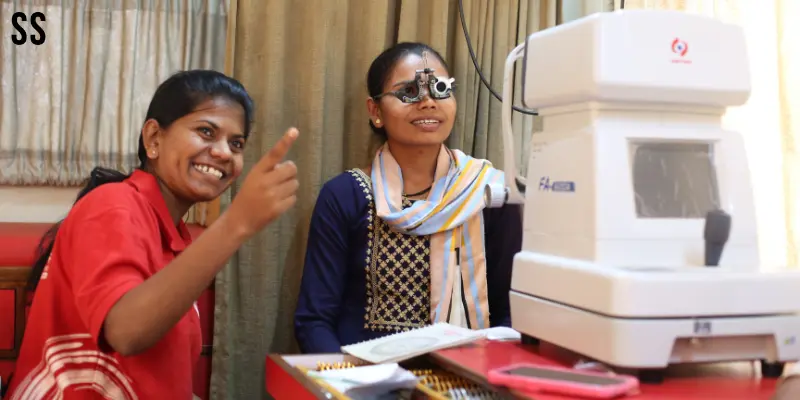

For Hamlet, Chiklap (Raigad) resident Sayali Santosh Devare, moving to Hyderabad for an 18-month vision technician training course was mired with doubts.
"There were times when I wanted to leave and return home. But I told myself, what will I do back in my village? I had to make this opportunity count," recalls the 24-year-old. Today, Devare works confidently in an eye hospital in Mumbai, helping patients navigate diagnoses and treatment plans, while financially supporting her family.
Devare is among 58 young women from rural Raigad in Maharashtra, who were trained and placed in eye care roles through an initiative supported by the Swades Foundation in partnership with Sankara Eye Hospital and Shanghvi Eye Institute.
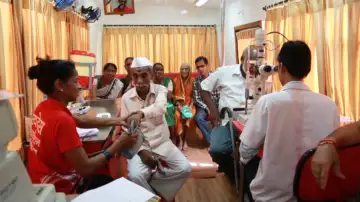
Eye checkup in a Swades mobile vision care van
The training programme-started five years ago by the two hospitals-found a natural ally in Swades, which had already been working in the region for decades to tackle issues of rural poverty, healthcare, and education.
"Five years ago, they (Sankara Eye Hospital and Shanghvi Eye Institute) came up with the idea of setting up world-class eye care facilities in Panvel, Navi Mumbai, and we shared our vision of uplifting rural communities, especially women," says Mangesh Wange, CEO of Swades Foundation.
A legacy of grassroots development
Swades Foundation began working in Maharashtra's rural belt in the mid-1990s before formally launching in 2012 under the leadership of Ronnie and Zarina Screwvala. Today, it operates in 11 talukas across Raigad and Nashik and has reached over half a million people.
Its development model is based on the four E's-Engage, Empower, Execute, and Exit-where it engages communities deeply, empowers them with tools and skills, executes solutions in partnership with other stakeholders, and eventually, exits once systems are self-sustaining.
"The idea is Swa se bane desh-we make our own country," says Wange, adding,"However, the biggest battle is always mental poverty, the belief that nothing can change."
A blindness crisis in rural Maharashtra
A woman poses with her new specs in the Swades Mobile Vision Care (MVC) van
When Swades began its healthcare work in Raigad, one of the first issues it encountered was the prevalence of vision impairment. "Nearly 30% of the population was over the age of 60-an age group vulnerable to cataracts and other age-related eye conditions," says Wange. With poor infrastructure and low awareness in the region, access to quality eye care was minimal.
According to the World Health Organisation, India accounts for nearly one-fifth of global blindness. The problem is particularly acute in rural districts, where resources are scarce and referrals are rare.
To address this, Swades launched a comprehensive eye care programme built around the three A's-Access, Affordability, and Awareness.
It deployed three mobile vision vans for large-scale screenings, as well as conducted door-to-door surveys and screenings with the help of its Swades Mitras, which has grown to a team of over 2,000 community volunteers presently.
It also partnered with hospitals in Mumbai and Pune to ensure timely and subsidised treatment. In total, the foundation screened 3.5 lakh people in Raigad-nearly the entire district population.
Growing local healthcare capacity
However, to make this effort sustainable, the foundation realised it needed a skilled healthcare workforce drawn from the very communities it aimed to serve. That's when the vision technician and ophthalmic assistant training programmes-developed by Sankara Eye Hospital and Shanghvi Eye Institute-became crucial.
Swades came on board to mobilise candidates, counsel families, and provide support for residential training in Hyderabad and Coimbatore.
"Trust is a big challenge when you go to a village. Families are protective, especially about daughters. And finding passionate, capable talent who want to work in rural areas-that's another challenge. But once the success stories started coming in, things changed," says Wange.
Young women leading change
Samruddhi Jangam
For girls like Devare, the programme opened up more than a career-it built self-belief. "I used to be very introverted. Now, I solve problems for patients and help them feel comfortable. I've become independent," she says.
Today, she earns over Rs 14,500 a month and supports her family back home. "My parents proudly tell relatives that I work in a hospital in Mumbai."
Samruddhi Jangam, 24, another trainee from Hamlet, Jangamwadi (Raigad), had similar concerns before she joined a two-year ophthalmic assistant course in Coimbatore. "We had always struggled financially. I didn't know what to expect. But the doctors and nurses treated us with so much care, and it felt like home very soon," she recalls.
At present, Jangam works at R Jhunjhunwala Hospital in Panvel and contributes to her siblings' education. "I'm proud to be able to support my parents."
Both Devare and Jangam say they want to continue studying and help other girls in their communities explore similar opportunities.
Looking forward
Swades Foundation's work in eye care is part of its broader healthcare strategy, which also includes maternal and child health and non-communicable diseases.
The foundation will also extend the vision care programme to areas such as Thane, where healthcare indicators remain poor. "Adivasi regions are a priority because they are the most underserved communities, says Wange.
He adds, "This is a long-term effort. We stay in a community for five years and work across sectors so that when we leave, people don't need us anymore. That's success."
As young people trained through this programme step into hospitals across Maharashtra, they're not just treating patients, they're breaking cycles of poverty, redefining gender roles, and proving that transformation can begin in the most remote corners of India, one village at a time.
Edited by Suman Singh