

Every day, India generates tonnes of waste that end up in landfills, water bodies, and open dumpsites. Waste management, until recently, was largely the responsibility of the informal sector, where workers laboured without safety gear, social security, or the dignity that formal employment brings.
Recycling, too, was fragmented-driven by small scrap dealers and waste pickers who kept cities functioning but remained invisible in the larger system.
Today, that equation is beginning to change. A new crop of social enterprises and climate-focused startups is re-imagining waste in different ways. From temple flowers and cigarette stubs to plastics and industrial scrap, these ventures are creating circular economies that clean up communities while generating livelihoods.
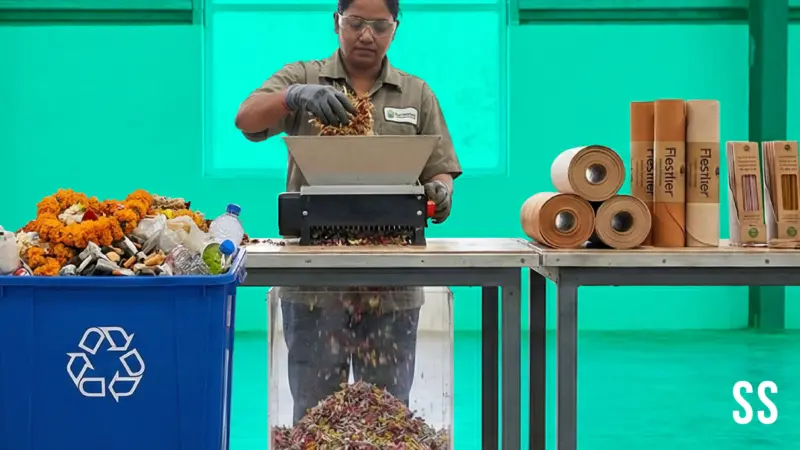
Founded by Ankit Agarwal, Phool set out to tackle the issue of temple flowers being dumped into rivers, where they decompose into toxic waste. To address this, the company created a daily collection network with temples, ensuring floral offerings are collected before they reach water bodies.
At its processing units, the collected flowers are cleaned, dried, and transformed into charcoal-free incense sticks and other wellness products. The startup later developed "Fleather," a plant-based leather alternative made using flower fibres, pushing the waste stream into higher-value applications.
By design, the operations are labour-intensive, employing women and low-income workers in sorting, rolling, and packaging. The model diverts tonnes of organic waste every day while creating steady incomes in communities that traditionally had few formal job opportunities.
Started by brothers Naman and Vipul Gupta, Code Effort tackles the problem of cigarette butts-one of the most littered and toxic forms of waste globally. These small filters contain plastic fibres and chemicals that can take years to decompose and often clog drains and contaminate soil.
The enterprise has established a nationwide collection system, partnering with waste pickers, volunteers, and institutions to gather discarded stubs.
Recycling over five million cigarette stubs a day, the tobacco is turned into compost, the paper covering is used to make paper and mosquito repellents, and the cellulose acetate is converted into fibers for yarn and textiles at Code Effort's chemical treatment plant in Noida.
The company works with over 2,500 waste pickers, taking their help in collecting cigarette stubs. Code Effort has also employed women artisans living in Nangli Village in Noida.
The startup has partnered with large firms such as Reliance Retail, supplying a range of products including textiles, paper, stationery, and gift items, all manufactured using recycled cigarette stubs.
Founded by Wilma Rodrigues, Saahas Zero Waste is one of India's early pioneers in structured waste management. The organisation works with apartment complexes, offices, and municipalities to handle waste at source. Over 100 tonnes are collected and processed daily across 50+ sites.
Its process begins with segregation and door-to-door collection. Food waste is composted or converted into biogas, dry waste sent to material recovery facilities is sorted into over 40 categories, and dispatched to authorised end markets. It closes the loop with a range of recycled products.
A key part of the model is formalising the workforce in waste management. Waste pickers are trained, provided protective gear, and integrated into stable jobs with safer working conditions. The result is both higher recycling rates and more dignified livelihoods.
Founded by Yuvraj Bhardwaj, Yashraj Bharadwaj, and Ishita Bansal, Plannex Recycling focuses on some of the most complex and difficult waste streams-plastics, tyres, batteries, and solar panels.
Instead of operating as a fragmented scrap business, the company has built an integrated infrastructure that can dismantle, shred, and process large volumes safely and compliantly, converting waste into reusable raw materials that re-enter industrial supply chains.
A key pillar of Plannex's model is the formal integration of informal waste workers - waste pickers and scrap collectors who traditionally work without safety nets. The company provides protective gear, healthcare access, upskilling workshops, and structured employment, enabling workers to move from precarious daily-wage work into stable roles.
Over time, many workers have grown into roles across compliance management, administration, and factory operations. The shift has brought both financial stability and dignity. Many now act as trusted connectors in their communities, helping others make similar transitions.
Founded by Victoria Joslin D'Souza, Bengaluru-based Swachha Eco Solutions moved from grassroots door-to-door awareness campaigns to partnering with civic bodies to set up dry waste collection centres across Bengaluru's wards. They have two recycling facilities-one in Bengaluru and another in Hosur-that process both post-consumer and industrial plastics, diverting large volumes of waste from landfills and informal disposal.
Swachha's operations include material recovery, density-based granulation of plastics like HDPE, PP, and LDPE, and selling recycled granules to manufacturers, effectively turning low-value waste into usable feedstock. The startup has positively impacted over half a million people's lives and formalised the employment of more than 2,800 informal waste pickers, bringing many into the formal economy. Sixty percent of its direct employees are women.
Edited by Megha Reddy