

India's beauty services market is booming, but beneath the gloss lies a trust problem. Fake products, uneven pricing, and unreliable service quality have become common complaints.
For brothers Mayank and Aditya Arya, the problem became personal. After calling a local salon professional home, their wives reported red, irritated skin. The cause? Counterfeit products are passed off as premium brands. Digging deeper, the founders uncovered a widespread problem: bulk bottles of brands like L'Oréal and VLCC being refilled with fakes, arbitrary pricing, and quality issues.
That experience led to the creation of Yes Madam.
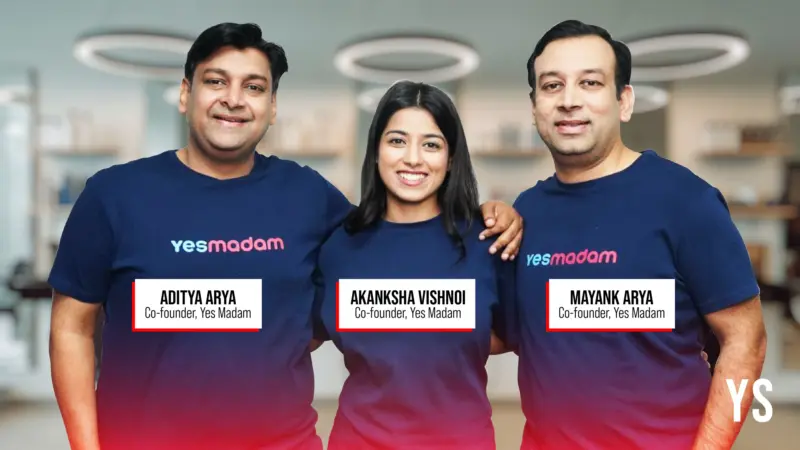
Founded in 2016 by Mayank Arya (CEO and Co-founder), Aditya Arya (Co-founder and COO), and Akanksha Vishnoi (Co-founder and CMO), Noida-based Yes Madam is a home-based beauty and wellness services platform built around transparency and control.
The platform offers more than 200 beauty, hair, and wellness services, from facials and waxing to manicures, delivered at home across 50+ cities.
Users browse services, choose preferred professionals (standard or premium), and see a clear price breakdown at checkout, including service charges and product costs. Pricing starts at Rs 6 per minute, with the option to use the platform's products or personal ones.
To eliminate counterfeit products, Yes Madam has developed in-house brands, Korean-inspired Sokora and Italian-inspired Organic Da Roma, sold exclusively on the platform. Packaged in single-use, mono-dose formats and scanned via barcode before each service, these products ensure authenticity and traceability.
"Today, 70-80% of all products used in our services come from these lines," Vishnoi says.
Tech-powered quality assurance
Yes Madam runs on an end-to-end tech stack designed to eliminate ambiguity at every step of the service. Once a booking is made, the system auto-assigns the nearest available professional from a local hub based on location, availability, and past customer preferences.
Professionals confirm bookings via a call, enter an OTP on arrival, and begin the service only after customer verification via another OTP. They arrive in uniform, photograph their setup to show disposables, and scan product barcodes before use, logging authenticity in real time. At the end of each session, customers sign off on room condition and valuables, followed by a final OTP to end the job.
"This creates a complete digital trail, from hygiene and timing to product standards and service quality," Vishnoi says.
Aditya says auto-assignment is the backbone of the platform. "It decides who serves whom efficiently, and even prioritises past favourites, which is rare in gig platforms."
Customer traction: from a lakh to nearly 18 lakh
The scale of Yes Madam's growth becomes clear when you compare two snapshots. In 2020, the platform had 1,24,554 customers and logged 1,76,427 bookings. By early 2026, it was serving 17,81,618 customers and recorded 24,60,510 bookings annually, roughly 14 times the number recorded in 2020.
Yes Madam started out in 20 cities in 2020. Today it operates in 58 cities, almost three times its original footprint. The expansion has been gradual, with the company focusing on Tier I markets first before pushing into new ones.
Delhi-NCR is its biggest market, followed by Bengaluru, Hyderabad, Mumbai, Pune, and Kolkata. The company says repeat bookings are higher among customers who use its in-house product lines.
Building and retaining the partner ecosystem
"In the end, partners make the platform work," Aditya says. So far, Yes Madam has onboarded more than 12,000 beauty professionals, with around 7,500 active today.
Partner acquisition blends paid digital channels like Facebook and Google ads with organic sources like referrals and walk-ins. After an initial screening call, candidates undergo in-person skill assessments, followed by tailored training that lasts between 15 and 45 days. This includes service techniques, theory, app usage, customer handling, basic security protocols, and even booking transport via Ola or Uber.
Before going live, partners clear theory and practical tests, background verification, and purchase a Rs 30,000 starter kit. "We also offer loans to make this accessible," Vishnoi says. Once active, professionals operate within a 2-3 km radius.
Financial upside is a key draw. While many workers at local parlours earn Rs 10,000-12,000 a month, Yes Madam professionals average Rs 45,000 in business. The top 20% earn up to Rs 90,000 gross, with take-home pay of about Rs 45,000.
Partners progress through tiers, from Standard to Gold, Diamond, Platinum, Titanium, and Queen, earning higher per-minute rates and lower commissions as performance improves. Promotions are automated based on ratings and repeat customers. Approximately 150 partners currently operate at zero commission.
Aditya says that rather than suspending underperformers, the platform focuses on retraining. Partners also receive accident and life insurance worth Rs 5 lakh, medical coverage, and easy loans-designed to build long-term loyalty, not churn.
Scaling smart in beauty's big boom
India's hyperlocal services market is projected to grow at a 19.6% CAGR through 2030, driven largely by rising smartphone access. Globally, the salon services market hit $264.93 billion in 2025 and rose to over $522.61 billion by 2034 at a CAGR of 7.9%. The opportunity is large, but so is the competition.
Yes Madam operates in a crowded space, competing with players like Urban Company and GetLook on services, and Sparkl and MakeO on products.
Belita, now part of Enrich Salons, also overlaps in parts of the market. The startup's strategy, however, has been to stay focused. Rather than expanding horizontally across categories, it has doubled down on beauty across home services, salons, and D2C products.
The startup's proprietary brands, Sokora and Organic Da Roma, are a key differentiator. "While many companies play in D2C beauty, no one has entered professional-use Korean beauty before us," Aditya says.
Services such as Korean waxing involve multiple steps, while facials now include add-ons like candle massages and herbal masks. According to Vishnoi, repeat rates for in-house products are significantly higher than for third-party options.
What's next?
Yes Madam's journey has been largely bootstrapped. "We got a rare four-shark deal on Shark Tank," Aditya says. But the founders chose not to proceed after reassessing the valuation. Since then, the startup has grown at 100% year on year while remaining EBITDA positive.
Now live in 50+ cities, with strong traction in Delhi-NCR, Bengaluru, Hyderabad, Mumbai, Pune, and Kolkata, the focus is shifting from expansion to depth. "We've covered Tier I markets. The next phase is increasing average ticket sizes through high-value services," Aditya says.
Hydra Facials, launched in 2025, already clock 15,000 monthly services in Delhi-NCR alone, and will be rolled out to other metros. Laser hair reduction, body toning, and male-focused services are also gaining momentum.
"Our end goal is a single, integrated beauty ecosystem, bringing home services, physical salons, and products together on one platform," Vishnoi says.