
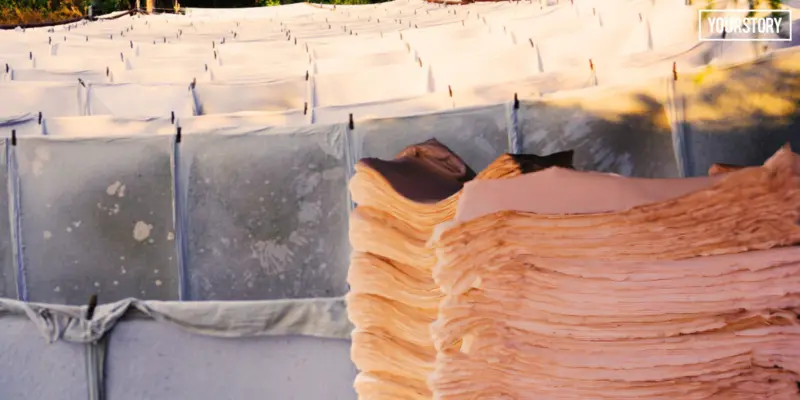

In Uttar Pradesh's Jalaun district, the town of Kalpi has built a distinctive handmade paper industry where discarded fabric waste is turned into thick, textured sheets used in everyday products.
File covers, diary pages, carry bags, card sheets, and packaging material produced from this paper move through stationery markets and office supply chains across the country.
The process begins with fabric cutting waste collected from tailoring units. What might otherwise be discarded is sorted, broken down, and processed into pulp before being shaped into sheets through manual techniques. Once dried and finished, these sheets are sold either as paper stock or converted into products such as diaries, file covers, card sheets, blotting paper, and carry bags.
Within Kalpi, the activity operates as a cluster where production is spread across small factories and adjoining workspaces. Women and wage workers form a significant part of the workforce, contributing to sorting raw material, preparing pulp, forming sheets, and finishing products. The industry connects local households, workshops, and traders into a chain that keeps the craft active within the district.
According to Narendra Kumar Tiwari, President of the Kalpi Handmade Paper Association, the industrial area in Kalpi has around eighteen active factories, supported by a wider network of units and allied workers linked to production and transport. This ecosystem allows the craft to function not only as a small-scale manufacturing activity but also as an important source of livelihood for many families in the area.
Kalpi's handmade paper carries formal recognition as well. The craft has received a Geographical Indication (GI) tag, acknowledging the district's historical association with handmade paper production. Local references often point to areas such as Kagazipura, which are linked to communities historically associated with the paper-making trade.
Raw material for the industry largely comes from outside the district. Fabric cutting waste is collected, cut into smaller pieces, and converted into pulp before being moulded into sheets through labour-intensive processes. After drying and finishing, these sheets are dispatched to markets where they are further converted into stationery and packaging products.
Trade networks extend well beyond Bundelkhand. One of the key domestic markets is Delhi's Chawri market, where traders and converters purchase handmade sheets and transform them into finished products depending on customer demand. From these markets, Kalpi's handmade paper finds its way to offices, retail shops, and packaging units across the country.
International demand also exists for the craft-based material. Export orders are often routed through Delhi-based exporters who ship handmade paper products to countries such as Australia, Canada, the United States, Germany, France, and Japan.
Under the One District One Product (ODOP) Programme, handmade paper has been recognised as the notified product of Jalaun district. Through ODOP, units have gained access to credit-linked subsidies, financial assistance, and market exposure opportunities. Participation in exhibitions and buyer interactions has helped introduce Kalpi's handmade paper to wider markets while also strengthening the cluster's visibility.
Through a combination of recycled raw materials, traditional skills, and expanding trade linkages, Kalpi's handmade paper industry continues to anchor a unique craft-based economy in Jalaun-transforming fabric waste into products that travel far beyond the district where they are made.