

Hello,
After Microsoft, Amazon now ups the ante in the AI game in India.
By 2030, the ecommerce giant plans to invest over $35 billion across all its businesses in India, with a focus on business expansion, AI-driven digitisation, export growth, and job creation.
This fresh investment builds on the nearly $40 billion it has deployed so far in the country, which goes towards building physical and digital infrastructure, including fulfilment centres, transportation networks, data centres, digital payments infrastructure, and technology development.
Meanwhile, Microsoft Chairman and CEO Satya Nadella said that the Windows maker will integrate advanced AI capabilities into two digital public platforms of the Union Ministry of Labour and Employment-e-Shram and the National Career Service.
ICYMI: Five books by and about women that we enjoyed this year.
In other news, Wakefit IPO received 2.52X subscription on the final day of bidding, marking the last IPO from the Indian startup ecosystem of this year.
Lastly, Gaurav Munjal of Unacademy has confirmed M&A plans, saying the edtech firm is open to consolidation if it results in a stronger combined entity. His comments come as the edtech company completes 10 years of existence.
Once one of India's best-known edtech startups, Unacademy may now be worth less than $500 million, 85% less than its pandemic-era peak valuation.
How the mighty have fallen!
In today's newsletter, we will talk about
- Meesho's landmark Dalal Street debut
- Rise of the fake invoice economy
- Redefining manufacturing via robotics
Here's your trivia for today: What famous liquor is made in a place where selling alcohol is illegal?
IPO
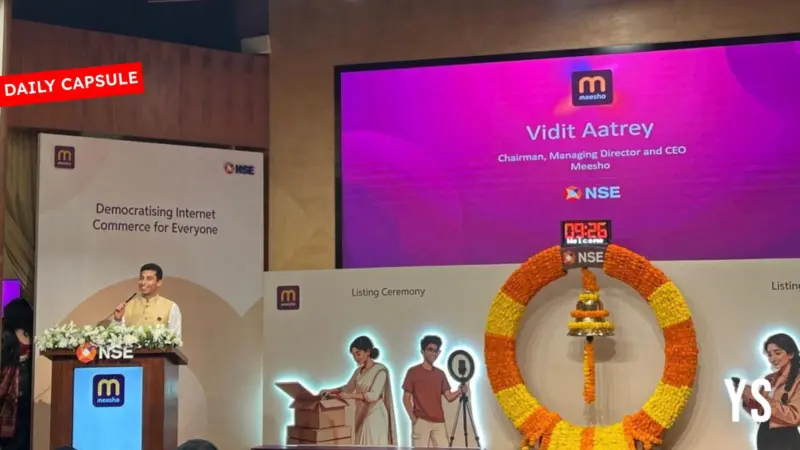
"Bharat today has arrived on Dalal Street," said Meesho CEO and MD Vidit Aatrey, culminating one of the most significant ecommerce initial public listings of India and marking a milestone in the company's decade-long promise of democratising ecommerce.
Meesho's shares listed at a 45% premium to its issue price of Rs 111, taking the total market cap of the ecommerce platform to Rs 72,751 crore. The stock opened at Rs 161.20 per share on the BSE, signalling sustained investor appetite for Meesho's Bharat-focused ecommerce model.
Strong returns:
- Elevation Capital, which invested in Meesho in 2017 and was its single largest shareholder then, now holds an 11.9% stake after the IPO, valued at nearly Rs 8,950 crore, giving it a 53X gain on its investment.
- Prosus and SoftBank-who together hold just shy of 22% in Meesho-have been on the sidelines of the IPO by not offloading any shares in secondary sales. Both investors are betting long on Meesho, which has turned out to be one of the only ecommerce players to generate free cash flow in India.
- Beyond investors, Meesho's IPO has also unlocked wealth for its early employees, thanks to ESOP liquidation opportunities during the public offering.
Funding Alert
Startup: Smart Joules
Amount: $10M
Round: Series B
Startup: Skydo
Amount: $10M
Round: Series A
Startup: Uolo
Amount: $7M
Round: Pre-Series B
Insight
The tax authorities are confronting an unprecedented spike in goods and services tax (GST) fraud, driven increasingly by "sleeping modules", dormant or inactive companies that are being resurrected as shells to issue fake invoices and siphon off input tax credits (ITC).
New government data submitted to Parliament shows that GST evasion through bogus entities has accelerated sharply over the past four years, becoming one of the biggest threats to the tax system since the regime was rolled out in 2017.
Fraud networks:
- While fake invoicing spans industries from steel scrap to electronics, a notable trend has emerged in pharmaceuticals, a sector where regulatory registration is complex, pricing is tightly controlled, and dormant units are easier to repurpose.
- The government says it has spent the past two years tightening GST registration protocols, with several measures rolled out, including stricter invoice matching, mandatory sequential filing, PAN-linked verification, physical verification and geo-tagging, e-invoicing expansion and tougher criminal provisions.
- Despite the stepped-up crackdown, authorities acknowledge one challenge: fraud networks are scaling faster than compliance mechanisms. Shell companies can be created using stolen PAN details, obscure addresses, and compromised Aadhaar credentials-often faster than tax systems can detect anomalies.
Startup
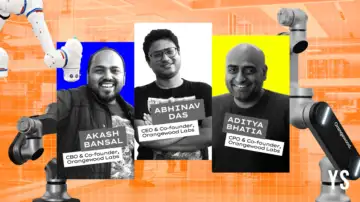
About a decade ago, Aditya Bhatia was working in the furniture industry when he hit a roadblock with manufacturing custom furniture. To solve the problem, he partnered with Akash Bansal and Abhinav Das to launch AI-powered robotics startup Orangewood Labs in 2017.
Currently, the startup offers industry solutions such as machine tending, bartending robots, and other industrial use cases, including AI-native Robotic Arms, and its novel Robot GPT platform, a hardware-agnostic system for creating and testing automation programs without physical hardware or deep expertise.
News & updates
- AI plans: Google launched its more affordable AI Plus plan in India as it seeks to compete on pricing with other low-cost AI offerings, like OpenAI's ChatGPT Go subscription. For new users, Google is offering AI Plus for Rs 199 per month for the first six months, after which you'll have to pay Rs 399 a month.
- Strategy: Mark Zuckerberg, months into building one of the priciest teams in technology history, is getting personally involved in daily work and pivoting Meta's focus to an AI model it can make money off of. One new model, codenamed Avocado, is expected to debut sometime next spring and may be launched as a "closed" model, Bloomberg reported.
- Funding: Adani Enterprises' $2.8 billion rights issue was oversubscribed, marking the group's biggest capital raise since a short-seller's allegations roiled the ports-to-power conglomerate in 2023. The share sale drew bids for 149.5 million shares against 138.5 million on offer.