
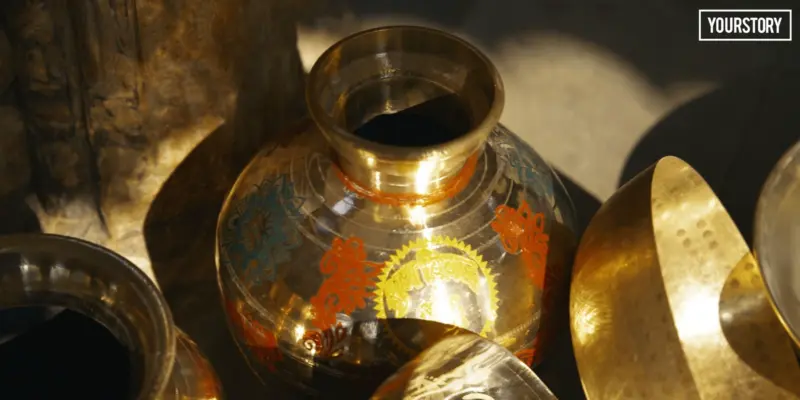

In Uttar Pradesh's Mirzapur district, brass utensils continue to hold relevance across both everyday use and ceremonial occasions. From household kitchens to wedding purchases, these products remain embedded in long-standing cultural practices, where durability, familiarity, and traditional value shape demand.
Recognised under the One District One Product (ODOP) programme, brass utensils are a key craft of Mirzapur, reflecting a legacy of metalwork that has evolved while retaining its foundational processes.
Historically, this trade developed as a cottage-based industry, with small furnaces and workshops operating within residential clusters. Over time, this decentralised system created a strong ecosystem of artisans and traders, where production relies equally on skilled craftsmanship and practical knowledge of materials.
The making of brass utensils involves multiple stages - selection and sorting of raw metal, melting, shaping, joining, cleaning, and polishing. A defining strength of Mirzapur's cluster lies in its understanding of material composition, particularly in handling mixed scrap metals. Artisans and traders assess the quality and suitability of metal before processing, ensuring that each vessel meets functional and structural requirements.
Biryan Singh, General Secretary of the brass utensil manufacturers and traders' association in Mirzapur, represents a family engaged in this craft for four generations. He notes that the district's association with brass utensils spans over a century, with earlier forms of large vessels once traded across wider regional markets.
Production in Mirzapur follows two primary methods. In the sheet-based process, metal billets are converted into sheets and circular forms, which are then shaped using wooden hammers - a technique that continues to define the craft, even as selective machine support has been introduced. In the casting method, molten brass is poured into moulds, after which different components may be joined, followed by finishing processes such as scraping, cleaning, and polishing.
At the core of both methods is material knowledge - the ability to identify, sort, and process metal appropriately. This expertise has contributed to the continuity of the craft in Mirzapur, even as similar production practices have expanded to other regions.
The scale of the cluster remains significant, with an estimated 15,000 to 20,000 artisans engaged in brass work across the district. Under ODOP, stakeholders have gained improved access to institutional support, including financial assistance and subsidy provisions, which have helped units manage working capital and sustain operations.
In Mirzapur, brass utensil production continues to follow a rhythm defined by precision and coordination - from raw metal selection to final polishing. As long as this sequence remains intact, traditional forms continue to adapt to modern use, ensuring that the craft retains its place in both cultural and functional spaces.